Quick answer
What to know first
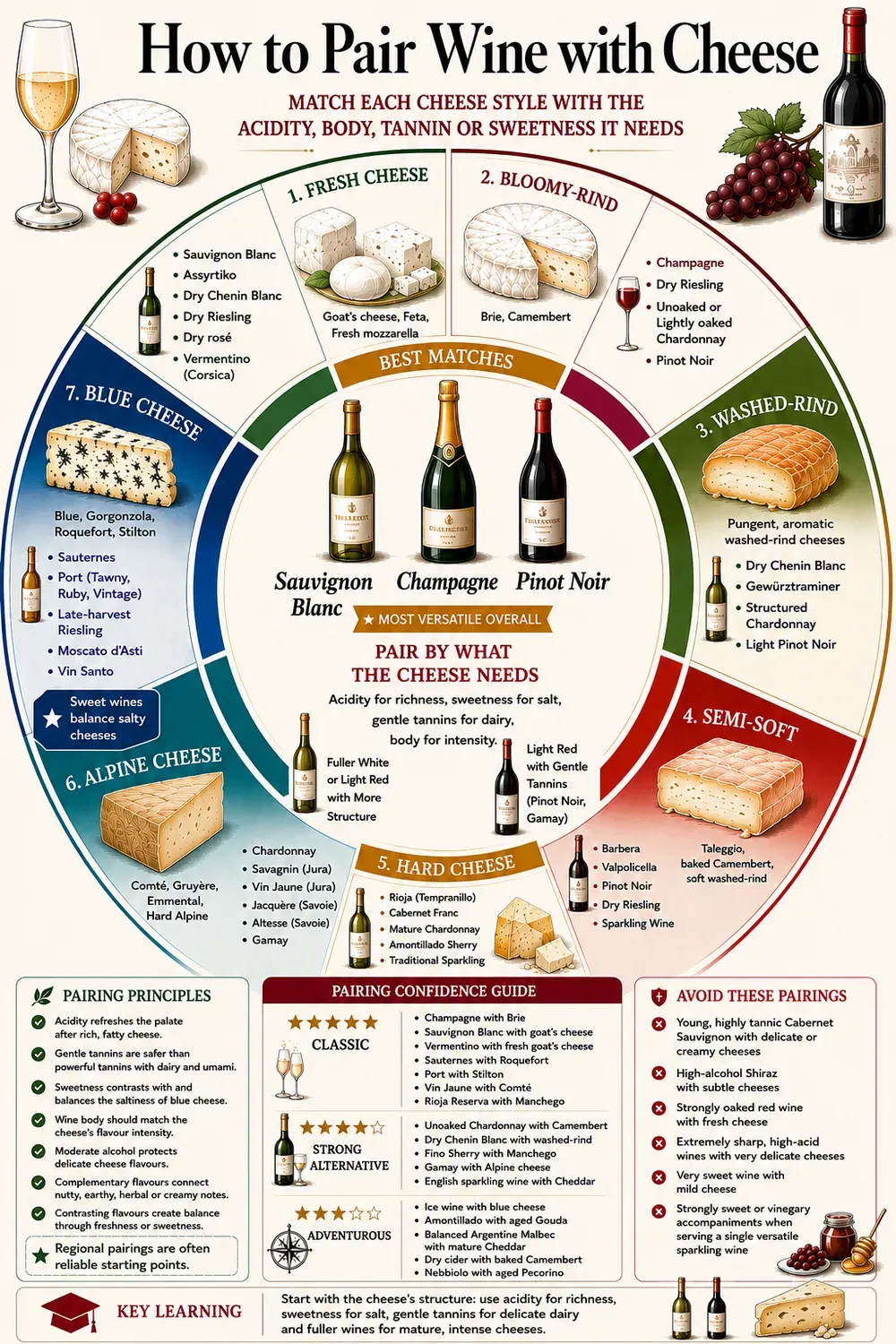
The best wine with cheese depends on the style of cheese, but Champagne, Sauvignon Blanc, Chardonnay and Pinot Noir are among the most versatile choices. Match the wine's body and acidity to the cheese's richness for the most balanced pairing.
Introduction
Few food and wine combinations are as celebrated as wine and cheese, yet pairing them well is more nuanced than simply choosing red wine. Across Britain and Europe, cheese appears on cheeseboards, in pubs, after dinner and as part of regional cuisine. The enormous variety of cheeses—from fresh goat's cheese to mature Cheddar, creamy Brie and pungent blue cheese—means there is no single perfect wine. Understanding the texture, saltiness, richness and intensity of each cheese helps create combinations where both the wine and the cheese taste even better together.
These regions have long traditions of producing wines that naturally complement local cheeses. Jura and Savoie are particularly renowned for classic mountain cheese pairings, while Corsica's fresh, mineral wines work beautifully with Mediterranean cheeses.
Key Takeaways
- Match wine intensity to cheese intensity.
- High acidity cuts through creamy, rich cheeses.
- Avoid heavily tannic young reds with most cheeses.
- Sweet wines are exceptional with blue cheese.
- Sparkling wines pair with almost any cheeseboard, though not every accompaniment.
- Regional wine and cheese combinations often work naturally.
- Don't assume red wine is always the best option.
What Cheese brings to the glass
Best overall wines for Cheese
Champagne
★★★★★
RegionsChampagne (France)
Crisp acidity and fine bubbles refresh the palate after rich cheeses while subtle brioche flavours complement aged varieties. It is one of the most versatile wines for mixed cheeseboards, though extremely spicy cheeses or strongly sweet or vinegary accompaniments can occasionally create less harmonious results.
Sauvignon Blanc
★★★★★
RegionsLoire Valley, Marlborough, South Africa
Bright citrus and herbal freshness perfectly balance tangy goat's cheese and lighter soft cheeses.
Pinot Noir
★★★★★
RegionsBurgundy, Oregon, New Zealand
Gentle tannins avoid overwhelming delicate cheeses while earthy red fruit complements washed-rind and semi-soft cheeses. However, washed-rind cheeses vary widely, and some styles (such as Époisses) may pair even more expressively with Chardonnay or aromatic whites like Gewürztraminer.
RegionsBurgundy, Chablis, Australia
Its balance of fruit, acidity and texture makes it an excellent partner for creamy cheeses including Brie and Camembert. In many cases, unoaked Chardonnay performs especially well, as it preserves freshness and avoids overpowering delicate dairy flavours.
Why these wines work with Cheese
Dominant strategy
Balance richness with acidity while matching wine intensity to the cheese.
Supporting principles
- Use acidity to refresh the palate after rich cheeses.
- Match tannin, sweetness and body to the cheese's texture and saltiness.
Understanding the Dish
Unlike most foods, cheese varies enormously in flavour, texture and richness, making it one of the most diverse pairing categories.
Cooking Method
Most cheeses are served fresh, although baked cheeses become richer and softer.
Dominant Flavours
Cream, butter, nuts, earth, mushrooms, herbs, caramel, salt and sometimes strong savoury or animal notes.
Richness
High richness calls for wines with vibrant acidity.
Fat
Fat coats the palate and benefits from wines that provide freshness and lift.
Acidity
Fresh cheeses often contain noticeable acidity, pairing well with crisp white wines.
Salt
Salt reduces the perception of bitterness and enhances fruitiness in wine, making fruit-forward styles more expressive.
Sweetness
Most cheeses are savoury, although washed-rind and blue cheeses can create surprisingly successful sweet-and-savoury combinations.
Umami
Aged cheeses contain significant umami, making softer tannins preferable.
Spice
Most cheeses are mild, though peppercorn and chilli cheeses require fruit-forward wines with moderate alcohol and good freshness.
Texture
Creamy cheeses favour silky wines, while hard cheeses can handle fuller-bodied styles.
Sauces and Accompaniments
Chutneys, honey, figs, grapes and crackers can influence the pairing. Sweet or acidic accompaniments may shift the balance, sometimes requiring a fresher or more structured wine.
Garnishes
Nuts, herbs and fruit add complementary flavours that can echo aromas in both red and white wines.
Why These Wines Work
Wine and cheese pairing is largely about balance.
High-acid wines refresh the palate after creamy cheeses, preventing the combination from feeling heavy.
Moderate tannins work better than powerful ones because proteins in cheese soften tannins, but overly aggressive tannins can still taste dry or chalky.
Sweeter wines balance salty blue cheeses beautifully, creating one of the classic food and wine pairings.
Body matters too. Light cheeses suit lighter wines, while mature hard cheeses can support fuller-bodied reds and whites.
Alcohol is best kept in balance with delicate cheeses—not because alcohol itself is problematic, but because higher alcohol wines often come with riper fruit, lower acidity and greater weight, which can overwhelm subtle flavours.
Complementary flavours—such as nutty Chardonnay with Comté or earthy Pinot Noir with Brie—often create harmonious combinations, while contrasting flavours like sweet Sauternes with Stilton provide exciting balance.
Classic Pairings
White Wine
Sauvignon Blanc with goat's cheese is one of the world's classic matches because lively acidity mirrors the cheese's freshness.
Red Wine
Light, elegant reds such as Pinot Noir or Gamay work well with Brie, Camembert and Gruyère thanks to their gentle tannins. Champagne, Chardonnay and Pinot Noir are all excellent with Brie, with Champagne often ranking highest for balance and versatility.
Rosé
Dry Provence rosé pairs well with young semi-soft cheeses during warmer months.
Sparkling Wine
Champagne complements almost any cheeseboard thanks to its acidity and cleansing bubbles, though very spicy cheeses or strongly sweet or vinegary accompaniments may occasionally reduce harmony.
Sweet Wine
Sauternes or late-harvest wines are superb with Stilton and other blue cheeses, balancing salt with sweetness.
Alternative Pairings
These alternative pairings build on classic regional combinations, offering more flexibility while still respecting the core principles of balance between acidity, fat, salt and texture. The original pairings remain especially valuable because they are time-tested, often rooted in local food traditions, and consistently reliable—meaning they work not just in theory, but in real-world tasting across a wide range of producers and styles.
- Albariño with young sheep's cheese
Albariño’s bright citrus acidity, saline edge and stone fruit character cut through the mild creaminess of young sheep’s cheese. This pairing is particularly effective in warmer weather, where the wine’s freshness enhances the cheese’s delicate, milky sweetness without overwhelming it. - Dry Chenin Blanc with washed-rind cheeses
High acidity and layered notes of green apple, quince and subtle honey allow dry Chenin Blanc to balance the pungent, savoury intensity of washed-rind cheeses. The wine’s structure helps tame the funk while still highlighting the cheese’s complexity. - Fino Sherry with Manchego
A classic Spanish pairing, Fino Sherry’s dry, nutty, saline profile mirrors the sheepy, slightly caramelised notes of aged Manchego. Its oxidative character enhances the cheese’s depth while cleansing the palate between bites. - Light Beaujolais with Alpine cheeses
Made from Gamay, Beaujolais offers soft red fruit, low tannins and refreshing acidity, making it ideal for nutty, firm Alpine cheeses like Comté or Gruyère. The wine’s fruitiness lifts the savoury richness without overpowering the cheese’s structure. - Dry Riesling with bloomy-rind cheeses
Crisp acidity, floral aromatics and stone fruit flavours in dry Riesling cut through the creamy, buttery texture of bloomy-rind cheeses such as Brie or Camembert. The wine’s precision keeps the pairing light, fresh and balanced. - Vermentino (Corsica) with fresh goat's cheese
Corsican Vermentino combines citrus freshness, herbs and a saline finish that complements fresh goat's cheese and Mediterranean cheeses without overwhelming delicate flavours.
Best grapes for Cheese
| Grape | Why it works | Flavour match |
|---|---|---|
| Chardonnay | Creamy texture with balanced acidity suits a wide range of cheeses. | Butter, hazelnut, citrus. |
| Sauvignon Blanc | Bright acidity cuts through fresh cheeses. | Citrus, herbs, gooseberry. |
| Pinot Noir | Soft tannins avoid overwhelming delicate cheeses. | Cherry, forest floor, mushroom. |
| Riesling | High acidity balances creamy cheeses and off-dry styles suit blue cheese. | Lime, apple, stone fruit. |
| Chenin Blanc | Combines freshness with texture. | Quince, apple, honey. |
| Gamay | Low tannins suit semi-soft and Alpine cheeses. | Raspberry, violet, cranberry. |
| Cabernet Franc | Moderate tannins pair well with mature Cheddar. | Red berries, herbs, graphite. |
Best Regions
- Champagne
- Burgundy
- Loire Valley
- Jura
- Savoie
- Corsica
- Northern Italy
These regions have long traditions of producing wines that naturally complement local cheeses. Jura and Savoie are particularly renowned for classic mountain cheese pairings, while Corsica's fresh, mineral wines work beautifully with Mediterranean cheeses.
Traditional Pairings
- Loire Sauvignon Blanc with Crottin de Chavignol
- Burgundy Chardonnay with Époisses
- Champagne with Brie de Meaux
- Sauternes with Roquefort
- Rioja Reserva with Manchego
- Vin Jaune with Comté
- Port with Stilton
- Apremont (Savoie) with Reblochon
- Mondeuse (Savoie) with Tomme de Savoie
- Vermentino (Corsica) with Brocciu
- Patrimonio Blanc (Corsica) with fresh goat's cheese
Cheese Type Pairing
Fresh Goat's Cheese
Choose Sauvignon Blanc or dry Chenin Blanc to match bright acidity and delicate herbal flavours. Loire Valley Sancerre and Pouilly-Fumé are classic pairings, while New Zealand Sauvignon Blanc adds extra tropical intensity. For a creamier style like Crottin de Chavignol, try dry Riesling or Albariño for a slightly rounder citrus profile.
Feta
Feta’s salty, tangy character works beautifully with crisp, high-acid whites such as Assyrtiko from Greece, Sauvignon Blanc, or Vermentino. Dry rosé also works well, especially in Mediterranean-style dishes with olives and tomatoes.
Brie and Camembert
Champagne is often the most complete pairing for Brie, offering freshness, texture and balance. Lightly oaked Chardonnay is also excellent, while Pinot Noir provides a softer red-fruit contrast. For a more indulgent pairing, try off-dry Chenin Blanc or even a light Beaujolais for a fruit-forward contrast.
Mozzarella (Fresh)
Fresh mozzarella pairs best with light, clean wines such as Pinot Grigio, Vermentino or young Sauvignon Blanc. In Caprese-style dishes with tomato and basil, dry rosé or light Italian whites like Soave work particularly well.
Mature Cheddar
Cabernet Franc, Rioja or mature Chardonnay complement the cheese's nutty depth. English sparkling wine is also a particularly strong match, as its acidity balances richness and refreshes the palate. For a bolder pairing, try fruit-driven or balanced Argentine Malbec, especially with well-aged Cheddar.
Gouda (Aged)
Aged Gouda’s caramel and butterscotch notes pair beautifully with Tawny Port, Zinfandel or rich Chardonnay. For a more unusual match, try dry Sherry such as Amontillado, which mirrors the nutty complexity.
Blue Cheese
Sweet wines such as Sauternes or Vintage Port provide one of the most celebrated flavour combinations. Stilton also pairs exceptionally well with Ruby Port or late-harvest Riesling. For a modern twist, try ice wine or even a rich dessert-style Muscat.
Gorgonzola
Creamy Gorgonzola Dolce works well with Moscato d’Asti or off-dry Riesling, while the stronger Piccante style pairs better with Sauternes or Vin Santo. The sweetness balances the salt and sharpness of the cheese.
Washed-Rind Cheese
Earthy Pinot Noir or dry Chenin Blanc can work well with many washed-rind cheeses, though some styles—particularly very pungent examples like Époisses—may show even better with aromatic whites such as Gewürztraminer or structured Chardonnay. These alternatives often provide greater aromatic lift and balance.
Taleggio
Taleggio’s creamy, slightly funky profile pairs well with Barbera, Valpolicella or light Pinot Noir. For white wine lovers, try structured Chardonnay or dry Riesling to balance its richness.
Hard Alpine Cheeses
Hard Alpine cheeses pair beautifully with Chardonnay, Savagnin, Vin Jaune and the fresh, mineral whites of neighbouring Savoie, whose Jacquère and Altesse-based wines complement cheeses such as Beaufort, Abondance and Tomme de Savoie.
Pecorino
Pecorino’s salty, sheep’s milk character works well with Vermentino, Chianti or crisp Sauvignon Blanc. For aged Pecorino, Chianti Classico, Rosso di Montalcino or Montepulciano offer especially reliable structure, while Nebbiolo can work in more robust, mature examples where tannins are less dominant.
Manchego
Manchego pairs classically with Rioja, especially Crianza or Reserva styles. Tempranillo-based wines enhance its nutty, slightly sweet profile, while dry Sherry (Fino or Amontillado) offers a traditional Spanish match.
Baked Camembert
The richer texture benefits from sparkling wine or lightly oaked Chardonnay to refresh the palate. Dry cider is also a fantastic alternative, especially in rustic or farmhouse-style pairings. For a red option, try light Gamay or Pinot Noir served slightly chilled.
Pairings by Occasion
Everyday
Sauvignon Blanc with goat's cheese or mature Cheddar offers reliable value and freshness.
Dinner Party
Champagne alongside a varied cheeseboard keeps pairings simple and consistently successful.
Special Occasion
Vintage Champagne or mature white Burgundy with carefully selected artisan cheeses creates memorable combinations.
Summer
Dry rosé, Sauvignon Blanc and sparkling wines work particularly well with lighter cheeses.
Winter
Fuller Chardonnay, Pinot Noir and sweet wines complement richer seasonal cheeseboards.
Wines to Avoid
- Young, highly tannic Cabernet Sauvignon
- High-alcohol Shiraz with delicate cheeses
- Strongly oaked reds with delicate cheeses
- Extremely acidic wines with very delicate cheeses
- Very sweet wines with mild cheeses
Common Mistakes
- Assuming every cheese needs red wine.
- Ignoring acidity.
- Serving wine too warm.
- Assuming one wine must suit every cheeseboard, rather than selecting a range or a versatile option like Champagne.
- Forgetting sparkling wine.
Buying Guide
Budget (£5–£12 / $7–$16)
Excellent cheese-pairing wines are available at modest prices. Look for crisp Sauvignon Blanc, dry Cava, Pinot Grigio and lighter Pinot Noir. These wines offer freshness and versatility without requiring a large budget.
Mid-Range (£12–£30 / $16–$40)
Quality improves noticeably with greater regional character, balance and complexity. Better Chardonnay, Loire Sauvignon Blanc, Pinot Noir and traditional-method sparkling wines provide outstanding value.
Premium (£30–£80+ / $40–$110)
Premium wines deliver more refinement, ageing potential and subtle flavour complexity. Mature Champagne, white Burgundy and fine Pinot Noir become particularly rewarding when paired with exceptional artisan cheeses. Beyond these classics, adventurous buyers should also consider Jura's Savagnin, Savoie's Jacquère and Corsica's Vermentino for distinctive regional pairings with artisan cheeses.
Common Misconceptions
Red wine is always best with cheese.
This is a widespread belief, but many red wines are too tannic for delicate cheeses and can create a bitter or metallic taste. In many cases, white or sparkling wines provide a more balanced and enjoyable pairing.
Strong cheese needs the strongest wine.
It might seem logical to match intensity with intensity, but overly powerful wines can overwhelm the complex flavours of strong cheeses. A better approach is to balance richness with acidity or sweetness rather than sheer strength.
Sweet wine cannot accompany savoury food.
Sweet wines are actually some of the best partners for savoury cheeses, especially salty blue varieties. The contrast between sweetness and salt creates a harmonious and highly regarded flavour combination.
Sparkling wine is only for celebrations.
While Champagne and other sparkling wines are often associated with special occasions, they are also excellent food wines. Their acidity and bubbles make them one of the most versatile choices for cheese pairings.
Expensive wine always makes the best pairing.
Price does not guarantee a better match with cheese, as balance and compatibility matter far more than cost. Many affordable wines pair exceptionally well when their acidity, body and flavour align with the cheese.
Questions about Wine and Cheese Pairing
What is the best all-round wine for cheese?
Champagne is the most versatile option because its acidity, bubbles and moderate body complement almost every style of cheese.
Why does white wine often pair better than red?
White wines generally have higher acidity and lower tannins, allowing them to balance rich dairy without overwhelming delicate flavours.
What wine pairs with blue cheese?
Sweet wines such as Sauternes or Vintage Port balance the cheese's saltiness and create one of the world's classic pairings.
Can I drink red wine with cheese?
Yes. Choose lighter reds with gentle tannins such as Pinot Noir or Gamay rather than heavily structured young reds.
Is Champagne really suitable for a whole cheeseboard?
In most cases, yes. Champagne's acidity and bubbles make it one of the most reliable choices across mixed cheeseboards.
Which cheese is best with Sauvignon Blanc?
Fresh goat's cheese is the classic pairing because both share bright acidity and fresh herbal notes.
Which wine works with mature Cheddar?
Mature Chardonnay, Cabernet Franc, Rioja Reserva and English sparkling wine are all excellent choices.
What if I prefer sweet wines?
Pair them with salty cheeses, especially blue cheese, for excellent balance.
Should I match wine by cheese type or accompaniments?
Start with the cheese itself, then adjust for chutneys, fruit or honey.
Start with Champagne
Champagne is the easiest place to begin because its acidity, bubbles and balanced structure pair successfully with an unusually wide range of cheeses. Once confident, compare it with Sauvignon Blanc and Pinot Noir to understand how acidity and tannin change the pairing.
Final Thoughts
Wine and cheese pairing is about harmony rather than strict rules. Match acidity, body and intensity to the cheese's richness and flavour, and you'll consistently achieve better pairings. Champagne, Sauvignon Blanc, Chardonnay and Pinot Noir provide excellent starting points before exploring regional classics and personal favourites.