Quick answer
What to know first
Chenin Blanc is a versatile white grape known for apple, pear, citrus and honeyed flavours. It is grown especially in France’s Loire Valley and South Africa, producing dry, sparkling and sweet wines.
Introduction
Chenin Blanc is one of the wine world's most versatile white grapes. It can produce crisp dry wines, richly textured oak-aged bottles, traditional-method sparkling wines and sweet wines capable of decades of ageing.
The Loire Valley in France remains its historic home. South Africa is another important source, especially for wines made from old vines. Whether you want a fresh dinner wine, an age-worthy white or an alternative to Chardonnay or Riesling, Chenin Blanc offers a wide range of styles.
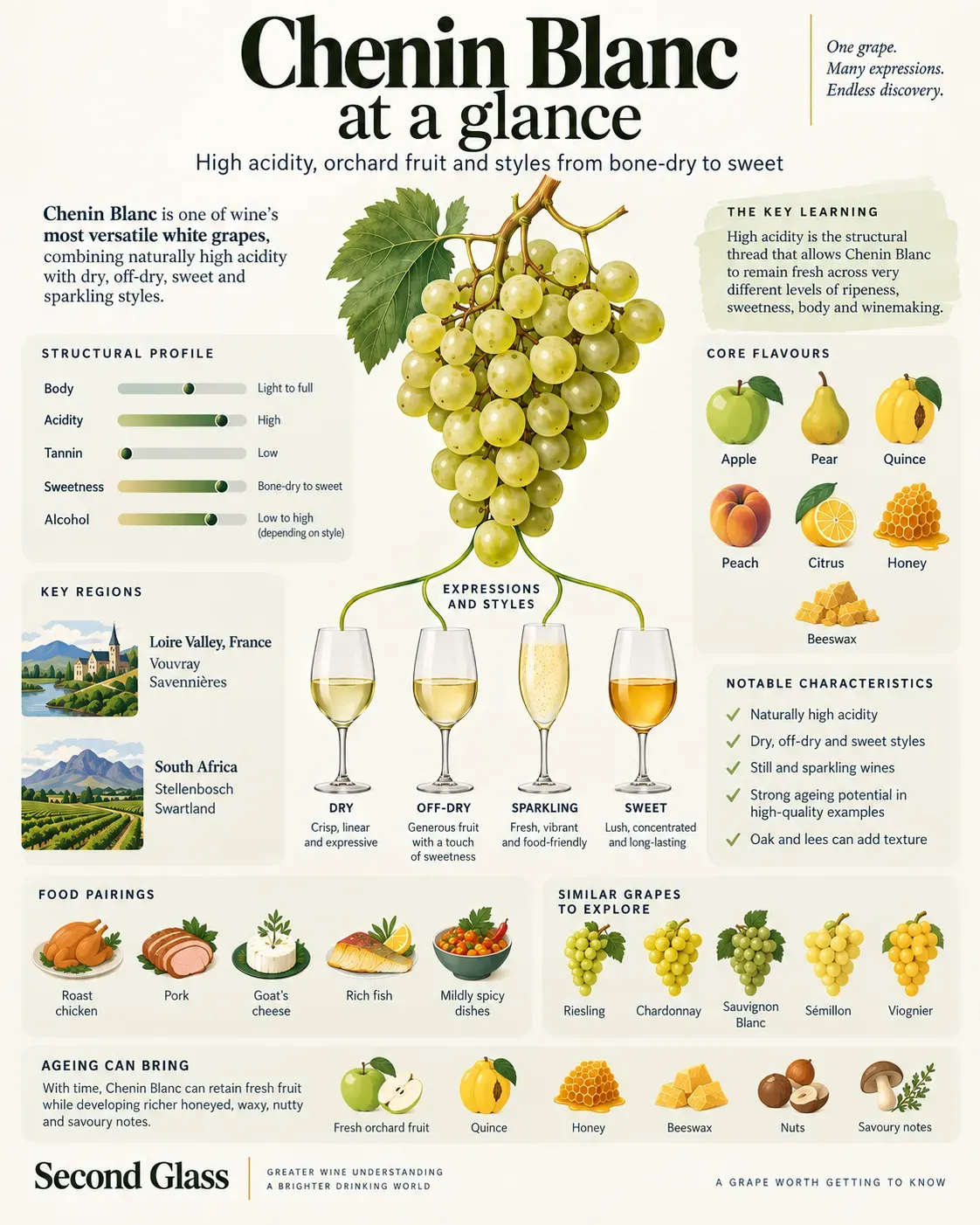
Naturally high acidity is the common structural thread connecting Chenin Blanc's diverse dry, sweet and sparkling styles.
Key Takeaways
- Chenin Blanc is naturally high in acidity, helping dry, sweet and sparkling styles stay fresh.
- Its historic home is the Loire Valley, especially Vouvray, Savennières, Anjou and Saumur.
- South Africa, where Chenin has traditionally also been called Steen, is a major source of fresh, textured and old-vine wines.
- Typical flavours include apple, pear, quince, citrus and stone fruit, while bottle age can bring honey, beeswax, dried fruit, nuts and savoury complexity.
- Chenin can be dry, off-dry, sweet or sparkling, with climate, fruit ripeness, vine age and winemaking shaping its final style.
How Chenin Blanc usually feels
What Is Chenin Blanc?
Chenin Blanc is a white grape variety historically associated with France's Loire Valley. It can produce inexpensive dry whites, serious cellar-worthy wines, sparkling wine and concentrated sweet wines.
Vouvray shows much of this range, producing still wines at different sweetness levels as well as sparkling styles. Savennières is particularly associated with structured dry Chenin, while Anjou and Saumur offer further dry, sweet and sparkling interpretations.
South Africa is central to Chenin's modern identity. The grape has long been widely planted there, and renewed interest in vineyard sites and old vines has helped establish premium South African Chenin as an important category.
What Does Chenin Blanc Taste Like?
Fruit Flavours
Young Chenin commonly shows green or yellow apple, pear, quince and citrus. Riper examples can develop peach, apricot, melon and other stone-fruit flavours.
Cooler sites and earlier picking tend to emphasise citrus and green fruit. Warmer conditions and later harvesting usually produce riper yellow-fruit and stone-fruit flavours.
Floral, Herbal and Spice Notes
Honeysuckle and white flowers may appear in ripe, aromatic examples. Depending on site and winemaking, Chenin can also show ginger, hay, dried herbs or spice.
Oak-aged wines may add toast, baking spice or vanilla, although oak is not essential to the variety.
Ageing Characteristics
With bottle age, Chenin can retain fresh fruit while developing honey, beeswax, dried-fruit, nutty and savoury complexity. Mature Chenin may taste substantially different from a young bottle.
Climate Influence
Cooler conditions generally produce leaner wines with citrus, green apple and firm freshness. Warmer conditions can bring riper pear, peach and tropical-fruit flavours. South African Chenin can combine this generosity with freshness, especially when fruit ripeness, vine balance and careful picking preserve acidity.
Why Does It Taste Like This?
Chenin's natural acidity gives it freshness and helps balance both ripe fruit and residual sugar. It is the main reason the grape can work in dry, sweet and sparkling wines without feeling heavy.
Climate affects the balance between acidity and ripeness. Cooler vineyards tend to produce citrus and green-fruit flavours, while warmer sites encourage yellow apple, pear, peach and sometimes tropical fruit.
Most conventional white Chenin has little perceptible tannin. Skin-contact versions can be grippier, but they are a separate style.
Winemaking also affects texture in different ways. Stainless steel preserves freshness and precision. Oak can add texture and, particularly when new, toast or spice. Lees contact can contribute weight, bread, nut and savoury notes, while malolactic fermentation can soften acidity and add a rounder, creamier impression. Older or larger barrels may contribute texture without obvious oak flavour.
In sweet wines, noble rot can concentrate fruit, sugar and flavour, producing honeyed and dried-fruit characters.
How to serve Chenin Blanc
White
Chenin Blanc
8–11°C 46–52°F
Serve chilled; richer or older examples can be allowed to warm slightly to show their texture and complexity.
Sparkling
Sparkling Chenin Blanc
7–10°C 45–50°F
Serve well chilled to keep the bubbles lively and the acidity refreshing. Allow more complex or lees-aged examples to warm slightly in the glass so their fruit, texture and pastry notes can emerge.
Sweet and fortified
Late Harvest Chenin Blanc
7–10°C 45–50°F
Serve chilled to balance the sweetness, but not so cold that its honeyed fruit disappears.
How Ageing Changes Chenin Blanc
Bottle Ageing
Simple, fruit-driven Chenin is usually best enjoyed young. More concentrated dry wines can develop for five to ten years or considerably longer, depending on quality and balance. Top Loire wines and concentrated old-vine South African examples can age particularly well, while high-quality sweet Chenin may evolve for decades.
Oak Ageing
Oak is optional. Some Loire and South African producers use barrels to build texture, structure and complexity. New oak can add toast and spice, while older or larger barrels mainly provide gentle oxygen exposure and texture.
A creamy impression may also come from lees contact, malolactic fermentation or the wine's natural concentration.
Lees Ageing
Lees are the spent yeast cells left after fermentation. Contact with them can add weight, bread, nut and savoury notes, especially in dry and sparkling wines.
Lees ageing is a clue to a wine's winemaking approach and potential texture, not a guarantee of concentration or quality.
Body, Acidity and Tannin
Chenin Blanc ranges from light to full-bodied.
A young, stainless-steel wine may be light to medium-bodied, crisp and direct. Greater fruit ripeness and concentration, oak fermentation or lees ageing can create considerably more weight.
Tannin is normally low in white Chenin. Skin-contact wines may have noticeable grip.
Where Is Chenin Blanc Grown?
Classic Regions
Loire Valley, France
The Loire is Chenin Blanc's classic European home. Its relatively cool conditions help preserve freshness, while different appellations produce very different styles.
Vouvray can be dry, off-dry, sweet or sparkling. Young wines often show apple, quince, citrus and floral notes, while mature examples become honeyed and waxy.
Savennières is known mainly for dry, structured Chenin. These wines can be firm when young and gain complexity with age.
Anjou and Saumur include dry and sparkling styles, while Coteaux du Layon and Quarts de Chaume are associated with concentrated sweet Chenin.
New World Regions
South Africa
South Africa is Chenin Blanc's major New World reference point. It produces fresh everyday wines as well as barrel-aged and old-vine examples.
Stellenbosch can produce concentrated wines with ripe orchard and stone fruit, often with oak or lees texture.
Swartland is especially important for dry-farmed old bush vines and site-specific wines. These vineyard and farming descriptions provide clues about origin and growing conditions, but do not by themselves guarantee ripe fruit, concentration, texture or quality.
Other significant sources include Paarl, Wellington and the wider Western Cape.
United States
California and other American regions produce smaller quantities of Chenin, ranging from straightforward dry wines to focused examples from older vines and cooler sites.
Emerging Regions
Chenin is also grown in smaller quantities in Australia, New Zealand and Argentina. These regions remain secondary to the Loire and South Africa but are worth exploring for fresh, alternative expressions.
Sparkling Wines Made From Chenin Blanc
Chenin is an important sparkling-wine grape in the Loire. Vouvray produces sparkling Chenin, including fully sparkling styles and pétillant, a lightly sparkling, lower-pressure style. Pétillant is therefore not a universal term for all sparkling Vouvray.
Crémant de Loire is a sparkling-wine appellation that may include Chenin as one of its grape varieties; it is not necessarily made entirely from Chenin.
These wines usually emphasise crisp orchard fruit and citrus, with bread, pastry or nutty flavours developing through lees ageing.
South Africa also produces traditional-method sparkling wines known as Cap Classique, which may include Chenin Blanc.
What to eat with Chenin Blanc
Ideal pairings
- Roast chicken
- Pork
- Goat's cheese
- Rich fish
- Shellfish
- Mildly spicy Asian dishes
Dry, medium-bodied Chenin works well with roast chicken, while richer examples suit pork and textured fish dishes. Fresh Loire styles are a natural match for goat's cheese, and off-dry Chenin can soften the heat of mildly spicy Asian dishes.
Everyday pairings
- Roast chicken
- Fish and chips
- Pork chops
- Chicken salads
- Goat's cheese tart
- Creamy vegetable dishes
- Mild curries
Crisp Chenin suits lighter foods, while richer or oak-aged examples can handle creamier dishes.
Pairings to avoid
Very hot chilli can make bone-dry, high-alcohol Chenin seem harsh, while very sweet desserts can make dry or moderately sweet examples taste thin. Heavy, strongly charred red meat can overwhelm delicate Chenin.
Similar grapes to try
| Grape | Similar | Difference |
|---|---|---|
| Riesling | High acidity, dry-to-sweet range and strong ageing ability. | Usually more aromatic and lighter-bodied. |
| Chardonnay | Can be fresh and unoaked or rich and barrel-aged. | Usually encountered across a narrower sweetness range; acidity varies substantially with climate and style. |
| Sauvignon Blanc | Refreshing acidity and compatibility with lighter foods and goat's cheese. | Generally more herbal, grassy and citrus-driven. |
| Sémillon | Can be textured, age-worthy and capable of producing sweet wines. | Usually has softer acidity and a waxier, broader profile. |
| Viognier | Can share peach, floral and ripe stone-fruit notes. | Typically fuller-bodied, more aromatic and lower in acidity. |
Buying Guide
How to Choose Chenin Blanc
Chenin Blanc is not always prominent on the front label, particularly in France, so start with the region or appellation:
- Vouvray: Still or sparkling Chenin; sweetness can range from dry to sweet. Terms such as sec for dry, demi-sec for off-dry, moelleux for sweet or pétillant for lightly sparkling, lower-pressure wine may appear, but style terms are not always displayed prominently.
- Savennières: Usually dry, structured and suited to ageing.
- Saumur: Often dry or sparkling, with some sweeter examples.
- Anjou: Can be dry, off-dry, sweet or sparkling; check the specific cuvée.
- Coteaux du Layon: Usually sweet Chenin.
- Quarts de Chaume: A prestigious Loire appellation associated with sweet Chenin.
- Crémant de Loire: Sparkling wine that may include Chenin among its grape varieties; it is not necessarily made entirely from Chenin.
- Stellenbosch, Swartland, Paarl or Wellington: South African regional names. South African Chenin is often dry unless the label says late harvest, sweet or dessert wine.
- Steen: A traditional South African name for Chenin Blanc, though modern labels usually use “Chenin Blanc.”
Retailer descriptions and producer information are useful when the label is unclear. Look for phrases such as dry, crisp, mineral, fresh or unoaked for lighter styles; rich, textured, barrel-aged, lees-aged or old vine for fuller wines; and off-dry, medium-sweet, late harvest or dessert wine for sweeter examples.
Terms such as old vine, old bush vine, dry-farmed, single vineyard, barrel fermented and lees-aged can provide clues about vineyard origin, farming, site specificity or winemaking texture. They do not guarantee concentration, complexity or quality, so also consider the producer, vintage, retailer notes and, where available, the technical sheet. Do not assume that all Loire Chenin is sweet or that all South African Chenin is rich.
Budget — £7–£12 / $10–$16
Look for South African Chenin Blanc labelled simply as dry or fresh. Expect straightforward apple, pear and citrus flavours, usually intended for drinking young.
Mid-Range — £12–£25 / $16–$35
This is a useful range for comparing styles. Try dry Vouvray, Saumur, Savennières or more ambitious South African wines.
For a sweeter wine, choose Vouvray labelled demi-sec or a Loire sweet-wine appellation rather than relying on the grape name alone.
Premium — £25+ / $35+
Premium Chenin often reflects vineyard site, fruit concentration, ripeness and careful ageing. Look for serious Savennières and Vouvray, Coteaux du Layon or Quarts de Chaume, and old-vine South African wines from recognised producers.
Choose these bottles when you want distinctive site character, ageing potential or complex texture rather than simply more intense fruit.
How to start exploring Chenin Blanc
1. Begin with a dry Loire Chenin Blanc. Choose a bottle from Vouvray, Savennières, Saumur or another Loire appellation. Focus on its freshness, apple, pear, quince and mineral character.
2. Try a dry South African Chenin Blanc. Compare it with the Loire wine, looking for differences in ripeness, body, texture and fruit intensity. South African examples often show riper orchard or stone fruit and may have more breadth.
3. Taste the wines side by side. Use similar glasses and serve both chilled but not ice-cold. Notice how the wines differ in acidity, weight, fruit character and finish.
4. Explore an off-dry Chenin Blanc. Choose a wine with noticeable but balanced residual sugar, such as an off-dry Vouvray. Notice how the wine remains fresh rather than heavy.
5. Try a sparkling Chenin Blanc. Look for sparkling Vouvray, Crémant de Loire or South African Cap Classique. Compare its crisp fruit and acidity with the still wines, noting any bread or pastry flavours from lees ageing.
6. Taste an aged or premium example. If possible, try a mature Loire Chenin or an old-vine South African wine. Look for honey, beeswax, nuts, dried fruit and savoury complexity alongside its remaining freshness.
7. Pair Chenin with food. Start with goat's cheese, roast chicken, pork, fish or mildly spicy dishes. Notice how sweetness, body and texture affect the pairing.
Common Misconceptions
Chenin Blanc is always sweet.
Many important Chenins are completely dry, while others are off-dry, sweet or sparkling.
Chenin Blanc is only a French grape.
France is its historic home, but South Africa is central to its modern identity and has an important heritage of old vines.
Cheap Chenin means Chenin is simple.
Affordable wines are often fruit-led, but top examples can be complex and exceptionally age-worthy.
Chenin Blanc needs oak.
It does not. Stainless steel, neutral barrels and noticeable oak can all produce convincing styles.
Chenin Blanc is only a still wine.
Sparkling Chenin has a long history in the Loire and is also made in South Africa.
Questions about Chenin Blanc
Where is Chenin Blanc from?
Chenin Blanc comes from France's Loire Valley, where it is central to appellations such as Vouvray, Savennières and Anjou. It is also widely grown in South Africa, one of the grape's most important modern homes.
Is Chenin Blanc dry or sweet?
Both. Chenin Blanc can produce bone-dry, off-dry, medium-sweet and intensely sweet wines. It can also make sparkling wine. Check the appellation, label and retailer description rather than assuming sweetness from the grape alone.
What does Chenin Blanc taste like?
Chenin Blanc commonly tastes of apple, pear, quince and citrus, with peach or other ripe fruit in warmer conditions. Mature wines can develop honey, beeswax, nuts and dried-fruit flavours.
Is Chenin Blanc similar to Sauvignon Blanc?
They share refreshing acidity, but Sauvignon Blanc is usually more herbal, grassy or sharply citrus-led. Chenin tends towards orchard and stone fruit and has a broader tradition of sweet and age-worthy styles.
Is Chenin Blanc similar to Chardonnay?
Both can make fresh unoaked wines or richer barrel-aged styles. Chenin usually has more prominent acidity and a wider range of sweetness levels.
What food goes best with Chenin Blanc?
Roast chicken, pork, goat's cheese, fish and mildly spiced dishes are excellent starting points. Match the wine's sweetness and richness to the food.
Can Chenin Blanc age?
Yes. High-quality Chenin can age extremely well. Serious dry and sweet Loire wines and concentrated South African examples can develop honeyed, waxy, nutty and savoury complexity.
Is South African Chenin Blanc good?
Yes. South Africa is one of the world's key sources of Chenin Blanc, ranging from inexpensive fresh whites to complex wines from old vineyards.
Is Chenin Blanc used for sparkling wine?
Yes. Chenin is used for sparkling wines in the Loire, including Vouvray, and can be included in South African Cap Classique. Its naturally high acidity makes it well suited to sparkling production.
Final Thoughts
Chenin Blanc is worth exploring because it can be crisp, rich, sweet, sparkling or age-worthy without losing its sense of freshness.
Start with a dry Loire wine and a dry South African wine, then compare an off-dry, sparkling or mature example. The differences between those bottles are the best introduction to Chenin Blanc's range.