Quick answer
What to know first
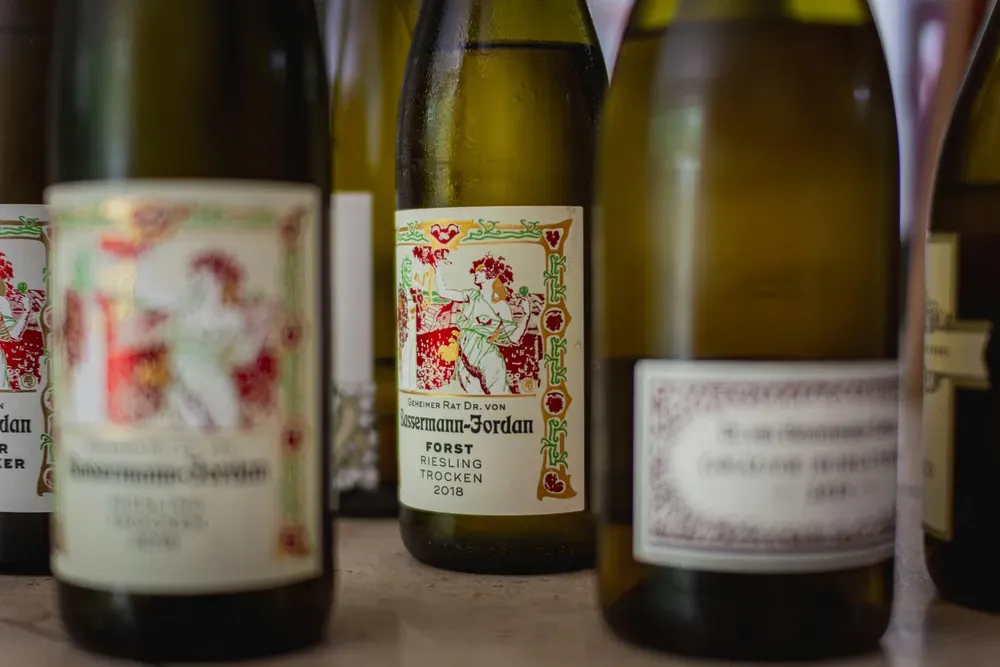
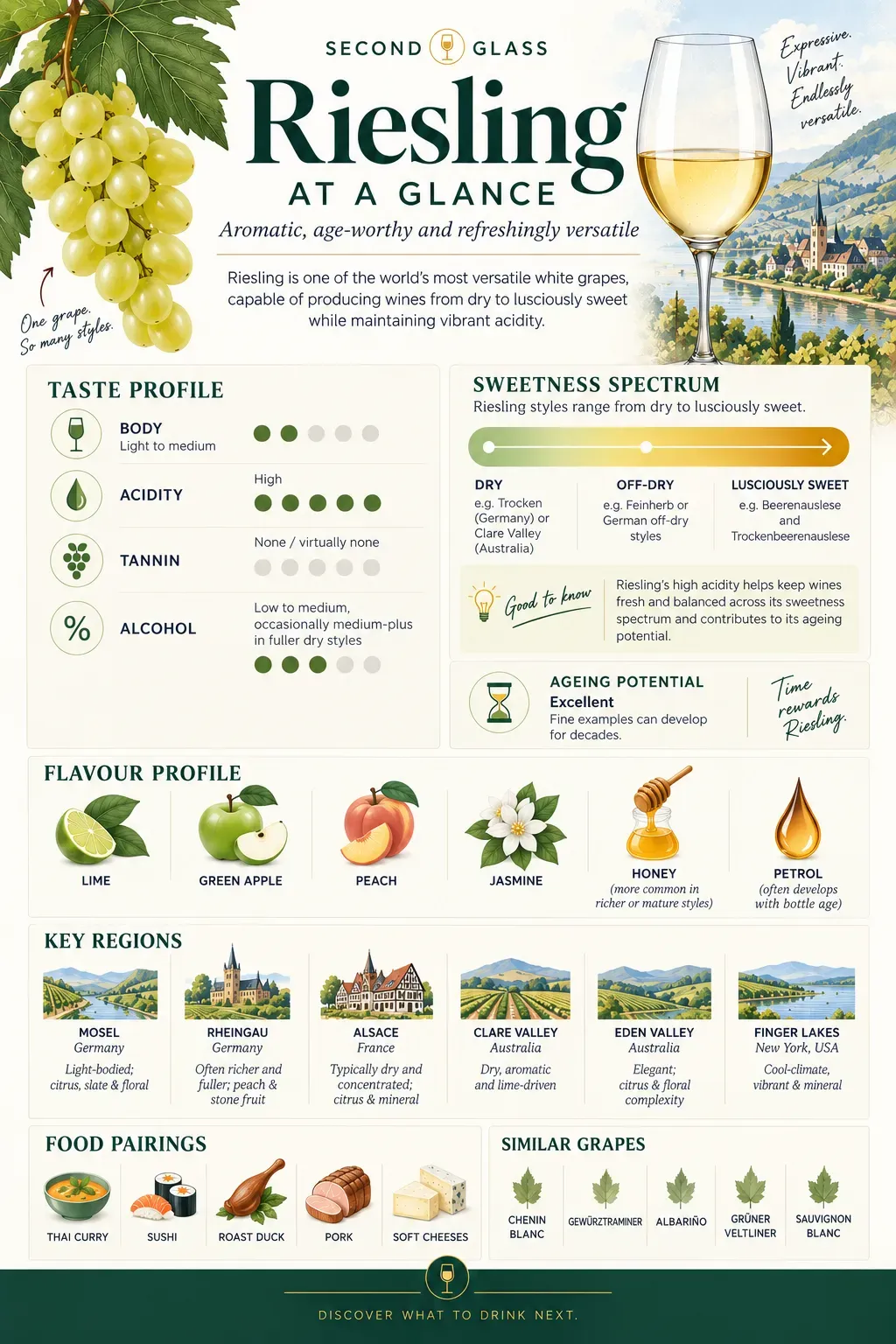
Riesling is an aromatic white grape best known for its high acidity and flavours of lime, green apple, peach and flowers. It is most famous in Germany but also thrives in Australia and France. Riesling can produce wines ranging from bone dry to intensely sweet while remaining fresh and vibrant.
How Riesling usually feels
Key Takeaways
- One of the world's most aromatic white grapes
- Usually high in acidity regardless of sweetness level
- Produces styles from dry to intensely sweet
- Fine examples can develop beautifully in bottle
- Particularly associated with Germany's cooler regions
- Off-dry styles are particularly versatile with spicy food
- Mature examples can develop distinctive honeyed, waxy and petrol aromas
What Is Riesling?
Riesling is an ancient white grape variety originating in Germany, where records date back to the fifteenth century. It is considered one of the world's great noble grapes because it expresses climate and site exceptionally well and can produce wines in an extraordinary range of styles.
Today, Riesling is grown across Europe, Australia, North America and New Zealand, producing wines that vary dramatically according to climate and winemaking choices.
What Does Riesling Taste Like?
Fruit Flavours
- Lime
- Lemon
- Green apple
- Peach
- Apricot
- Mandarin
Floral Notes
- Jasmine
- Orange blossom
- Honeysuckle
- White flowers
Herbal and Spice Notes
- Wet stone
- Ginger
- Fresh herbs
- Mineral notes
Ageing Characteristics
Young Riesling tends to emphasise citrus, green fruit, stone fruit and flowers. With bottle age, some examples develop honey, beeswax, dried citrus, savoury complexity and the distinctive petrol-like aroma associated with mature Riesling.
Climate Influence
Cool climates emphasise citrus, green apple and mineral notes. Warmer sites produce riper peach, apricot and tropical fruit characteristics.
Why Does It Taste Like This?
Riesling's naturally high acidity is its defining feature. Even sweeter examples can feel fresh because acidity balances the residual sugar.
Riesling wines contain virtually no tannin because white wines are generally fermented with little or no skin contact. This preserves freshness and purity of fruit while creating a wine that feels light and elegant rather than grippy. Riesling naturally contains aroma compounds and precursors that contribute to its pronounced floral and fruit-driven character.
Winemaking also plays a major role. New oak is generally avoided so the grape's aromas and sense of freshness remain prominent. Decisions about harvest timing and fermentation help determine whether the finished wine is dry, off-dry or sweet.
How Ageing Changes Riesling
Why Riesling Ages So Well
Riesling's naturally high acidity gives the wine structure and freshness as it matures. In concentrated, well-balanced wines, this can support long bottle ageing without the wine quickly becoming flat or tired.
Young vs Mature Riesling
Young Riesling typically shows fresh lime, lemon, green apple, peach and floral aromas. As it matures, the fruit can become more dried or preserved in character, while notes of honey, beeswax and savoury complexity emerge.
Why Does Aged Riesling Smell Like Petrol?
The petrol or kerosene-like aroma sometimes found in Riesling is associated with a compound called TDN. It can become more noticeable as the wine ages and is a recognised part of mature Riesling's aromatic profile, although its intensity varies considerably between wines.
Petrol character is therefore not automatically a fault, nor is it something every Riesling develops strongly. Some drinkers enjoy it as part of the grape's mature complexity, while others prefer younger, more fruit-driven wines.
Which Rieslings Are Worth Ageing?
Concentrated wines with strong acidity and good balance are the best candidates. Quality dry Rieslings, top German wines and concentrated sweet styles can all reward bottle age, although inexpensive, fruit-driven examples are usually best enjoyed while young and fresh.
The finest Rieslings can develop for decades, but ageing potential varies substantially with style, vintage, concentration and storage conditions.
Is Riesling Dry or Sweet?
Riesling can be dry, off-dry, medium sweet or sweet. This range is one of the grape's defining characteristics, and sweetness can dramatically change how Riesling tastes and what foods it suits.
Dry
Dry Riesling contains little perceptible sweetness. Expect crisp acidity, citrus and green or stone-fruit flavours, often with a clean, precise finish.
Dry styles are particularly associated with regions such as Alsace and Australia's Clare and Eden Valleys, while Germany also produces excellent dry Riesling. On German labels, Trocken is a useful indication that the wine is dry.
In the glass: crisp, refreshing and usually citrus-driven.
Off-Dry
Off-dry Riesling has a small but noticeable degree of sweetness. The residual sugar softens the grape's high acidity without necessarily making the wine taste overtly sweet.
This balance makes off-dry Riesling especially versatile with spicy or aromatic food.
In the glass: juicy, fresh and gently sweet rather than dessert-like.
Medium Sweet
As residual sugar increases, Riesling becomes richer and more obviously sweet while its acidity helps prevent the wine from feeling heavy.
These wines can show ripe peach, apricot, citrus and floral flavours and work particularly well when the food itself contains sweetness, spice or richness.
In the glass: clearly sweet but still lively and refreshing.
Sweet
At the sweetest end of the spectrum, Riesling can produce concentrated dessert wines with intense fruit, honeyed flavours and powerful acidity.
Styles such as Beerenauslese and Trockenbeerenauslese can reach this end of the spectrum, producing complex wines designed for slow drinking and, often, long ageing.
In the glass: concentrated, luscious and intensely flavoured, balanced by acidity.
What Do Kabinett, Spätlese and Auslese Mean?
This is where German Riesling can initially seem confusing.
Kabinett, Spätlese and Auslese are not simply sweetness levels. They are Prädikat terms connected primarily to the ripeness of the grapes at harvest, so you cannot reliably assume that moving from Kabinett to Spätlese to Auslese is the same as moving from dry to increasingly sweet wine.
A Spätlese, for example, can be made in a dry style, while another may retain noticeable sweetness. Auslese is made from riper, selectively harvested grapes but can also vary in its finished sweetness.
For beginners, the practical lesson is simple: don't use Kabinett, Spätlese and Auslese alone to decide how sweet a German Riesling will taste. Look for additional sweetness information on the label, retailer description or producer notes. The word Trocken is particularly useful because it indicates a dry German wine.
Body, Acidity and Tannin
Riesling generally has a light to medium body and virtually no tannin. Its hallmark is bright, mouth-watering acidity that gives the wine energy and precision.
Sweetness and alcohol can change the impression of weight: a delicate German Riesling may feel exceptionally light, while a concentrated dry example from Alsace or Australia can feel fuller and more substantial.
Where Is Riesling Grown?
Classic Regions
Mosel, Germany
Steep, cool vineyards produce some of Riesling's most distinctive wines, often combining light body and high acidity with citrus, floral and slate-like characteristics. Styles range from dry to intensely sweet, making Mosel particularly useful for understanding Riesling's versatility.
Rheingau, Germany
Often produces richer, fuller examples with peach and stone-fruit flavours alongside the grape's characteristic acidity.
Alsace, France
Typically makes dry, concentrated Rieslings with citrus, stone-fruit and mineral character. These wines can feel fuller than many German examples.
New World Regions
Clare Valley, Australia
Known for intensely aromatic, lime-driven dry Rieslings with high acidity and a precise, refreshing profile.
Eden Valley, Australia
Produces elegant dry wines with citrus and floral complexity, often with excellent potential to develop in bottle.
Finger Lakes, New York
Its cool conditions suit Riesling particularly well, producing vibrant wines across dry, off-dry and sweeter styles.
Emerging Regions
- New Zealand
- Canada
- England
- Washington State
Famous Wines Made From Riesling
Riesling is less about one famous wine and more about a collection of distinctive regional and stylistic expressions.
German Riesling ranges from dry Trocken wines to delicate wines with residual sweetness and intensely concentrated noble sweet styles. Mosel and Rheingau are among its best-known regions.
Alsace is particularly associated with concentrated dry Riesling, while Australia's Clare and Eden Valleys have built reputations for precise, citrus-driven dry examples.
Sparkling Wines Made From Riesling
Riesling can produce sparkling wine, although sparkling expressions are less common internationally than still Riesling.
Germany is particularly associated with Riesling Sekt, which can range from straightforward, fruit-driven sparkling wine to more complex examples. Riesling's naturally high acidity suits sparkling production, helping the finished wine retain freshness.
Expect citrus, green apple and floral flavours, with bubbles adding texture and lift. Compared with still Riesling, the emphasis is often on freshness and immediate energy rather than the same expression of sweetness, vineyard character or bottle-aged complexity.
Food Pairing Guide
Ideal Pairings
- Thai curry
- Sushi
- Pork
- Roast duck
Riesling's high acidity and aromatic intensity make it particularly effective with spicy cuisine and richer dishes. Off-dry styles can be especially useful with chilli because a little residual sugar can soften the impression of heat.
Sushi requires more nuance. Dry or gently off-dry Riesling can work beautifully with richer fish, prawns or preparations containing spice, while sweeter examples may overwhelm delicate, lightly seasoned sushi.
Everyday Pairings
- Roast chicken
- Grilled prawns
- Salads
- Soft cheeses
Dry Riesling works particularly well with lighter seafood, salads and simply prepared poultry, while slightly sweeter styles give you more flexibility when sauces introduce spice or sweetness.
Pairings To Avoid
- Heavily smoked dishes
- Strongly bitter vegetable dishes
These flavours can sometimes overshadow Riesling's aromatic detail. They are not absolute rules, however: the grape's high acidity and occasional residual sugar can make Riesling more adaptable with bitterness than many other white wines.
Similar grapes to try
| Grape | Similar | Difference |
|---|---|---|
| Chenin Blanc | High acidity and excellent ageing potential. | Usually richer and more textured. |
| Gewürztraminer | Intensely aromatic character. | Lower acidity and more exotic spice. |
| Albariño | Fresh citrus and stone-fruit flavours. | Less variation in sweetness levels. |
| Grüner Veltliner | Mineral and highly food-friendly style. | More savoury and peppery in profile. |
| Sauvignon Blanc | Bright acidity and freshness. | More herbaceous and generally less age-worthy. |
Buying Guide
Budget (£10–£20 / $12–$25)
At this price point, look for young Rieslings from Germany, Australia or the Finger Lakes. Expect bright citrus flavours such as lime, lemon and green apple, with high acidity and a refreshing finish.
These wines tend to prioritise freshness and fruit rather than layers of complexity. Most are best enjoyed young, although quality can be excellent for the price.
Spending within this range is particularly worthwhile when you want an aromatic, food-friendly white for everyday drinking. Check the label or retailer description if sweetness matters to you, because similarly priced Rieslings can range from dry to noticeably sweet.
Mid-Range (£20–£40 / $25–$50)
This is often the sweet spot for quality Riesling. Wines become more concentrated and expressive, with greater texture, length and regional character.
You are more likely to encounter distinctive vineyard or regional expression, and many wines in this bracket can improve with several years of bottle age. Rheingau, Alsace and Eden Valley are useful regions to explore, alongside higher-quality examples from Mosel and Clare Valley.
Spending more is worthwhile when you want greater precision and complexity rather than simply more fruit intensity. This range also offers a useful entry point into Rieslings designed for short- to medium-term cellaring.
Premium (£40+ / $50+)
Premium Rieslings can rank among the world's most complex white wines. Bottles at this level may come from exceptional vineyard sites, old vines, highly selective harvesting or concentrated sweet-wine styles.
Expect greater depth, length and precision, with the best examples revealing increasingly complex aromas as they develop. Premium dry and sweet Rieslings can both be age-worthy, although their trajectories and flavour profiles differ.
Spending more is most worthwhile when vineyard expression, rarity or cellaring potential matters to you. Noble sweet wines and highly regarded single-vineyard Rieslings can rise far beyond these starting prices.
Buying Tips
- Don't assume Riesling is sweet: check the label or wine description.
- Look for Trocken when you specifically want a dry German Riesling.
- If you're new to the grape, comparing a dry Australian Riesling with an off-dry German example is an excellent way to understand its range.
- Off-dry Riesling is particularly versatile with spicy food.
- Buy inexpensive fruit-driven styles for freshness rather than long-term cellaring.
- For ageing, prioritise concentration, balance and good storage conditions rather than assuming every Riesling will improve indefinitely.
Beginner Guidance
If you're new to Riesling, start by deciding whether you want dry or slightly sweet, because sweetness changes the experience more than almost anything else. The best first comparison is a dry Australian Riesling alongside an off-dry German Riesling, because the contrast makes the grape's range immediately obvious. The Australian wine will usually emphasise citrus, precision and a crisp finish, while the German example will show how a little residual sugar can soften Riesling's high acidity without making it feel heavy. Check labels for words such as Trocken when you want a dry German wine, and use retailer descriptions if the sweetness level is unclear. Once you understand which side of the spectrum you prefer, you can explore regions, vineyard character and bottle age with much more confidence.
How To Experiment
- Buy one dry Australian Riesling, ideally from Clare Valley or Eden Valley.
- Buy one off-dry German Riesling, ideally from Mosel.
- Serve both well chilled and taste them side by side rather than on different days.
- Compare the acidity first: notice that both should feel fresh even though one contains more residual sugar.
- Compare the fruit profile: look for lime and citrus in the Australian wine, then peach, floral or riper fruit notes in the German example.
- Taste both with a mildly spicy dish and notice how the off-dry wine changes the perception of heat.
- Finish by deciding which balance you prefer — crisp and dry, or softer and gently sweet — then use that preference to guide your next Riesling purchase.
Common Misconceptions
Riesling Is a Simple, Fruity White Wine
Riesling can be immediately appealing when young, but its character extends far beyond straightforward fruit. Vineyard site, climate, ripeness and residual sugar can produce striking differences in texture, aroma and flavour.
All German Riesling Tastes the Same
Germany produces a remarkably broad spectrum of Riesling. Regional differences, vineyard position, grape ripeness and winemaking choices can result in wines ranging from delicate and light-bodied to concentrated and powerful.
Riesling Needs Residual Sugar to Balance Its Acidity
Residual sugar can soften Riesling's naturally high acidity, but it is not essential. Well-made dry Riesling can achieve balance through ripe fruit, concentration and texture while retaining the grape's characteristic freshness.
Riesling Is Only Suited to Cool Climates
Riesling is strongly associated with cool climates, but successful examples are also produced in warmer regions and sites. Cooler conditions tend to emphasise citrus and green fruit, while warmer sites can produce fuller wines with peach, apricot and riper fruit flavours.
Expensive Riesling Must Be Sweeter
Price and sweetness are not directly connected. Premium Riesling can be bone dry, off-dry or intensely sweet; vineyard quality, concentration, rarity, production methods and ageing potential all influence price.
More about Riesling
Is Riesling a white or red wine?
Riesling is a white wine grape. It is used overwhelmingly to make white wines, ranging from dry and light-bodied to intensely sweet, as well as some sparkling wines.
What does Riesling taste like?
Riesling typically tastes of lime, lemon, green apple, peach or apricot, often with floral aromas. Climate, ripeness, sweetness and age influence the exact profile, and mature examples can develop honey, beeswax, dried citrus and petrol-like notes.
Is Riesling dry or sweet?
Riesling can be both. It is made across a broad spectrum from bone dry through off-dry and medium sweet to intensely sweet. German terms such as Kabinett, Spätlese and Auslese describe grape ripeness categories rather than functioning as a simple sweetness scale.
Is Riesling always sweet?
No. Many Rieslings are completely dry, particularly examples from Alsace, Australia and Germany labelled Trocken. Other Rieslings retain varying amounts of residual sugar, so checking the label or wine description is the easiest way to know what to expect.
Why does Riesling smell like petrol?
A compound known as TDN can create the petrol or kerosene-like aroma associated with some Rieslings, particularly as they mature. Its presence and intensity vary, and it is not automatically a wine fault.
Does Riesling age well?
Yes. High-quality Riesling can age extremely well because its naturally high acidity helps preserve freshness. Concentrated dry wines and fine sweet Rieslings are particularly capable of developing complex honeyed, waxy, dried-fruit and savoury flavours over time.
What food goes with Riesling?
Riesling pairs particularly well with spicy food, pork, duck and many seafood dishes. Dry styles suit lighter seafood and poultry, while off-dry Riesling is especially useful with chilli, aromatic spices and dishes containing a little sweetness.
Is Riesling good with spicy food?
Yes. Off-dry Riesling is particularly effective with spicy food because its residual sugar can soften the perception of chilli heat while high acidity keeps the pairing fresh.
Is Riesling usually oaked?
No. Riesling is generally made with little or no new-oak influence so that its fruit, floral aromas and acidity remain prominent. Some producers use neutral vessels or lees ageing to influence texture without introducing obvious oak flavours.
Can Riesling make sparkling wine?
Yes. Riesling is used for sparkling wine, particularly German Riesling Sekt. Its naturally high acidity makes it well suited to sparkling production, typically producing fresh wines with citrus, apple and floral characteristics.
Final Thoughts
Riesling's great strength is its range. The same grape can produce a bone-dry, lime-driven Australian wine, a delicate German Riesling with gentle sweetness or a concentrated dessert wine, yet high acidity and aromatic character provide a recognisable thread between them.
Understanding that spectrum is the key to understanding Riesling — and to finding the style you actually want to drink.