
Quick answer
What to know first
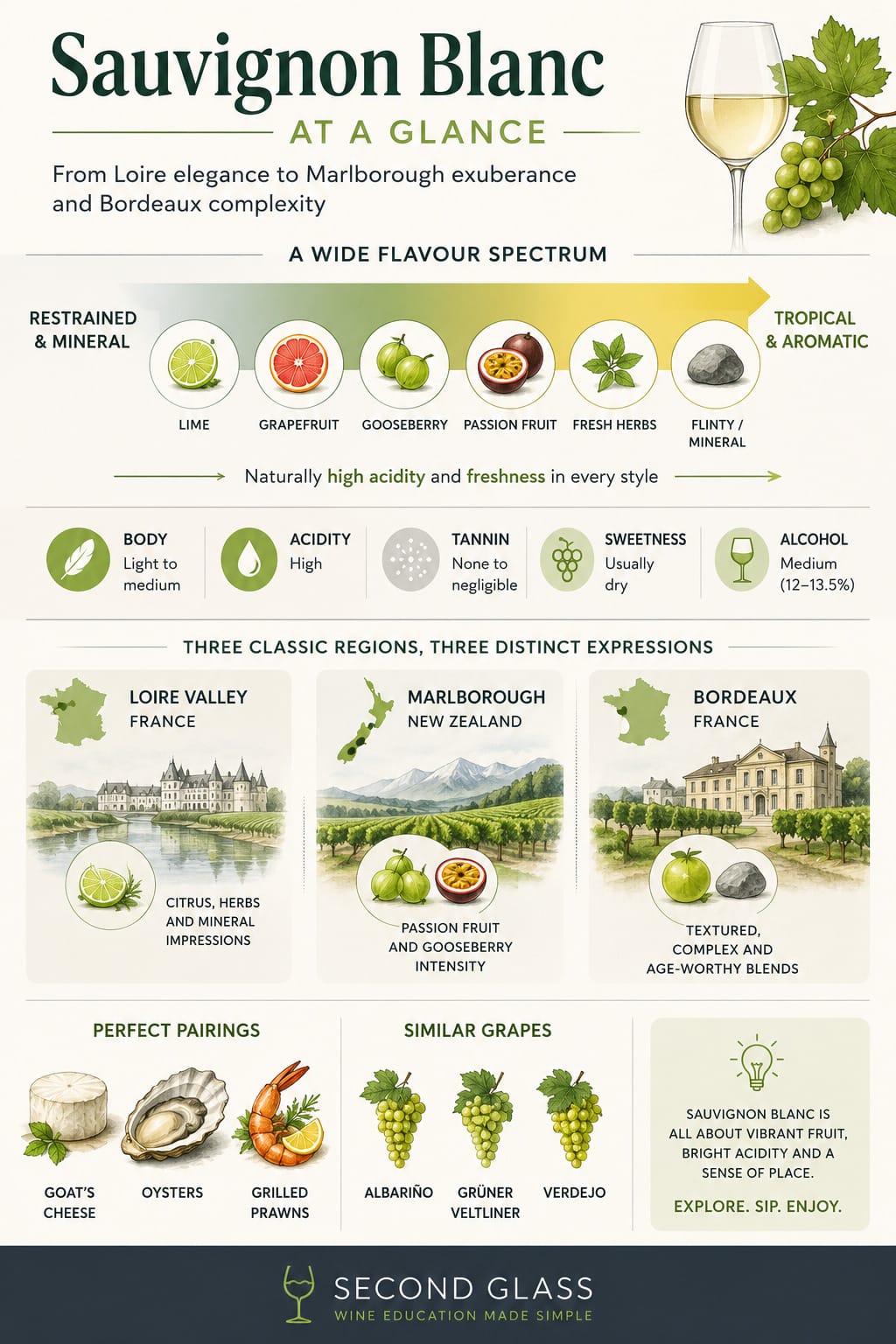
Sauvignon Blanc is an aromatic white grape known for producing crisp, usually dry wines with flavours of citrus, gooseberry and fresh herbs. It is particularly associated with France's Loire Valley and New Zealand's Marlborough region.
How Sauvignon Blanc usually feels
Key Takeaways
- Sauvignon Blanc is one of the world's most recognisable white grapes.
- It typically produces dry wines with naturally high acidity.
- Styles range from restrained and mineral in impression to intensely aromatic and tropical.
- The Loire Valley, Marlborough and Bordeaux all produce internationally respected expressions.
- It pairs exceptionally well with seafood, salads and goat's cheese.
- Most examples are best enjoyed young and fresh.
- A small number of concentrated wines can develop complexity with bottle age.
What Is Sauvignon Blanc?
Sauvignon Blanc is a white grape variety widely believed to have originated in France, most likely in the country's southwest. Its name is thought to derive from the French word sauvage, meaning wild, reflecting the grape's early origins.
Today, Sauvignon Blanc is planted around the world and is among the most important white grape varieties internationally. It is capable of expressing notable differences according to climate and winemaking. In cooler regions it often produces citrus, herbal and mineral impressions, while warmer areas encourage riper tropical fruit flavours and greater texture.
Its naturally high acidity and adaptability have made it one of the defining white grapes of modern wine.
What Does Sauvignon Blanc Taste Like?
Fruit Flavours
- Lime
- Grapefruit
- Green apple
- Gooseberry
- Passion fruit
- Pineapple
- White peach
Floral Notes
- Elderflower
- White blossom
- Honeysuckle
Herbal and Spice Notes
- Fresh-cut grass
- Tomato leaf
- Green herbs
- Bell pepper
- Flint or smoky mineral impressions
Ageing Characteristics
With age, Sauvignon Blanc can develop notes of honey, beeswax, dried herbs and savoury complexity.
Climate Influence
Cool climates often produce citrus, herbal and mineral-driven styles. Warmer regions generally create riper tropical fruit flavours and a fuller body.
Why Does It Taste Like This?
Climate
Like many grape varieties, Sauvignon Blanc retains acidity particularly well in cooler conditions. It also tends to maintain refreshing acidity even when relatively ripe, contributing to its vibrant citrus character and aromatic precision.
Acidity
Naturally high acidity gives Sauvignon Blanc its refreshing, mouth-watering finish and makes it especially versatile with food.
Aromatic Compounds
Sauvignon Blanc contains naturally occurring aroma compounds and flavour precursors that contribute to its distinctive character. Depending on ripeness, growing conditions and winemaking choices, these can produce notes ranging from fresh herbs and bell pepper to passion fruit and grapefruit.
Tannins
As a white grape, Sauvignon Blanc contains negligible tannin and therefore feels crisp rather than structured.
Winemaking
Most producers ferment Sauvignon Blanc in stainless steel to preserve freshness and aromatic intensity. Some premium examples are fermented or matured in oak to create additional texture and complexity.
How Ageing Changes Sauvignon Blanc
Bottle Ageing
When Sauvignon Blanc is young, it is all about fresh, bright flavours and strong aromas. You’ll usually notice:
- Green fruit: gooseberry, green apple
- Citrus: lime, grapefruit
- Fresh herbal notes: grass, nettle, basil
These flavours are strongest in the first 1–3 years after bottling.
As the wine gets older, these fresh flavours slowly change and soften. You may notice:
- Fruit becomes softer: lime and gooseberry often give way to riper or preserved fruit notes such as lemon curd, baked apple or dried tropical fruit
- Green notes fade: fresh grass and herbs become more like dried herbs or hay
- Smoother taste: the sharp acidity feels more balanced and less sharp
- New gentle flavours appear: hints of honey, beeswax, or light nuts in well-made wines
Wines with strong natural acidity (often from cooler regions) tend to age better and keep their freshness for longer.
Oak Ageing
Oak is not always used in Sauvignon Blanc, but when it is, it changes the wine’s feel and structure more than its flavour, particularly when older or larger barrels are used.
There are two main ways oak is used:
1. Fermenting in Oak
This means the wine is made in oak barrels from the start. It can:
- make the wine feel smoother
- give it more body and weight
- help flavours blend together more naturally
2. Ageing in Oak
After fermentation, the wine may rest in barrels:
- New oak (less common): can add light vanilla, spice, or toast
- Older oak (more common): adds texture without strong oak flavour
Oak ageing can create:
- A creamier texture
- Light spice notes (like baking spice or white pepper)
- A fuller, richer feel in the mouth
- Less sharp fruit, but more balance and depth
A well-known example is white Bordeaux (Pessac-Léognan), where Sauvignon Blanc is often blended with other grapes and aged in oak to create a richer, more complex wine.
Lees Ageing
Lees ageing means the wine is left to rest on the natural yeast particles after fermentation.
These yeast cells slowly break down and release compounds that improve the wine.
This process helps:
- Soften the texture of the wine
- Make the wine feel smoother and rounder
- Blend flavours together more evenly
It can also add gentle flavours like:
- fresh bread, bread dough or light biscuit
- light creaminess
- a slightly savoury note
Some winemakers also gently stir the wine during this stage to increase richness, but this is usually done only for fuller, more complex styles.
Ageing Potential
Most Sauvignon Blanc is made to be enjoyed young and fresh, usually within 1–3 years of release.
However, some styles can age much longer depending on where they are from and how they are made.
Wines that age well:
- White Bordeaux (Pessac-Léognan): often blended and oak-aged, can last 10–15+ years
- Top Sancerre and Pouilly-Fumé from leading producers: can develop more complex flavours over 5–10 years
- Carefully made New World wines (like some Marlborough single vineyards): if they have good balance and acidity
What improves with age:
- flavours become more blended and smooth
- new complex notes appear (honey, dried herbs, nuts)
- texture becomes richer and more layered
What fades with age:
- very fresh fruit flavours (lime, gooseberry)
- strong green herbal notes
- the “zesty” freshness of young wine
In simple terms, ageing changes Sauvignon Blanc from a bright, fruity, and aromatic wine into something more smooth, layered, and complex—but only a small number of wines are made to improve with long ageing.
Body, Acidity and Tannin
Sauvignon Blanc is generally light to medium-bodied with naturally high acidity and little to no perceptible tannin.
Its mouthfeel is typically crisp and refreshing rather than rich or creamy, although oak-aged examples can develop greater weight and texture.
Where Is Sauvignon Blanc Grown?
Sauvignon Blanc is a highly adaptable grape variety, but its expression changes dramatically depending on climate, soil, and winemaking style. From crisp, mineral-driven European wines to intensely aromatic New World styles, each region brings a distinct personality to the grape.
Classic Regions
Loire Valley, France
The Loire Valley is widely regarded as the spiritual home of Sauvignon Blanc, particularly in appellations such as Sancerre and Pouilly-Fumé. While the grape’s broader origins are thought to lie in southwestern France, it is in the Loire that it has become most closely associated with a pure, terroir-driven expression. The region’s cool continental climate and varied limestone-rich soils help produce wines that are precise, linear, and highly expressive of place.
Typical characteristics include:
- Citrus notes such as lemon, lime, and grapefruit
- Distinct herbal tones like nettle, grass, and crushed green leaves
- A pronounced mineral edge often described as flint, chalk, or wet stone
- High natural acidity, giving the wines structure and longevity
These wines are often unoaked, allowing purity and site expression to take centre stage. In top examples, subtle smoky or gunflint notes (especially in Pouilly-Fumé) add further complexity.
Bordeaux, France
In Bordeaux, Sauvignon Blanc plays a different role, often as part of a blend with Sémillon and occasionally Muscadelle. It is used in both dry white wines and the region’s famous sweet wines from Sauternes and Barsac.
In dry white Bordeaux, Sauvignon Blanc contributes:
- Fresh citrus and green fruit character
- Herbal lift and aromatic intensity
- Acidity that balances the richer texture of Sémillon
When blended, Sémillon contributes body, waxy texture, and mid-palate richness, making Sauvignon Blanc feel less angular and more rounded. The result is a more structured wine that can develop notes of honey, nuts, and dried citrus over time.
New World Regions
Marlborough, New Zealand
Marlborough is the benchmark for the modern, intensely aromatic style of Sauvignon Blanc. The region’s cool nights, high sunshine hours, and free-draining soils create wines with explosive fruit character.
Typical profile:
- Passion fruit, guava, and ripe gooseberry
- Fresh-cut grass, basil, and green pepper notes
- High aromatic intensity with immediate impact on the nose
- Crisp acidity balanced by ripe tropical fruit
This style is often described as “loud” or “expressive,” and it has played a major role in defining global expectations of Sauvignon Blanc since the 1980s.
California, USA
California produces a wide spectrum of Sauvignon Blanc styles due to its diverse climates and winemaking approaches.
Common expressions include:
- Cool coastal styles (Sonoma, Napa Carneros): crisp citrus, green apple, and herbal notes with bright acidity
- Warmer inland styles: riper tropical fruit such as melon, peach, and pineapple
- Some producers market Sauvignon Blanc as Fumé Blanc, with many examples showing oak influence, offering vanilla, spice, and a rounder texture
This diversity makes California one of the most stylistically flexible regions for the grape.
South Africa
South African Sauvignon Blanc is known for its balance between fruit purity and savoury complexity. Coastal regions such as Stellenbosch and Elgin are particularly important, though the country produces a wide stylistic range from Loire-like restraint to more New World fruit-driven expressions.
Typical characteristics:
- Bright citrus fruit (lime, lemon, grapefruit)
- Distinct herbal and green pepper notes
- Occasional tropical fruit in warmer sites
- A textured palate with good concentration and structure
Many producers aim for a style that sits between the restraint of the Loire and the fruit intensity of New Zealand.
Chile
Chile’s long, narrow geography allows for strong coastal influence, particularly from the Pacific Ocean, which helps preserve acidity and freshness.
Typical profile:
- Citrus-driven flavours such as lime and grapefruit
- Tropical notes including pineapple and passion fruit in warmer zones
- Herbal undertones and a clean, crisp finish
- Excellent value across most quality tiers
Regions like Casablanca and San Antonio are especially known for producing vibrant, expressive Sauvignon Blanc.
Emerging Regions
England
England is an emerging region for Sauvignon Blanc, with plantings still relatively small compared with varieties such as Chardonnay and Pinot Noir, but quality is steadily improving in southern regions such as Sussex and Kent.
Wines tend to show:
- High acidity and delicate structure
- Citrus-driven profiles (lemon, lime, green apple)
- Subtle herbal and floral notes
- A restrained, elegant style closer to the Loire than the New World
As vineyard maturity increases, both quality and consistency are expected to continue improving.
Tasmania, Australia
Tasmania is one of Australia’s coolest wine regions, making it ideal for producing refined, high-acid Sauvignon Blanc.
Typical characteristics:
- Crisp citrus and green fruit flavours
- Clean, precise structure with excellent freshness
- Occasional tropical lift in warmer vintages
- A more restrained style compared to mainland Australia
Tasmanian Sauvignon Blanc often appeals to drinkers who prefer elegance over overt fruit intensity.
Famous Wines Made From Sauvignon Blanc
- Sancerre
- Pouilly-Fumé
- Bordeaux Blanc
- Marlborough Sauvignon Blanc
- Fumé Blanc
- Premium South African Sauvignon Blanc
Together, these wines demonstrate Sauvignon Blanc's ability to express both place and winemaking philosophy.
Sparkling Wines Made From Sauvignon Blanc
Sparkling Sauvignon Blanc exists but remains relatively uncommon.
These wines usually emphasise freshness and aromatic lift, although styles vary considerably depending on region and production method. Some examples highlight citrus and herbal notes, while others show more tropical fruit character.
What to eat with Sauvignon Blanc
Ideal pairings
- Goat's cheese
- Oysters
- Grilled prawns
- Sushi
- Asparagus
- Fresh salads
The grape's acidity and herbal notes complement delicate, fresh ingredients exceptionally well.
Everyday pairings
- Roast chicken
- Fish and chips
- Green vegetable risotto
- Chicken Caesar salad
- Pasta with herbs
Pairings to approach carefully
- Rich smoked dishes
- Very sweet desserts
- Heavy meat stews with intensely rich sauces
These dishes can overwhelm Sauvignon Blanc's freshness and aromatic detail, although lighter tomato-based or herb-driven stews can occasionally work surprisingly well.
Similar grapes to try
| Grape | Similar | Difference |
|---|---|---|
| Albariño | High acidity and citrus fruit. | Usually less herbal and aromatic. |
| Vermentino | Fresh and aromatic. | Often more savoury and Mediterranean in character. |
| Grüner Veltliner | Crisp and food-friendly. | More peppery and textured. |
| Riesling | Aromatic intensity and refreshing acidity. | Frequently sweeter and more floral. |
| Verdejo | Herbal and citrus-driven profile. | Slightly fuller texture and bitterness. |
| Assyrtiko | Mineral and fresh. | More saline and structured. |
Buying Guide
Budget (£5–£10 / $6–$13)
At this entry level, Sauvignon Blanc is typically produced in a fresh, fruit-forward style designed for immediate drinking. Grapes are often sourced from efficient, well-managed vineyards where yields are balanced for consistency and accessibility rather than site expression.
In the glass, expect bright citrus notes such as lemon and lime, alongside green fruit characters like green apple and green melon. Many examples also show the grape’s signature herbaceous edge—think cut grass, gooseberry, or light bell pepper.
Acidity is usually high and zesty, giving the wine its refreshing, easy-drinking profile. Winemaking is generally minimal, with stainless steel fermentation and no oak influence, preserving purity and freshness.
These wines are best enjoyed young, often within a year or two of release, and are ideal for casual drinking, aperitifs, or pairing with simple dishes like salads, seafood, or goat cheese.
Mid-Range (£10–£25 / $13–$32)
In the mid-tier, Sauvignon Blanc begins to show clear regional identity and greater winemaking intention. Fruit is often sourced from more selectively managed vineyards or specific sub-regions, which adds concentration and depth.
The flavour profile becomes more layered: alongside citrus and green fruit, you may find tropical notes such as passion fruit, guava, or ripe melon, depending on origin. The herbal character is still present but tends to be more refined and integrated rather than overtly grassy.
Winemaking techniques may include partial lees ageing, which adds texture and a subtle creaminess, or carefully controlled fermentation temperatures to preserve aromatic intensity while building structure. Some producers may also experiment with neutral oak or large-format barrels, adding complexity without overpowering the fruit.
The result is a wine with more weight, better balance, and a clearer sense of place—for example, the mineral impressions of Sancerre, the tropical intensity of Marlborough, or the softer, rounder style of Chilean coastal regions.
These wines pair well with more complex dishes such as grilled fish, herbed chicken, or creamy pasta, and can often benefit from short-term cellaring of 2–4 years.
Premium (£25+ / $32+)
At the premium level, Sauvignon Blanc becomes a serious, site-driven wine rather than a purely aromatic expression. Grapes are typically hand-harvested from carefully managed, low-yielding vineyards, often from specific parcels with distinctive soils and growing conditions, including limestone, flint or volcanic sites.
The aromatic profile is still vibrant but far more complex, moving beyond simple citrus and tropical fruit into layers of preserved lemon, grapefruit zest, elderflower, and sometimes smoky or flinty notes (especially in classic Loire expressions).
Winemaking is more involved and may include extended lees ageing, barrel fermentation, or ageing in large neutral oak vessels, all of which contribute texture, depth, and subtle savoury complexity without masking varietal character.
On the palate, these wines show greater structure, tension, and persistence, with acidity that feels more integrated and a finish that lingers long after each sip. In top examples, Sauvignon Blanc gains a surprising ability to age gracefully for 5–10 years or more, developing notes of honey, dried herbs, and waxy citrus peel.
These are wines that move beyond refreshment into gastronomy, pairing beautifully with dishes like roast poultry, shellfish in butter sauces, or refined vegetarian cuisine with herbs and citrus elements.
Common Misconceptions
Sauvignon Blanc is always grassy
Not all examples are intensely herbal. Climate, ripeness and winemaking choices significantly influence flavour.
Sauvignon Blanc cannot age
While many examples are best enjoyed young, certain concentrated wines can evolve beautifully over time.
Sauvignon Blanc is always light-bodied
Oak-aged and premium examples can possess considerable texture and weight.
All Sauvignon Blanc tastes the same
The differences between Loire Valley, Bordeaux and Marlborough styles can be striking.
Questions about Sauvignon Blanc
Is Sauvignon Blanc always dry?
No. Most Sauvignon Blanc is made in a dry style, but the grape can also be used in sweet wines, particularly in parts of France.
Why does Sauvignon Blanc sometimes smell grassy?
Certain naturally occurring aroma compounds can create herbal notes such as fresh-cut grass, tomato leaf and bell pepper. These characteristics are often more pronounced in cooler climates.
What does Sauvignon Blanc taste like — does it ever show passion fruit?
Yes. In many New World styles, especially from New Zealand, Sauvignon Blanc can show **passion fruit**, along with tropical notes like guava, pineapple and citrus. This is one of the grape’s most recognisable flavour profiles, particularly in New Zealand.
Should Sauvignon Blanc be served chilled?
Yes. Sauvignon Blanc is generally best served well chilled, around 8–10°C, to highlight its freshness and aromatic intensity. Fuller, oak-aged examples can also be enjoyed slightly warmer, around 10–12°C.
Can Sauvignon Blanc be aged?
Most examples are intended for early drinking, but some premium wines from Bordeaux and the Loire Valley can age gracefully for many years. In addition, certain high-quality oak-aged New World expressions (for example from New Zealand or California) can also develop well with short to medium-term cellaring.
What foods pair best with Sauvignon Blanc?
Seafood, goat's cheese, salads, asparagus and herb-driven dishes are classic pairings because they complement the wine's acidity and aromatic profile.
If you are new to Sauvignon Blanc
Start with Marlborough Sauvignon Blanc if you enjoy vibrant fruit and aromatic intensity, then explore the Loire Valley for more restrained, mineral-driven styles and Bordeaux for richer, textured expressions that often include oak influence.
Final Thoughts
Sauvignon Blanc has earned its global popularity by combining freshness, aromatic intensity and considerable versatility. Whether you prefer the mineral elegance of the Loire Valley, the tropical exuberance of Marlborough or the textured complexity of Bordeaux Blanc, there is a style to suit almost every palate.
For most wine drinkers, Sauvignon Blanc offers an approachable and food-friendly introduction to the diversity of white wine, while its finest examples demonstrate that this seemingly simple grape can also deliver depth, complexity and impressive ageing potential.