
Quick answer
What to know first
Sancerre is a Loire Valley appellation in central France, famous for dry Sauvignon Blanc with citrus, orchard fruit and fresh herbal or mineral notes. These styles are shaped by a cool climate and a patchwork of vineyard sites. It also produces smaller amounts of Pinot Noir for red and rosé wines.
Introduction
Sancerre is one of the most recognisable names in French wine, yet most people encounter it in a very narrow way: as a bottle of crisp Sauvignon Blanc on a restaurant list. That familiarity hides something more interesting. Sancerre is not a grape variety at all, but a place—and once you understand that, the name on the label starts to mean something quite different.
Because it is a place, not a style, Sancerre can vary more than its reputation suggests. Two wines made from the same grape, under the same appellation name, can feel noticeably different in the glass. The question is why—and that is what makes Sancerre worth exploring.
Key Takeaways
- Sancerre is a place in the eastern Loire Valley, not a grape variety.
- Sauvignon Blanc is the dominant grape and defines the region’s best-known wines.
- Pinot Noir is used for the appellation’s smaller production of red and rosé wines.
- Three broad soil families are traditionally used to understand Sancerre’s vineyard landscape, alongside slope, exposure, vine age, vineyard layout and winemaking choices, all contributing to variation.
- White Sancerre is typically dry, fresh and citrus-driven, with herbal, floral or stony impressions.
- Most Sancerre is made for early drinking, but better sites and producers can produce wines with real ageing potential.
- The more you explore different villages and producers, the more Sancerre stops tasting like a single style and starts revealing itself as a landscape.
How Sancerre usually feels
- Colour
- Predominantly white, with smaller amounts of red and rosé
- Fruit
- Lemon, Grapefruit, Green apple, Pear, Gooseberry and White peach
- Floral
- White flowers
- Savoury
- Fresh herbs, Grass, Chalk in some wines, Stony impressions in some wines, Smoky impressions in some wines and Flinty notes
Where Is Sancerre?
Sancerre sits in central France, in the eastern Loire Valley. Vineyards wrap around the hilltop town of Sancerre and spill into neighbouring communes on the slopes west of the Loire River.
It is still the Loire, but not the Atlantic-influenced west. The climate feels more continental here: colder winters, warmer summers, and a greater sense that the seasons are in charge.
Frost is the recurring threat. Spring can arrive gently one week and brutally the next, and growers live with that uncertainty every year.
The landscape itself is not flat. It rises and falls in folds of hills, with vineyards facing different directions, catching different light, and ripening at slightly different speeds. Those small shifts in site are one of the reasons Sancerre never tastes entirely uniform.
Why Is Sancerre Famous?
Sancerre’s reputation is built on Sauvignon Blanc, but it wasn’t always this way.
Before phylloxera in the late 19th century, the region was more mixed, with a stronger presence of red grapes. After replanting, Sauvignon Blanc gradually took over, and Pinot Noir remained in a supporting role.
By the 20th century, Sancerre had become a reference point for dry white wine. Clean, aromatic, and easy to recognise, it found a natural place on restaurant lists and export markets.
But the reputation only tells part of the story. The wines are not all the same. Some are sharp and citrus-led, others feel broader, more textured, or quietly smoky. These differences come from the interaction of vineyard site—its soils, slope, exposure and water balance—alongside vintage conditions and the choices made by individual growers.
Important grapes in Sancerre
-
Sauvignon Blanc
- Style
- Dry, fresh and typically light to medium-bodied white wine with high acidity; expressions range from bright and citrus-led to more textured, concentrated and age-worthy.
- Flavour profile
- Lemon, grapefruit, green apple, pear, gooseberry, white peach, white flowers and fresh herbs, with chalky, stony or smoky impressions
- Structure
- Light to medium-bodied, dry and typically high in acidity
- Food pairings
- Crottin de Chavignol, goat's cheese, oysters, shellfish, grilled fish, asparagus and herb-led dishes
-
Pinot Noir
- Style
- Light to medium-bodied dry red and dry rosé wines, generally fresh and restrained, with low to moderate tannin in the reds.
- Flavour profile
- Red cherry, raspberry and red berries, with citrus in rosé styles and subtle earthy, spicy and floral notes
- Structure
- Generally light to medium-bodied with fresh acidity and low to moderate tannin in red wines
- Food pairings
- Roast chicken, mushrooms, charcuterie, grilled salmon, lighter pork dishes and salads
What Do Wines From Sancerre Taste Like?
White Sancerre is typically dry, crisp and citrus-driven, with high acidity and a light to medium body.
The first impression is fruit: lemon, grapefruit, green apple, sometimes pear or white peach.
Then come herbal and floral notes—white flowers, fresh herbs, a touch of grass.
In some more site-focused wines, a mineral dimension appears: chalk, stone, smoke or flint. These are sensory impressions rather than literal flavours—the kind of sensations tasters reach for when they describe wet stone, chalk or a just-struck match.
With age, fruit recedes and texture becomes more important: waxy, nutty, sometimes honeyed, with greater depth and complexity.
Cool vintages emphasise tension and citrus precision, while warmer years bring softer fruit and rounder structure.
Climate and Terroir
Sancerre has a cool, semi-continental climate. Winters can be harsh, springs unpredictable and summers warm but rarely extreme.
This climate preserves acidity but also brings risk, especially frost and hail.
Three broad soil families are traditionally used to understand Sancerre’s vineyard landscape:
Terres blanches – Clay-limestone soils that often give wines a sense of breadth and structure.
Caillottes – Stony limestone soils that tend to produce bright, direct and expressive wines.
Silex – Flint-rich soils sometimes associated with a subtle smoky character.
These are tendencies rather than rules. Vineyard position, vine age and winemaking decisions all interact with soil to shape the final wine.
Wine Styles of Sancerre
White Sancerre
The defining style: dry, fresh and citrus-led. Entry-level wines are simple and immediate, while better examples show more texture, depth and length.
Red Sancerre
Light, elegant Pinot Noir with soft tannins and restrained structure. Styles range from simple and fruity to more complex and site-driven.
Rosé Sancerre
Dry, pale and refreshing, focused on red fruit and citrus with a clean finish.
What to eat with Sancerre
Regional specialities
Crottin de Chavignol goat's cheese is the classic regional partner for white Sancerre, combining tangy, savoury cheese with the wine's high acidity and fresh citrus and herbal character.
- Crottin de Chavignol and white Sancerre
- Freshwater fish and white Sancerre
Everyday local pairings
- Oysters and white Sancerre
- Shellfish and white Sancerre
- Grilled fish and white Sancerre
- Asparagus and white Sancerre
- Roast chicken and red Sancerre
- Mushrooms and red Sancerre
- Charcuterie and Sancerre Rosé
Pairings to avoid
Very sweet dishes can make dry Sancerre seem sharper, while powerful meat sauces can overwhelm delicate whites. Very hot chilli can also make the combination of dryness, acidity and alcohol feel more pronounced.
The Sancerre names worth recognising
-
Chavignol
Memory hook: Sancerre's famous wine-and-goat's-cheese village.
Known for: Sauvignon Blanc and Pinot Noir from varied limestone-based vineyard sites.
Why it matters: It is one of Sancerre's best-known villages and a useful place for exploring differences between individual vineyards and producers.
-
Bué
Memory hook: A highly regarded village south-west of Sancerre.
Known for: Focused Sauvignon Blanc and noteworthy Pinot Noir from limestone-rich vineyards.
Why it matters: Its wines help demonstrate how vineyard position and producer choices create variation within the appellation.
-
Verdigny
Memory hook: An important wine-growing village north-west of Sancerre.
Known for: Fresh Sauvignon Blanc with citrus and orchard-fruit character.
Why it matters: Its varied sites contribute to the diversity of Sancerre's northern and western vineyards.
-
Ménétréol-sous-Sancerre
Memory hook: An eastern village strongly associated with flint-rich vineyards.
Known for: Fresh Sauvignon Blanc that can show smoky, stony or flinty sensory impressions.
Why it matters: It provides a useful introduction to the silex-associated side of Sancerre.
-
Sancerre
Memory hook: The hilltop town at the heart of the appellation.
Known for: Surrounding vineyards producing predominantly Sauvignon Blanc alongside Pinot Noir.
Why it matters: It is the geographical and historical focal point for exploring the wider appellation.
Similar wine regions to explore
| Entity | Shared thread | How it differs |
|---|---|---|
| Pouilly-Fumé | Neighbouring Loire appellation focused on dry Sauvignon Blanc | Distinct soils, exposures and vineyard geography across the Loire |
| Touraine | Fresh, citrus and herb-led Sauvignon Blanc | Much larger and more diverse in grapes and wine styles |
| Marlborough | Fresh, aromatic Sauvignon Blanc with high acidity | Typically more overtly fruity and herbaceous |
| Adelaide Hills | Cool-climate Sauvignon Blanc with fresh acidity | Typically riper in fruit expression |
| Casablanca Valley | Fresh, aromatic Sauvignon Blanc from a cool climate | Strong maritime influence contrasts with inland Sancerre |
Buying Wines From the Region
Price reflects producer, site and demand as much as quality.
Budget (£15–£25 / $20–$35)
At this level, Sancerre is about clarity.
Lemon, grapefruit, green apple. Light herbal notes. Clean acidity. Wines that are best enjoyed young, when their freshness is at its most direct.
They are less likely to be built around the identity of a particular vineyard site, but they can still give a clear introduction to the appellation.
Mid-Range (£25–£45 / $35–$65)
This is where Sancerre starts to open up.
Fruit becomes more layered: citrus, pear, white peach. The texture becomes slightly rounder, the finish longer. Some wines feel more linear, others more generous.
Differences between producers and vineyard areas begin to matter more, even if they are still subtle.
Premium (£45–£100+ / $65–$130+)
At the top level, Sancerre becomes more about interpretation than definition.
Single vineyards, old vines, careful selection. The fruit is more concentrated, less obvious. Citrus gives way to stone, smoke, flint, beeswax and spice.
These wines are not simply “more intense.” They are more specific. They take longer to reveal themselves and often change significantly with age.
Beginner Guidance
Start simple: a classic white Sancerre from a reliable producer.
Then compare it with Marlborough Sauvignon Blanc. The differences in fruit, texture and intensity become immediately clearer.
After that, move within the Loire—Pouilly-Fumé, Menetou-Salon—and finally try a red Sancerre to see how Pinot Noir behaves in the same landscape.
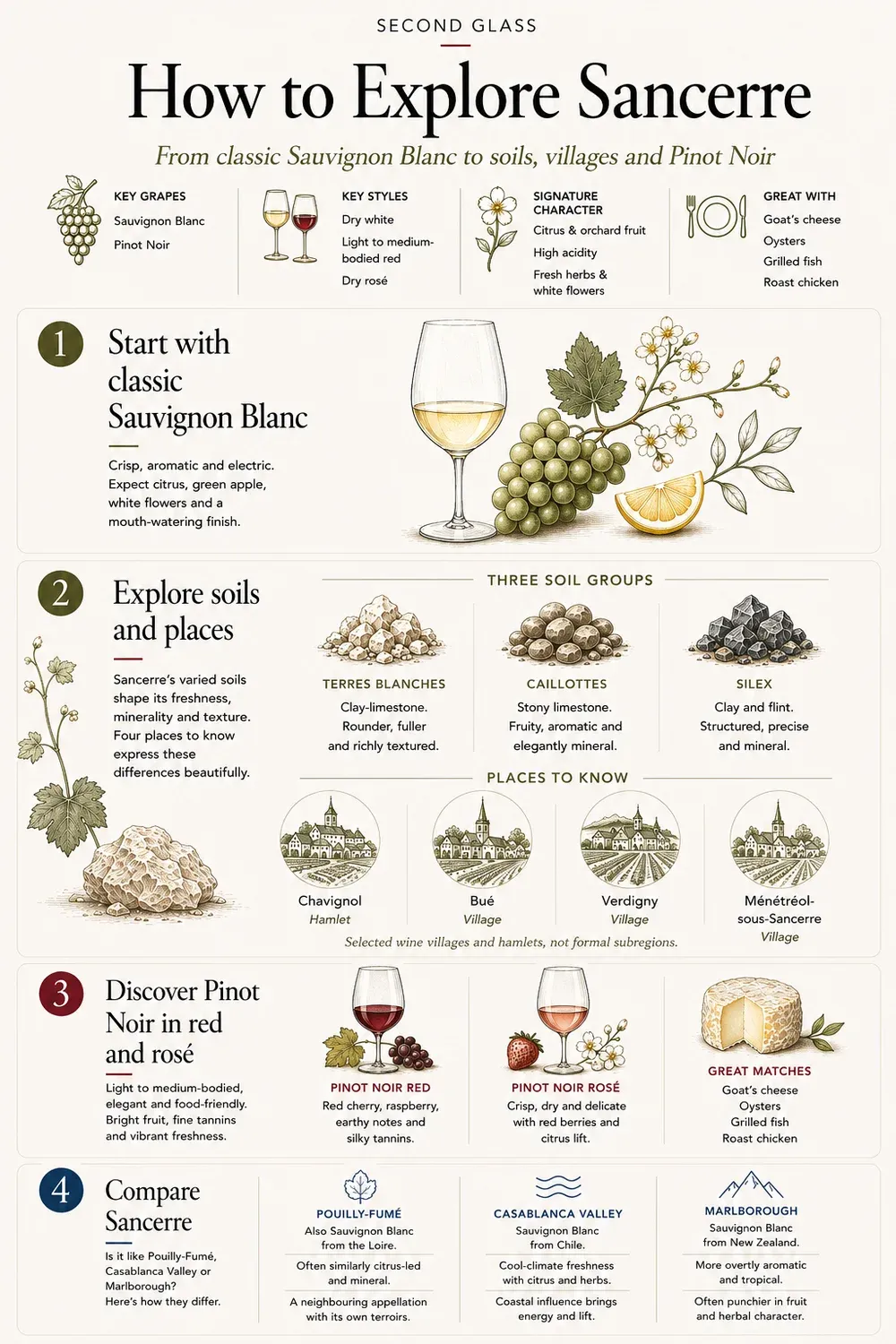
How To Start Exploring Sancerre
- Step 1 — Begin with a classic white Sancerre.
- Step 2 — Compare wines from different villages.
- Step 3 — Compare wines associated with limestone, clay and flint soils.
- Step 4 — Try Sancerre Rouge or Rosé.
- Step 5 — Explore vineyard-designated wines.
- Step 6 — Compare with other Loire and New World Sauvignon Blancs.
Common Misconceptions
Sancerre is widely known, but that familiarity has created a few persistent misunderstandings. Clearing them up makes it easier to understand what the region actually represents — and why its wines can be more diverse than expected.
“Sancerre is a grape variety”
Sancerre is not a grape. It is a protected wine appellation in the Loire Valley of France. White Sancerre is made from Sauvignon Blanc, while red and rosé Sancerre are made from Pinot Noir. The name on the bottle therefore identifies where the wine comes from rather than the grape variety itself.
“All Sancerre tastes the same”
Most Sancerre is Sauvignon Blanc, but that does not make the wines uniform. Differences in soil, slope, vineyard exposure, village, vintage and winemaking can produce noticeable variations in aroma, texture, concentration and ageing potential.
“Sancerre is always light and simple”
Many accessible Sancerres emphasise freshness, citrus fruit and early drinking, but the appellation can also produce more concentrated and structured wines. Differences in vineyard site, vine age, yields, vintage and approaches to fermentation and maturation can contribute to greater texture, complexity and capacity to develop in bottle.
“Sancerre is only Sauvignon Blanc”
Sauvignon Blanc dominates Sancerre and is responsible for its best-known white wines, but it is not the appellation's only grape. Pinot Noir is used to make Sancerre Rouge and Sancerre Rosé, offering a less familiar but established side of the region.
“Flinty or smoky notes come directly from flint in the soil”
Terms such as “flinty”, “stony” and “smoky” are tasting descriptors, not evidence that minerals from the soil have literally passed into the wine as flavour. Silex, or flint-rich, vineyards are traditionally associated with these sensory impressions in Sancerre, but the relationship between geology and perceived flavour is more complex than direct flavour transfer.
“Sancerre is the same as Pouilly-Fumé”
Sancerre and Pouilly-Fumé are separate appellations on opposite sides of the Loire. Both are strongly associated with dry Sauvignon Blanc, and some vineyard areas share related geological formations. However, their geology is not identical: each appellation has its own distribution of soils, vineyard exposures and producers, creating plenty of variation within and between the two regions.
“Sancerre is always best young”
Many Sancerres are made to showcase freshness and are enjoyable relatively young, but this is not true of every wine. Concentrated examples from strong sites and producers can develop additional texture and savoury, waxy, smoky or nutty complexity with bottle age.
“The name guarantees quality”
Sancerre AOC is a legally defined appellation with rules governing geographical origin, permitted grape varieties and aspects of wine production. Wines sold under the appellation are required to comply with those rules, but the Sancerre name is not a guarantee that every bottle will be of equal quality. Producer, vineyard site, vintage, yields and winemaking decisions can all influence the character and quality of the finished wine.
“Sancerre is just a modern export style”
Sancerre's international popularity is relatively modern, but winegrowing in the area has a much longer history. The region's present-day focus on Sauvignon Blanc was shaped in part by vineyard replanting following the phylloxera crisis of the late 19th century. Modern Sancerre therefore combines a long viticultural history with significant changes in grape growing, production and international demand.
Questions about Sancerre
What wine is Sancerre best known for?
Sancerre is best known for dry white Sauvignon Blanc with high acidity and citrus and orchard-fruit flavours. Many wines also show herbal, floral, chalky, stony or smoky impressions. The appellation produces smaller amounts of red and rosé wine from Pinot Noir.
Is Sancerre a dry wine?
Yes. White Sancerre is typically a dry wine made from Sauvignon Blanc, with high acidity and flavours of citrus, orchard fruit and fresh herbs. The appellation also produces dry red and rosé wines from Pinot Noir.
What grapes are used in Sancerre?
Sauvignon Blanc and Pinot Noir are the key grapes. Sauvignon Blanc dominates production and is used for white Sancerre, while Pinot Noir produces the appellation's red and rosé wines.
Is Sancerre always Sauvignon Blanc?
No. White Sancerre is made from Sauvignon Blanc, but Sancerre Rouge and Sancerre Rosé are made from Pinot Noir. White wine dominates production, which is why Sancerre is so closely associated with Sauvignon Blanc.
Does Sancerre improve with age?
Some Sancerre improves with age. Most straightforward whites are best enjoyed for their youthful freshness, while concentrated wines from strong sites and producers can gain savoury, waxy, smoky and nutty complexity over several years.
What food goes best with Sancerre?
Goat's cheese is the classic match, particularly Crottin de Chavignol. White Sancerre also suits oysters, shellfish, grilled fish, asparagus and herb-led dishes, while red Sancerre pairs well with roast chicken, mushrooms and charcuterie.
Is Sancerre good value?
Sancerre can offer excellent quality, but international demand means it is rarely inexpensive. Menetou-Salon, Quincy and some Sauvignon Blanc from Touraine can provide useful alternatives for drinkers seeking similar freshness at lower prices.
Is Sancerre the same as Pouilly-Fumé?
No. Sancerre and Pouilly-Fumé are separate Loire Valley appellations on opposite sides of the Loire. Both specialise in dry Sauvignon Blanc, but their individual vineyard sites, geology and producers create different expressions.
How should a beginner explore Sancerre?
Start with a classic white Sancerre, then compare wines from different villages or vineyard sites. Try a Sancerre Rouge to explore Pinot Noir, followed by comparisons with Pouilly-Fumé, Menetou-Salon and Marlborough Sauvignon Blanc.
Final Thoughts
Sancerre is not a single flavour but a landscape expressed through wine.
Sauvignon Blanc provides the familiar entry point, but the real interest lies in how place, soil and people shape that grape into many different expressions.
Next time you see Sancerre on a label, it is no longer just Sauvignon Blanc. It is a place—interpreted by a grower, through a particular vineyard, in a particular year.