Quick answer
What to know first
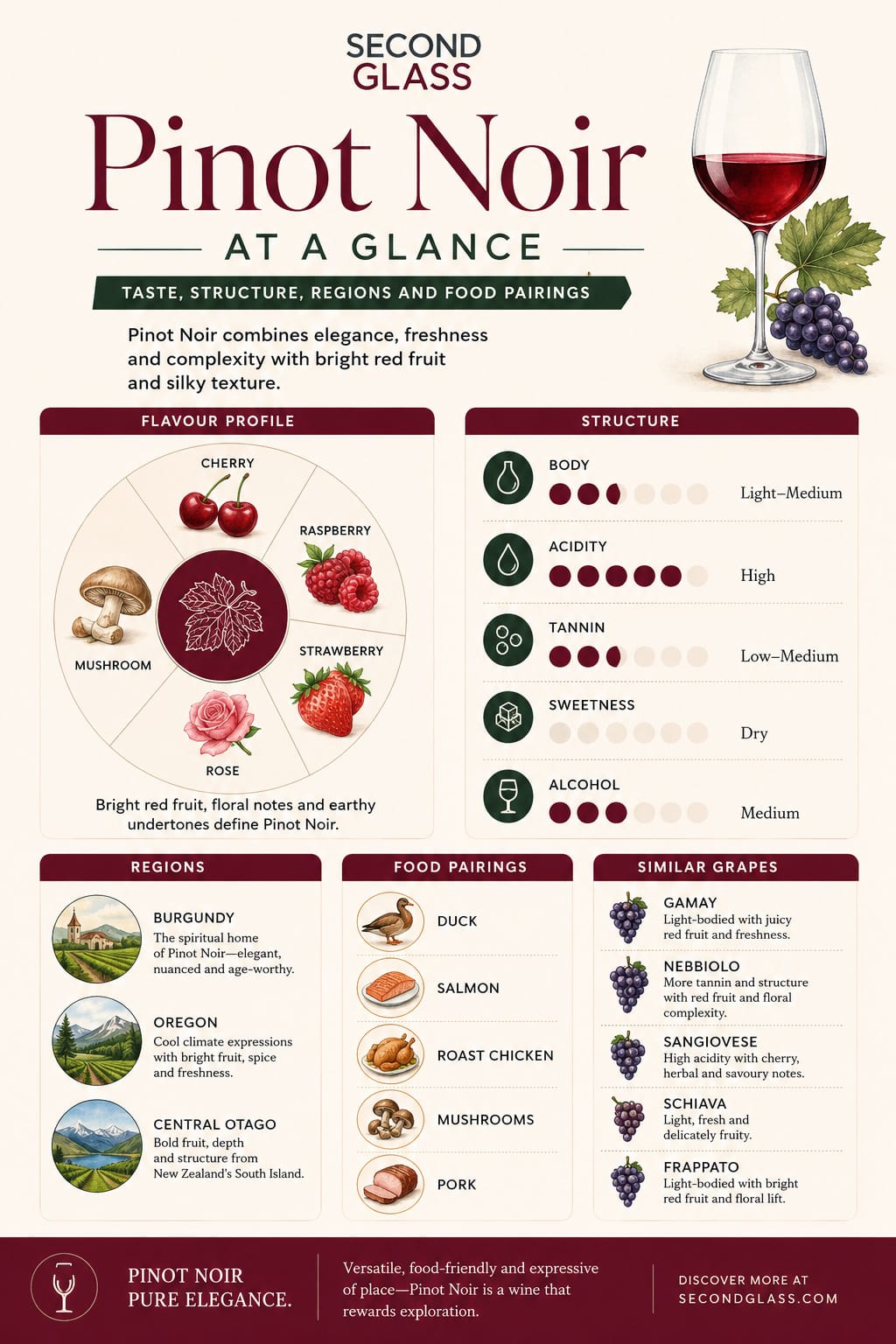
Pinot Noir is an elegant red grape that produces light- to medium-bodied wines with bright acidity, soft tannins and flavours of cherry, raspberry, strawberry, rose and earthy notes. Originally from Burgundy, it now excels in cool-climate regions worldwide.
How Pinot Noir usually feels
Key Takeaways
- One of the world's most respected red grapes.
- Produces elegant wines with high acidity and silky texture.
- Burgundy remains the benchmark region.
- Excels in cool to moderate climates.
- Often considered highly expressive of terroir.
- One of the most food-friendly red wines.
- Used in both still wines and Champagne.
- Top examples can age for decades.
What Is Pinot Noir?
Origins
Pinot Noir is one of the world's oldest cultivated grape varieties and has been grown in Burgundy for centuries.
Its name comes from:
- Pinot = pine cone
- Noir = black
A reference to its tightly packed grape clusters.
Why Wine Lovers Obsess Over Pinot Noir
Pinot Noir is often described by wine professionals as one of the grape varieties most capable of expressing terroir.
Small changes in:
- Soil
- Climate
- Elevation
- Exposure
- Winemaking
can dramatically influence the final wine.
Many enthusiasts value Pinot Noir for this sensitivity to place, although other varieties such as Riesling, Nebbiolo and Chenin Blanc are also frequently praised for their terroir expression.
Family Tree
Pinot Noir is the parent variety of:
- Pinot Gris
- Pinot Blanc
and is one of the most genetically important grape varieties in the world, having produced numerous natural mutations and contributing to the parentage of many other grape varieties.
What Does Pinot Noir Taste Like?
Primary Fruit Flavours
Most Pinot Noir displays:
- Cherry
- Raspberry
- Wild strawberry
- Cranberry
- Redcurrant
Riper examples may show:
- Black cherry
- Plum
- Damson
Floral Notes
Common aromas include:
- Rose petal
- Dried flowers
Earthy Characteristics
One of Pinot Noir's defining traits.
Depending on region and age:
- Forest floor
- Mushroom
- Truffle
- Autumn leaves
- Damp earth
Spice and Savoury Notes
- Clove
- Cinnamon
- Tea leaf
- Dried herbs
- Subtle savoury spice
Why Does Pinot Noir Taste Like This?
Thin Skins
Pinot Noir naturally has thin skins, leading to:
- Pale colour
- Softer tannins
- Delicate texture
High Acidity
Its naturally high acidity creates:
- Freshness
- Energy
- Food-friendliness
Climate
Cool Climate Pinot Noir
Typical flavours:
- Cranberry
- Raspberry
- Red cherry
- Rose petal
Examples:
- Burgundy
- Germany
- England
Moderate Climate Pinot Noir
Typical flavours:
- Cherry
- Black cherry
- Plum
Examples:
- Tasmania
- Warmer sites within generally cool regions such as Oregon and Sonoma Coast
Note: Regions like Oregon and Sonoma Coast are predominantly cool climate overall, but certain vineyard sites and warmer vintages can produce more moderate-climate expressions.
Winemaking
Key stylistic decisions include:
- Whole-cluster fermentation
- Native yeasts
- Oak ageing
- Extraction levels
- Lees ageing
How Pinot Noir Changes With Age
Young Pinot Noir
- Fresh cherry
- Raspberry
- Floral notes
Mature Pinot Noir
- Mushroom
- Truffle
- Forest floor
- Dried flowers
- Game
Oak Influence
Oak may contribute:
- Vanilla
- Baking spice
- Toast
- Smoke
Well-made Pinot Noir integrates oak rather than showcasing it.
Ageing Potential
| Style | Potential |
| Everyday Pinot Noir | 3–5 years |
| Quality Regional Wines | 5–10 years |
| Top Producers | 15–30+ years |
Most everyday Pinot Noir is best enjoyed within a few years of release, when its fresh fruit and vibrant acidity are at their peak. However, high-quality examples from regions such as Burgundy, Oregon, Germany, New Zealand and select California producers can age for decades, developing complex aromas of earth, spice and savoury notes over time.
Is Pinot Noir Dry?
Yes.
Almost all still Pinot Noir wines are dry.
The fruity aromas can sometimes create an impression of sweetness, but residual sugar is typically very low.
Where Is Pinot Noir Grown?
Burgundy, France
The benchmark.
Typical notes: Cherry, Rose, Earth, Truffle
Style: Elegant, Structured, Complex, Ageworthy
Champagne, France
Pinot Noir is one of Champagne's three principal grapes.
Typical notes: Strawberry, Red apple, Brioche, Citrus
Produces: Blanc de Noirs, Rosé Champagne, Vintage Champagne
Oregon, USA
Typical notes: Cherry, Cranberry, Forest floor
Known for: Balance, Freshness, Precision
Central Otago, New Zealand
Typical notes: Black cherry, Plum, Spice
Known for: Concentration, Vibrancy
Sonoma Coast, California
Typical notes: Dark cherry, Raspberry, Baking spice
Known for: Richness, Fruit intensity
Note: Sonoma Coast is a large and diverse region, with some vineyard sites producing distinctly cool-climate Pinot Noir styles.
Germany (Spätburgunder)
Typical notes: Cherry, Spice, Earth
Known for: Precision, Elegance, Strong value relative to Burgundy
While top German Spätburgunder can be expensive, many examples still offer excellent value compared with similarly regarded Burgundy.
Famous Pinot Noir Appellations
If you're shopping for Pinot Noir, these names are worth knowing:
Burgundy
- Gevrey-Chambertin
- Chambolle-Musigny
- Volnay
- Pommard
- Vosne-Romanée
- Nuits-Saint-Georges
Outside Burgundy
- Willamette Valley, Oregon, USA
- Sonoma Coast, California, USA
- Russian River Valley, California, USA
- Central Otago, South Island, New Zealand
- Ahr Valley, North Rhine-Westphalia, Germany
Pinot Noir in Sparkling
Many drinkers don't realise that Pinot Noir is also one of the world's most important sparkling wine grapes. While it’s best known for still red wines, Pinot Noir plays a crucial structural role in many of the world’s finest sparkling wines, especially in traditional method styles like Champagne. Its relatively thin skins and early ripening nature make it well-suited to cooler climates, where it can retain the high acidity needed for fresh, age-worthy sparkling wines.
In sparkling production, Pinot Noir is often pressed gently to extract minimal colour, allowing winemakers to create white sparkling wines from red grapes (known as Blanc de Noirs). It contributes body, depth, and subtle red fruit character, balancing the brightness and finesse of Chardonnay when the two are blended together. Additional flavours such as brioche, toast and nutty notes typically develop from yeast autolysis and bottle ageing rather than from the grape itself.
Typical Flavours
- Strawberry, Red apple, Citrus
- Raspberry, Cherry, Lemon zest
- Brioche, Toast, Almond, Hazelnut, Cream (from ageing and lees contact)
Key Styles
- Blanc de Noirs (100% Pinot Noir, often richer and more structured)
- Rosé Champagne (made by blending red Pinot Noir or through skin contact)
- Vintage Champagne (often includes a significant proportion of Pinot Noir for structure and ageing potential)
- Non-Vintage Champagne blends (Pinot Noir adds body and consistency year to year)
Major Regions
- Champagne (France) – the benchmark region, especially in Montagne de Reims and Aube
- England – increasingly known for high-quality sparkling wines using Pinot Noir
- Tasmania – cool climate produces elegant, finely structured sparkling wines
- California (Carneros, Anderson Valley) – fruit-forward styles with balanced acidity
What to eat with Pinot Noir
Perfect matches
Poultry
- Roast chicken
- Duck breast
- Turkey
Fish
- Salmon
- Tuna steak
Vegetables
- Mushroom risotto
- Truffle dishes
- Lentils
Pork
- Pork loin
- Pork belly
Fine dining pairings
- Beef Wellington
- Game birds
- Morel mushrooms
- Truffle-based dishes
Pairings to avoid
- Very spicy curries
- Sweet barbecue sauces
- Powerful blue cheeses
Similar grapes to try
| Grape | Similar | Difference |
|---|---|---|
| Gamay | Light body, bright acidity, and red berry fruit. | Usually juicier, more youthful, and less earthy. |
| Nebbiolo | Aromatic complexity and strong expression of place. | Much firmer tannins, higher structure, and more savoury flavours. |
| Sangiovese | Fresh acidity and food-friendly character. | More savoury, firmer in structure, and often shows tomato and dried herb notes. |
| Frappato | Perfumed aromas, bright red fruit, and elegance. | Typically more floral and Mediterranean in character. |
| Schiava | Delicate body, freshness, and subtle red fruit. | Usually paler, lighter, and often shows almond and spice notes. |
| Nerello Mascalese | Transparency to terroir, freshness, and earthy complexity. | More mineral, volcanic, and generally firmer in tannin. |
| Mencía | Red fruit, floral notes, and vibrant acidity. | Usually more herbal, mineral, and slightly darker-fruited. |
Buying Guide
Under £15 ($15–$20)
At this entry level, focus on regions that offer reliable value and approachable styles. Germany (especially basic Spätburgunder), Chile, and Southern France (such as Languedoc or Pays d’Oc) are your best bets. Expect lighter-bodied wines with simple red fruit flavors like cherry and raspberry, moderate acidity, and minimal oak influence. These wines are ideal for casual drinking but may lack complexity and aging potential.
£15–£30 ($20–$40)
This is the sweet spot for quality-to-price ratio. Look for Oregon (particularly entry-level Willamette Valley bottlings), New Zealand (especially Marlborough and Central Otago), and better German producers. Wines in this range typically show more structure, brighter acidity, and greater depth of flavor, including notes of red berries, spice, and subtle earthiness. You may also start to see some oak integration and more refined tannins.
£30–£60 ($40–$75)
Here you begin to access serious Pinot Noir with clear regional character. Look for village-level Burgundy, top Oregon producers, and premium New Zealand Pinot Noir. These wines offer greater complexity, including layered fruit, floral notes, and savory elements like mushroom or forest floor. Expect better balance, longer finishes, and the potential for short- to medium-term aging.
£60+ ($75+)
At this level, you’re entering the world of fine wine. Look for Premier Cru Burgundy, leading German Spätburgunder, and top producers from Oregon and California (especially Sonoma Coast and Santa Barbara). These wines deliver exceptional depth, precision, and nuance, with evolving aromas of red and dark fruit, spice, earth, and mineral notes. They often have excellent aging potential, developing complexity over 10–20 years or more depending on the producer and vintage.
Common Misconceptions
Pinot Noir Is Always Light
While Pinot Noir is typically light- to medium-bodied, some examples from warmer climates or low-yielding vineyards can be surprisingly concentrated and powerful.
Pinot Noir Cannot Age
High-quality Pinot Noir from top producers can develop remarkable complexity over decades, revealing earthy, savoury and floral characteristics.
Burgundy and Pinot Noir Are Different
Most red Burgundy is made from Pinot Noir, although the region is divided into many appellations with distinct styles.
Pinot Noir Is Sweet
Despite its ripe fruit flavours, almost all still Pinot Noir is fermented dry.
Pinot Noir Must Be Expensive
Burgundy's finest wines command high prices, but excellent value can be found in regions such as Germany, Chile, Oregon and New Zealand. Within Burgundy itself, many Bourgogne Rouge wines offer an affordable introduction to Pinot Noir, showcasing its youthful character without Premier Cru or Grand Cru prices.
FAQs
Is Pinot Noir red or white?
Pinot Noir is a red grape variety used to make red wine. However, it can also be used to produce white wines, such as Blanc de Noirs Champagne, where the juice is pressed off the skins quickly to avoid extracting colour.
Is Pinot Noir a dry wine?
Yes. Almost all still Pinot Noir is fermented dry, with very little residual sugar. Its bright fruit flavours can sometimes create the impression of sweetness.
Is Pinot Noir lighter than Cabernet Sauvignon?
Yes. Pinot Noir is generally lighter in body, lower in tannins and more delicate in texture than Cabernet Sauvignon.
What temperature should Pinot Noir be served at?
Serve most Pinot Noir between 14–16°C. Serving it slightly cooler than room temperature helps preserve its freshness and aromatic complexity.
Does Pinot Noir use oak?
Many producers mature Pinot Noir in oak barrels, but the amount of new oak varies by producer and region. The best examples use oak to add texture and complexity without masking the fruit or expression of terroir.
Is Pinot Noir used in Champagne?
Yes. Pinot Noir is one of the three principal grape varieties used in Champagne, contributing body, structure and red fruit character to both blends and Blanc de Noirs wines.
Why is Pinot Noir so expensive?
Pinot Noir is difficult to grow, produces relatively low yields and is especially sensitive to climate and vineyard conditions. Combined with strong demand—particularly for Burgundy—this often results in higher prices than many other red wines.
Can you chill Pinot Noir?
Yes. Pinot Noir is often at its best served lightly chilled, around 14–16°C, especially young, fruit-forward styles. A short spell in the fridge before serving can enhance freshness and highlight its aromas.
If you are new to Pinot Noir
If you're new to Pinot Noir, focus on the style rather than the prestige.
Pinot Noir is often described as elegant rather than powerful. If you're used to fuller-bodied reds such as Cabernet Sauvignon, Malbec or Shiraz, expect a lighter colour, softer tannins and brighter acidity.
A good place to start is with Pinot Noir from Oregon, New Zealand or Germany, where the grape's red-fruit character and freshness are usually easy to recognise. Look for flavours such as cherry, raspberry and strawberry, and pay attention to the wine's silky texture.
When serving Pinot Noir, try it slightly cooler than most red wines, around 14-16°C, and pair it with simple dishes such as roast chicken, salmon or mushroom risotto. These combinations highlight why Pinot Noir is considered one of the most food-friendly wines in the world.
Most importantly, don't worry about identifying every aroma or flavour. Start by asking yourself three simple questions:
- Is the wine more fruity or earthy?
- Does it feel light or full-bodied?
- Would you want another glass?
Those answers will tell you far more about your preferences than any tasting note.
Final Thoughts
Pinot Noir remains one of the wine world's most fascinating grapes. Its combination of elegance, freshness, aromatic complexity and ability to express terroir makes it a favourite among both beginners and seasoned enthusiasts. Whether you're exploring your first bottle or hunting for great Burgundy, Pinot Noir offers a lifetime of discovery.