
Quick answer
What to know first
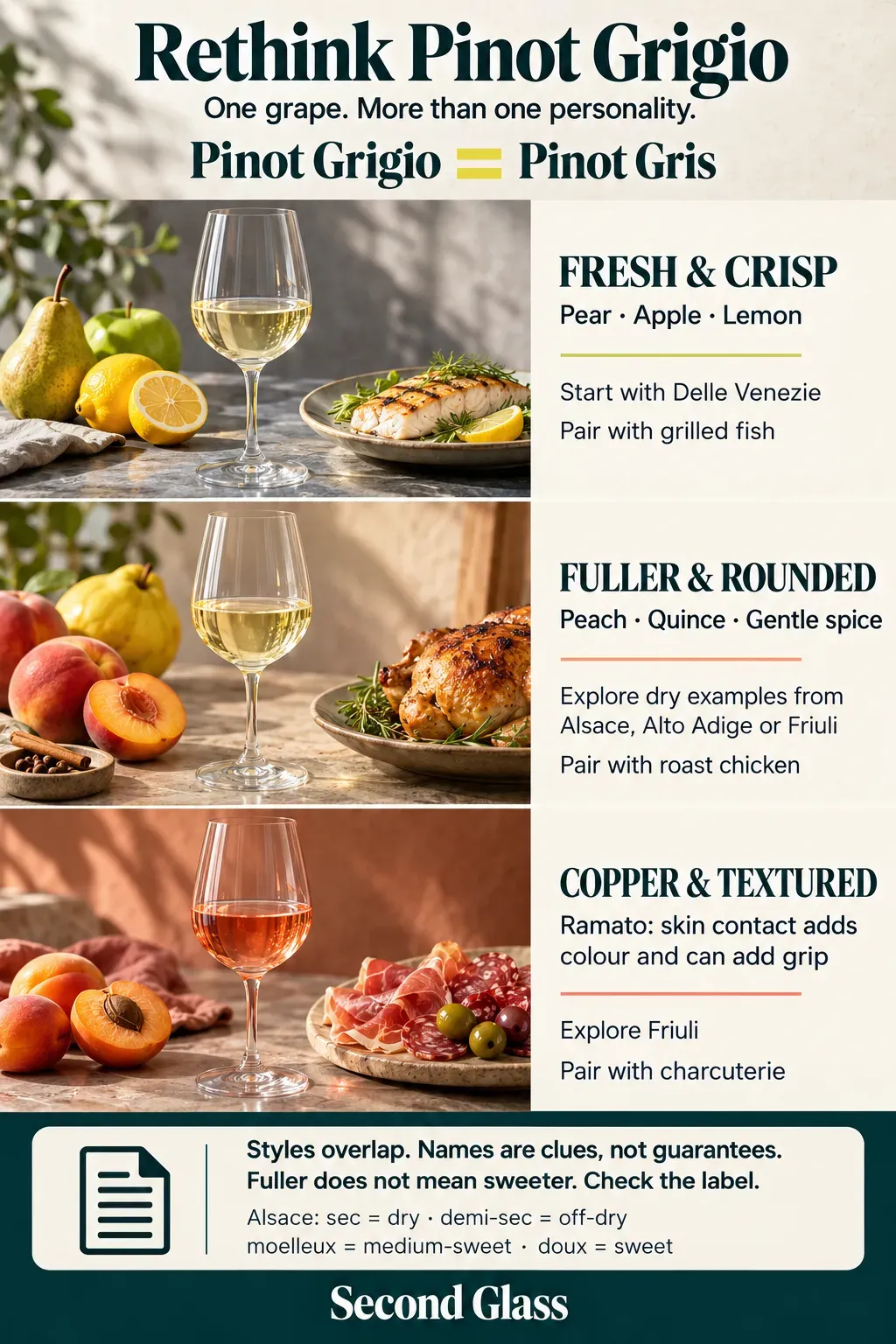
Pinot Grigio, also called Pinot Gris, makes whites ranging from crisp pear-and-citrus styles to rich, spiced wines. Northern Italy and Alsace are famous sources, offering refreshing everyday bottles and textured wines for food.
Introduction
Pinot Grigio is often the first white wine people feel comfortable ordering: familiar, refreshing and easy to enjoy with dinner. But that everyday reputation tells only part of its story.
The same grape can produce a delicate Italian white, a generous Alsace Pinot Gris or a copper-coloured wine with a gently grippy texture. Understanding those differences makes choosing a bottle much easier.
This guide explores what Pinot Grigio tastes like, where to find its different styles and how to match them with food.
How Pinot Grigio usually feels
- Flavour notes
- Pear, Apple, Lemon, Peach and quince in riper styles, Ginger and gentle spice in fuller styles and Nutty, waxy or honeyed notes in some concentrated or mature wines
Key Takeaways
- Pinot Grigio and Pinot Gris are the same grape. The names often suggest different styles, but do not guarantee them.
- Northern Italy is a useful starting point for fresh, dry wines. Alto Adige, Trentino and Friuli also offer substantial, textured examples.
- Alsace Pinot Gris is often fuller-bodied, with ripe fruit and spice. Check whether the wine is sec, demi-sec, moelleux or doux, or use the label’s sweetness scale, rather than assuming it is dry.
- The grapes have pinkish-grey skins. Contact with those skins can produce copper-coloured ramato wines.
- Match the wine’s weight to the food. Light bottles suit delicate seafood; richer versions work with roast poultry, mushrooms and creamy dishes.
- Most everyday bottles are best enjoyed young. Selected concentrated wines can develop well in the cellar.
What Is Pinot Grigio?
Pinot Grigio is the Italian name for Pinot Gris, a grape associated with Burgundy and originating as a colour mutation of Pinot Noir. Its berries can have greyish-pink, purple or brownish tones, despite its usual classification as a white-wine grape. Both grigio and gris mean “grey”.
The variety spread beyond France and became particularly important in northern Italy, Alsace and Germany. In Germany, you will usually encounter it as Grauburgunder, with Ruländer another recognised name.
Today, Pinot Grigio has two overlapping identities: an accessible, fresh white wine and a grape capable of making much more substantial wines. The country, vineyard and producer’s approach tell you more than the name alone.
What Does Pinot Grigio Taste Like?
Fresh, Crisp Styles
Fresh Italian styles commonly suggest pear, apple and lemon. Their appeal often lies in a clean, refreshing palate rather than an especially powerful aroma.
Cooler sites and earlier picking tend to preserve acidity and lighter body. Stainless-steel fermentation usually supports this clean, fruit-focused style.
Fuller, Riper Styles
Riper examples can move towards peach, quince and broader orchard-fruit flavours. Concentrated Pinot Gris may show dried apricot, baked fruit, ginger or gentle spice.
These wines can feel broad, rounded or slightly oily, even when dry. Lees are the yeast cells or sediment left after fermentation; ageing a wine on fine lees can add breadth and a softer, more rounded mouthfeel. Lees ageing, barrel fermentation or maturation in wood can add texture and complexity without necessarily making the wine taste strongly oaky. A smoky impression, particularly in some Alsace examples, does not automatically prove oak ageing.
Ramato and Skin-Contact Styles
Pinot Grigio’s greyish-pink skins contain colour and compounds that can contribute texture. Prompt pressing produces a pale white wine, while skin contact can create copper or pink shades and a gently drying grip.
This approach is associated with ramato, a copper-coloured style particularly linked with Friuli. The result can range from delicate to structured, depending on the length and method of skin contact.
Sweetness and Ageing Flavours
Pinot Grigio and Pinot Gris can be dry, off-dry or sweet. Ripe fruit, noble rot and bottle development may all contribute honeyed aromas, so honey notes alone do not prove that a wine is sweet or old.
As suitable wines mature, fresh fruit may give way to nutty, waxy, savoury or honeyed impressions. These changes are most likely in concentrated wines with enough acidity and structure to develop.
How Winemaking Shapes the Style
When grapes are picked, how long the juice remains with the skins and how the wine is matured all influence the finished bottle.
Earlier harvesting generally preserves more acidity and limits potential alcohol. Riper grapes can produce more generous fruit and fuller wines; retaining some grape sugar adds sweetness, but ripeness itself does not guarantee a sweet finish.
Oak can contribute toast, vanilla or spice when new barrels are used. Older barrels may mainly affect texture and allow gradual oxygen exposure. Ageing on fine lees can add breadth and a softer, more rounded mouthfeel, helping a dry wine feel substantial without strong oak flavours or residual sweetness.
Bottle Ageing and Ageing Potential
Fresh, straightforward Pinot Grigio usually offers its greatest pleasure when young. Drink most everyday bottles within roughly one to three years of the vintage, as extended storage may reduce the crisp fruit that made them appealing.
More substantial dry examples may reward several years, while selected Alsace wines, including concentrated sweet styles, can last considerably longer. Price and the name “Pinot Gris” alone do not establish ageing potential; follow advice for the specific bottle before committing to long storage.
How to serve Pinot Grigio
White
Pinot Grigio
7–10°C 45–50°F
Serve chilled to keep its light citrus and pear character fresh. Let a very cold glass warm slightly if the aromas seem muted.
White
Pinot Gris
8–11°C 46–52°F
Serve chilled; richer Pinot Gris can warm slightly, while lighter Pinot Grigio is best nearer the lower end.
Orange
Ramato Pinot Grigio
8–12°C 46–54°F
Serve cool to keep its copper-skinned freshness lively. Let the glass warm slightly to reveal more perfume and gentle texture.
White
Textured Pinot Grigio
8–11°C 46–52°F
Serve cool rather than ice-cold so its texture and fruit remain apparent. Let a very cold glass warm slightly before drinking.
Where Is Pinot Grigio Grown?
Classic Regions
Northern Italy
Delle Venezie DOC covers Veneto, Friuli-Venezia Giulia and the province of Trento. It is a major source of fresh, approachable Pinot Grigio, often with pear, apple and citrus flavours. Its broad geography means there is considerable variation between bottles.
Alto Adige combines sunny growing conditions with Alpine influences. Wines can range from delicate and fresh to fuller examples with ripe apple, pear and quince. Trentino also offers both accessible and more substantial styles.
Friuli-Venezia Giulia is particularly worth exploring for texture and savoury detail. Alongside pale whites, look for ramato, a copper-coloured style made through contact with the grape skins.
Alsace, France
Alsace’s relatively dry, sunny growing conditions can support ripe Pinot Gris with a fuller body, ripe orchard fruit and gentle spice. These wines may feel broader than everyday Italian Pinot Grigio.
Alsace Pinot Gris can range from dry to sweet. For a practical guide, sec indicates a dry style, demi-sec means off-dry, moelleux indicates a medium-sweet style, and doux indicates a sweet style. If those terms are not shown, use the label’s sweetness scale or the retailer’s description, especially when pairing the wine with a savoury meal.
Germany
Look for Grauburgunder, particularly from Baden, Pfalz and Rheinhessen. Depending on site and winemaking, wines can combine pear-like fruit with rounded texture and a fresh finish.
Dry examples are common, but richer and sweet styles also exist. The word trocken is a useful indication that a German wine is dry.
New World Regions
Oregon, United States
Oregon Pinot Gris, notably from the Willamette Valley, can combine citrus and floral character with a rounded palate. The region produces both lighter wines and substantial examples with ageing potential.
New Zealand
New Zealand Pinot Gris often emphasises pear, apple, stone fruit and gentle spice. Cooler South Island regions can produce more tightly structured wines, while warmer North Island sites may yield broader, riper expressions.
Dryness varies, and some wines retain a little sweetness. Lees work and barrel fermentation can add texture.
Australia
Australia makes both crisp Pinot Grigio and richer Pinot Gris, with plenty of overlap. King Valley is worth exploring for fresh pear-and-citrus styles, while Mornington Peninsula offers cool-climate examples that can have greater texture.
The name is a clue to the intended style, rather than a regulated promise.
Pinot Grigio Labels and Styles to Look For
| Wine or label to explore | What to expect |
|---|---|
| Pinot Grigio delle Venezie DOC | Commonly fresh, accessible white wine; other styles also exist |
| Alto Adige / Südtirol Pinot Grigio | Styles ranging from fresh orchard fruit to substantial, textured whites |
| Friuli Collio or Friuli Colli Orientali Pinot Grigio | Often a useful direction for fuller dry wines |
| Pinot Grigio Ramato | Copper-coloured skin-contact wine, with texture varying by method |
| Alsace Pinot Gris | Dry to sweet wines, frequently with generous body |
| Alsace Grand Cru Pinot Gris | Vineyard-specific wines that may offer greater concentration; check sweetness |
| Alsace Pinot Gris Vendanges Tardives or Sélection de Grains Nobles | Late-harvest / selected noble-rot wines; check the bottle’s sweetness |
| German Grauburgunder | Often dry, rounded white wines with orchard-fruit character |
These names identify origins or styles, rather than guaranteeing a particular flavour or quality level.
Sparkling Wines Made From Pinot Grigio
Sparkling Pinot Grigio exists, although it is much less familiar than the still wine. Delle Venezie DOC includes spumante, meaning sparkling, and copper-coloured sparkling examples are also possible.
Tank-method examples undergo their second fermentation in a pressurised tank, preserving a fresh, fruit-led character. Expect orchard fruit, possible floral notes and the extra lift of bubbles; do not assume the toasty complexity associated with long bottle ageing.
Check the sweetness terminology carefully. Extra Dry sparkling wine is sweeter than Brut, despite how the words sound. Sparkling Pinot Grigio is also distinct from Prosecco, whose principal grape is Glera.
Match the dish to the style
Ideal pairings
- Grilled fish with lemon — fresh, dry Pinot Grigio
- Prawns or seafood pasta — lighter styles
- Roast chicken — fuller dry Pinot Grigio or Pinot Gris
- Mushroom risotto — textured Pinot Gris
- Roast pork with apple — generous Pinot Gris
- Moderately spiced dishes — off-dry Pinot Gris
Light bottles complement delicate seafood without dominating it. Fuller dry examples have enough weight for roast poultry, creamy dishes and mushrooms. Off-dry Pinot Gris can work with moderate spice, especially when alcohol and chilli heat are kept in balance.
Everyday pairings
- Vegetable pasta
- Chicken salad
- Simple fish supper
- Creamy pasta with fuller dry styles
- Roast vegetables
- Mild cheese tart
- Charcuterie or savoury vegetable dishes with ramato
Choose a crisp bottle for lighter meals and a fuller dry example for richer dishes. Ramato can contribute a gently grippy texture alongside charcuterie or savoury vegetables.
Pairings to approach carefully
Delicate Pinot Grigio may disappear beside heavily charred steak or powerful blue cheese. Dry, high-alcohol examples can intensify chilli heat, while sweet desserts can make dry wine seem sharper and less fruity. A concentrated sweet Pinot Gris is a different proposition; sauce, seasoning and the particular wine matter as much as the main ingredient.
Six grapes to explore next
| Entity | Shared thread | How it differs |
|---|---|---|
| Pinot Blanc | Often offers gentle orchard fruit and a rounded palate. | Usually a subtler alternative to rich, spicy Pinot Gris. |
| Chardonnay | Can range from fresh and light to full and textured. | Oak and buttery flavours are more prominent in many familiar styles. |
| Grüner Veltliner | Offers refreshing dry wines that work well with food. | Often has a more peppery or herbal character. |
| Vermentino | Combines citrus freshness with a food-friendly savoury edge. | Can have more noticeable herbal notes and a gently bitter finish. |
| Albariño | A useful alternative for refreshing seafood-friendly whites. | Often has more pronounced acidity and aromatic lift. |
| Chenin Blanc | Makes dry, off-dry and sweet wines with orchard-fruit flavours. | Usually offers firmer acidity, with notable ageing potential in selected styles. |
Buying Guide
The following are approximate retail bands for 750 ml bottles in the UK and US, rather than currency conversions. Local taxes, availability and promotions affect prices.
Budget
Around £7–£12 / $10–$17
Look for a recent-vintage Pinot Grigio from Delle Venezie or another clear northern Italian origin. Expect clean pear, apple or citrus flavours and a straightforward, young-drinking style suited to casual meals.
Mid-Range
Around £12–£25 / $17–$30
This is a useful range for exploring Alto Adige, Friuli, Oregon and New Zealand. Bottles may offer more texture, definition or persistence, with lees ageing, riper fruit or barrel work contributing to the style.
Premium
Around £25–£60+ / $30–$80+
Explore vineyard-specific Italian wines, ambitious ramato and concentrated Alsace Pinot Gris. At this level, look for a distinctive origin, greater detail or a deliberate dry, off-dry or sweet style rather than simply more alcohol or oak.
Beginner Guidance
Start with a dry Alto Adige Pinot Grigio if you want a clear introduction with fresh fruit and enough texture to make it interesting. Look for pear, apple and citrus in the description, rather than assuming every bottle will be light. If you prefer broader wines, try an Alsace Pinot Gris clearly labelled dry. Serve your first bottle around 10–12°C, then let it warm slightly in the glass so you can notice how its aromas and texture change. Choose grilled fish for a lighter style or roast chicken for a fuller one, making the wine easier to understand alongside food.
How To Experiment
- Step 1 — Pour a fresh Pinot Grigio delle Venezie beside a dry Alsace Pinot Gris, using similar glasses at similar temperatures.
- Step 2 — Smell both before tasting, noting whether the fruit seems citrus-led, pear-like or more ripe and spiced.
- Step 3 — Compare acidity, body and length, separating fruitiness from actual sweetness.
- Step 4 — Taste both with a plain piece of bread, then with roast chicken or a mild cheese.
- Step 5 — Add a ramato on another occasion to explore what skin contact changes: colour, texture and any drying grip.
Common Misconceptions
- “Pinot Grigio and Pinot Gris are different grapes.” They are Italian and French names for the same variety.
- “Pinot Grigio is always light and simple.” Some Italian examples are substantial, complex and capable of developing with age.
- “Pinot Gris is always sweet.” It can be dry, off-dry or sweet; consult the label or wine description.
- “White wine must come from green-skinned grapes.” Pinot Grigio’s coloured skins usually contribute little colour when the juice is pressed away from them promptly.
- “Copper-coloured Pinot Grigio must be faulty.” Ramato gets its intended colour from skin contact; colour alone is not a sign of oxidation.
Questions about Savagnin
Is Savagnin the same as Sauvignon Blanc?
No. They are distinct but genetically related varieties: Savagnin is one of Sauvignon Blanc’s parent varieties.
What are Heida and Païen?
They are local names for Savagnin in Switzerland’s Valais. Heida is used particularly in the Upper Valais, while Païen is common in the French-speaking Lower Valais.
Which Savagnin style should a beginner try?
Start with a fresh/ouillé wine for citrus, orchard fruit and lively acidity. Try sous-voile or Vin Jaune if you enjoy nutty, savoury flavours.
Is Vin Jaune fortified?
No. Vin Jaune is a dry, unfortified wine made from Savagnin and aged in barrels under a natural yeast veil.
What does the yeast veil do?
It helps protect the wine from direct oxidation while also transforming it during ageing and developing distinctive savoury aromas.
Are all Arbois, Côtes du Jura and L’Étoile whites made from Savagnin?
No. These appellations make whites from different permitted grapes and blends. The appellation name alone does not identify the grape.
Can Savagnin be used in sparkling wine?
Yes. Savagnin is one of the permitted grapes for Crémant du Jura and can be used as a blending component. Not every Crémant du Jura includes it.
Is Savagnin always dry?
No. Most Savagnin wines are dry, but it may also be used in Vin de Paille, a sweet Jura wine made from dried grapes.
Final Thoughts
Pinot Grigio becomes more interesting once you look beyond the familiar name. Start with the style you want—fresh, rounded or skin-contact—then use origin, sweetness information and winemaking details to choose.
A crisp Italian white and a dry Alsace Pinot Gris tasted side by side are a rewarding first step: one grape, with plenty of room to explore.