
Quick answer
What to know first
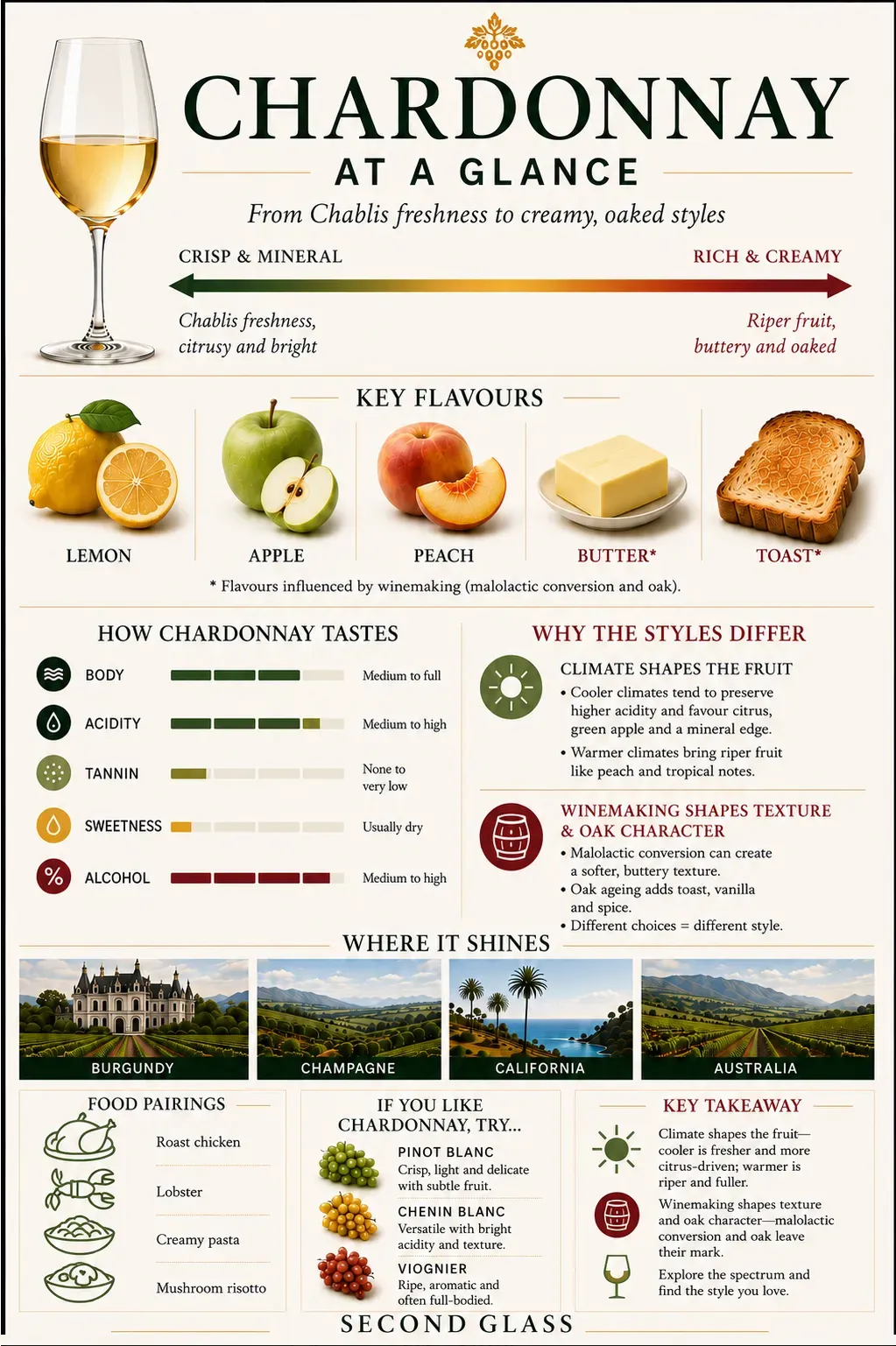
Chardonnay is a white grape known for apple, citrus and peach flavours. Depending on winemaking choices, it can also show buttery notes and vanilla. It is famous in Burgundy, Champagne, California and Australia, and is loved for its range from crisp and refreshing to rich and creamy.
How Chardonnay usually feels
Key Takeaways
- Chardonnay is one of the world's most widely planted and adaptable white grapes.
- It can taste crisp, lean and fresh or rich, creamy and oaky.
- Burgundy, especially Chablis, Côte de Beaune and Mâconnais, is its classic home.
- Champagne often uses Chardonnay for elegant sparkling wines.
- Oak ageing can add vanilla, toast and spice, while malolactic conversion can contribute buttery notes and creaminess.
- Unoaked Chardonnay is usually fresher, with citrus, apple and restrained fruit flavours.
- It pairs well with roast chicken, creamy sauces, seafood, mushrooms and soft cheeses.
What Is Chardonnay?
Chardonnay is a white grape variety originally associated with Burgundy in eastern France. It is now grown across the wine world because it adapts well to different climates, soils and winemaking choices.
Its great strength is flexibility. In Chablis, Chardonnay can be sharp, citrus-led and often gives impressions that wine drinkers describe as chalky or mineral. In the Côte de Beaune, it can become layered, nutty and complex. In warmer regions such as California or parts of Australia, it often shows riper peach, melon and tropical fruit.
Chardonnay is also one of the key grapes of Champagne, where it brings freshness, elegance and citrus lift to sparkling wine.
What Does Chardonnay Taste Like?
Fruit Flavours
Cool-climate Chardonnay often tastes of lemon, green apple, pear and grapefruit. Warmer-climate Chardonnay can show peach, melon, pineapple and mango.
Floral Notes
Chardonnay is not usually a highly floral grape. In some cooler or delicate styles, you may find light blossom or white flower notes, but fruit, texture and winemaking character are usually more prominent.
Herbal and Spice Notes
Unoaked Chardonnay can show subtle herbal freshness. Oaked examples may develop vanilla, clove, nutmeg, toast and gentle smoke.
Ageing Characteristics
With age, good Chardonnay can develop hazelnut, almond, honey, toast, baked apple and savoury complexity. The best examples retain freshness as they mature.
Climate Influence
As a general pattern, cooler climates give Chardonnay more acidity and citrus-driven flavours, while warmer climates often produce fuller-bodied wines with riper fruit. However, site, elevation and winemaking choices can influence the final style significantly.
Why Does It Taste Like This?
Chardonnay is often described as a "blank canvas", but that does not mean it lacks character. Instead, the grape clearly expresses both its growing conditions and the decisions made in the winery.
In cool climates, the grapes ripen slowly. This usually preserves acidity and gives flavours of lemon, apple and pear. In warmer climates, the grapes generally ripen more fully, creating peach, melon and tropical notes.
Chardonnay has relatively neutral aromatics compared with grapes such as Riesling or Sauvignon Blanc. This allows winemaking choices to shape the final style more noticeably than in some highly aromatic varieties.
Oak barrels can add vanilla, toast and spice. Malolactic conversion, in which sharper malic acid is converted into softer lactic acid, can create a creamier texture and the buttery character that some Chardonnay drinkers enjoy. Lees ageing can add richness, bread dough and nutty depth.
Chardonnay has little to no tannin because white wines are usually made without extended skin contact. Its structure comes instead from acidity, alcohol, body and texture.
How Ageing Changes Chardonnay
Bottle Ageing
High-quality Chardonnay can become more complex in bottle, moving from fresh fruit towards baked apple, hazelnut, honey, toast and savoury notes.
Oak Ageing
Oak can add vanilla, spice, toast, smoke and a broader texture. The effect depends on barrel size, age of oak, time in barrel and the winemaker's style.
Lees Ageing
Lees ageing is common in many serious Chardonnays. It can add creaminess, bread dough, subtle nuttiness and extra weight.
Micro-Oxygenation
Traditional barrel ageing naturally allows small amounts of oxygen into the wine. This can soften texture and help develop nutty, rounded flavours.
Ageing Potential
Simple Chardonnay is best enjoyed young. High-quality examples from Burgundy, top Californian sites, Australia, South Africa and other serious regions can age beautifully.
Body, Acidity and Tannin
Chardonnay usually has medium to full body, medium to high acidity and little to no tannin. Cool-climate examples often feel crisp and linear. Warm-climate or oaked examples usually feel rounder, richer and creamier.
Where Is Chardonnay Grown?
Classic Regions
Burgundy, France
The benchmark region. Chablis is cool, crisp and often described as mineral or chalky, while the Côte de Beaune gives richer, more complex wines. Mâconnais often offers ripe, approachable Chardonnay.
Champagne, France
Chardonnay brings freshness, citrus and elegance to sparkling wines. Blanc de Blancs Champagne is made entirely from white grapes and is most commonly produced from Chardonnay.
New World Regions
California, USA
Styles range from rich, buttery and oaky to fresh, coastal and restrained. Sonoma, Napa and Santa Barbara are especially important.
Australia
Modern Australian Chardonnay can be precise, bright and refined. Margaret River, Yarra Valley and Adelaide Hills are key areas.
New Zealand
Often combines bright acidity with ripe citrus and stone fruit. Styles can be elegant, fresh and lightly oaked.
South Africa
Can offer excellent balance between ripe fruit, freshness and subtle oak, especially in cooler coastal areas.
Emerging Regions
England
Increasingly important for sparkling Chardonnay and some still wines, helped by cool-climate acidity.
Oregon
Known for fresh, elegant Chardonnay with citrus, apple and restrained oak.
Famous Wines Made From Chardonnay
- Chablis
- Meursault
- Puligny-Montrachet
- Chassagne-Montrachet
- Pouilly-Fuissé
- Blanc de Blancs Champagne
- California Chardonnay
- Margaret River Chardonnay
- Yarra Valley Chardonnay
Sparkling Wines Made From Chardonnay
Chardonnay is one of the world's most important sparkling wine grapes. In Champagne, it is used in blends and in Blanc de Blancs styles, which are usually made entirely from Chardonnay.
Sparkling Chardonnay often tastes of lemon, green apple, white peach and chalk-like freshness. Examples that spend longer ageing on their lees can also develop brioche, almond and other toasty notes. Traditional-method ageing can add biscuit, toast and creamy texture.
What to eat with Chardonnay
Ideal pairings
- Roast chicken
- Lobster with butter
- Creamy pasta
- Mushroom risotto
- Salmon
- Roast pork
- Brie or Camembert
Everyday pairings
- Chicken pie
- Fish and chips
- Macaroni cheese
- Caesar salad
- Grilled prawns
- Butternut squash
- Mushroom toast
Pairings to approach carefully
Very spicy food can make rich or heavily oaked Chardonnay taste heavy or bitter. Sharp vinaigrettes can clash with richer styles. Very sweet dishes usually make dry Chardonnay taste sour.
Similar Grapes
Similar grapes to try
| Grape | Similar | Difference |
|---|---|---|
| Pinot Blanc | Gentle, apple-led, dry white. | Usually lighter and less complex. |
| Chenin Blanc | Can be dry, textured and age-worthy. | More honeyed and higher in acidity. |
| Viognier | Full-bodied white with ripe fruit. | More floral and lower in acidity. |
| Marsanne | Full-bodied, nutty white. | Less fresh, more waxy and savoury. |
| Sémillon | Can be rich, waxy and age-worthy. | More lanolin and lemon curd character. |
| Aligoté | Burgundy white grape with freshness. | Lighter, sharper and less creamy. |
| Pinot Gris | Round texture and orchard fruit. | More spice and sometimes more richness. |
Buying Guide
Budget
Look for unoaked or lightly oaked Chardonnay from Mâconnais, Chile, South Africa or southern France. Expect apple, citrus and simple stone fruit.
Mid-Range
Explore Chablis, Oregon, Margaret River, Yarra Valley, Sonoma Coast or good Bourgogne Chardonnay. These usually offer better balance, texture and site character.
Premium
Look to top Burgundy villages, serious grower Champagne, leading Californian producers and age-worthy Australian Chardonnay. Expect greater depth, precision and ageing potential.
Common Misconceptions
All Chardonnay is buttery.
Not true. Buttery flavours usually come from malolactic conversion and can be enhanced by oak ageing rather than being an inherent flavour of the grape itself.
Chablis is not Chardonnay.
Chablis is Chardonnay from a cool part of northern Burgundy.
Unoaked Chardonnay is always simple.
Some unoaked styles are simple, but great unoaked Chardonnay can be precise, complex and age-worthy.
Chardonnay is always heavy.
Cool-climate Chardonnay can be crisp and refreshing, and some examples can also be elegant and concentrated rather than heavy.
FAQs
What does Chardonnay taste like?
Chardonnay can taste of lemon, apple, pear, peach, melon or pineapple depending on climate. Oaked styles may also show butter, vanilla, toast and spice. Cool-climate Chardonnay is usually fresher and more citrus-led, while warm-climate Chardonnay is often fuller and fruitier.
Is Chardonnay always oaked?
No. Chardonnay can be oaked or unoaked. Unoaked styles are usually fresher, with citrus, apple and restrained fruit notes. Oaked styles are rounder and may show vanilla, toast and buttery richness.
Is Chardonnay dry or sweet?
Chardonnay is usually dry. Most still Chardonnay, Chablis and white Burgundy are dry, as are many sparkling versions. Some inexpensive examples may taste slightly sweet because of ripe fruit or residual sugar.
What food goes best with Chardonnay?
Chardonnay pairs well with roast chicken, creamy pasta, lobster, salmon, mushrooms and soft cheeses. Match leaner Chardonnay with lighter seafood and richer Chardonnay with creamier or more buttery dishes.
Can Chardonnay age?
Yes, but not all Chardonnay is made for ageing. Simple examples are best young. High-quality Chardonnay from Burgundy, Champagne, California, Australia and South Africa can develop nutty, honeyed and toasty complexity with age.
Is Chablis the same as Chardonnay?
Chablis is a wine region in northern Burgundy, and its white wines are made from Chardonnay. Chablis usually tastes leaner, fresher and is often described as having chalky or mineral impressions compared with many warmer-climate Chardonnays.
Is Chardonnay used in sparkling wine?
Yes. Chardonnay is one of the key grapes of Champagne and is also used in sparkling wines around the world. Blanc de Blancs sparkling wine is usually made entirely from Chardonnay and is valued for its freshness and elegance.
If you are new to Chardonnay
Start with unoaked Chablis to understand Chardonnay's crisp side, then try a lightly oaked Burgundy or coastal New World Chardonnay to see how texture and oak change the grape.
Final Thoughts
Chardonnay is not one style of wine. It is a spectrum: crisp Chablis, creamy white Burgundy, rich California Chardonnay and elegant Blanc de Blancs sparkling wine all come from the same grape. Learn the style, region and influence of oak and malolactic conversion, and Chardonnay becomes one of the most rewarding grapes to explore.