
Quick answer
What to know first
Burgundy is an eastern French wine region famous for Pinot Noir and Chardonnay. Its wines range from crisp Chablis to complex reds and rich whites with flavours of citrus, orchard fruit, red berries and savoury earth.
How Burgundy usually feels
Key Takeaways
- Burgundy lies in eastern France and stretches from Chablis to Beaujolais.
- Pinot Noir and Chardonnay dominate the region.
- Small differences in vineyard sites are central to Burgundy's identity.
- The Côte d'Or produces many of the world's most sought-after wines.
- Styles range from fresh, precise whites to rich, age-worthy examples and elegant reds that vary from approachable to long-lived.
- Burgundy is divided into distinct subregions, each with its own climate, soils and wine styles.
- Burgundy rewards exploration by village, vineyard and producer.
Where Is Burgundy?
Burgundy, or Bourgogne, lies in eastern France between Paris and Lyon. The wine region stretches for more than 200 kilometres and comprises several distinct areas, including Chablis, the Côte d'Or, Côte Chalonnaise and Mâconnais.
The landscape is varied, with rolling limestone slopes, valleys and sheltered vineyards. Many of the best-known vineyards, particularly in the Côte d'Or, sit on east and south-east-facing slopes that maximise sunlight exposure.
The climate is broadly continental, bringing cold winters, warm summers and a meaningful risk of spring frost and hail. This climate creates vintage variation and contributes to Burgundy's reputation for nuanced, site-specific wines.
Burgundy is one of the world's most influential wine regions because of its focus on terroir and its classification of vineyards according to quality and place.
Why Is Burgundy Famous?
Burgundy's reputation stretches back to the Middle Ages, when monastic orders meticulously studied vineyard sites and recognised that neighbouring plots could produce dramatically different wines.
Today, Burgundy is celebrated for expressing place with extraordinary precision. Rather than focusing on grape varieties, the region often highlights villages and vineyards.
Wine enthusiasts seek Burgundy because it produces:
- Some of the world's most elegant Pinot Noir
- Benchmark Chardonnay in a wide range of styles
- Highly distinctive wines shaped by specific vineyard sites
- Exceptional ageing potential in top examples
The region's Grand Cru and Premier Cru vineyards are among the most prestigious and collectible in the world.
Climate and Terroir
Climate
Burgundy has a predominantly continental climate with cold winters and warm summers. Frost, hail and uneven growing seasons can significantly influence quality and production.
Soils
Limestone is Burgundy's defining soil type. Clay, marl and chalk also play important roles.
These soils influence water availability, vine growth and ripening conditions, all of which help shape wine style, particularly in Chardonnay.
Elevation and Topography
Many of Burgundy's finest vineyards occupy gentle slopes between approximately 200 and 400 metres above sea level. These slopes offer favourable sunlight exposure and drainage.
Aspect is crucial. Slight changes in elevation and orientation can result in markedly different wines.
How Terroir Shapes Wine Style
Burgundy's terroir strongly influences wine style, including aroma, texture and structure, although vineyard management and winemaking decisions also play important roles. The relative influence of these factors varies between producers and wine styles. As a broad guide, limestone soils are often associated with freshness and tension, while clay-rich sites can produce wines with greater richness and texture.
Pinot Noir may become delicate and floral on one hillside and deeper and more structured on another only a short distance away. Chardonnay can range from steely and precise to broad and richly textured depending on site.
Important grapes in Burgundy
| Grape | Style | Flavour profile | Structure | Food pairings |
|---|---|---|---|---|
| Pinot Noir | Elegant red wines with complexity and ageing potential. | Red cherry, raspberry, cranberry, rose and forest floor. | Light to medium body, moderate tannins and fresh acidity. | Roast chicken, duck, mushroom dishes and pork. |
| Chardonnay | Dry white wines ranging from crisp and precise to rich and complex. | Lemon, green apple, pear, white flowers and hazelnut. | Medium to full body with vibrant acidity. | Seafood, creamy poultry dishes and soft cheeses. |
| Aligoté | Fresh, lively white wines. | Citrus, green apple and subtle herbal notes. | Light-bodied with high acidity. | Oysters, salads and goat's cheese. |
| Gamay | Fruity, approachable reds in selected parts of Burgundy. | Cherry, strawberry and floral notes. | Light body with soft tannins. | Charcuterie, grilled sausages and roast chicken. |
Wine Styles of Burgundy
Red
Predominantly Pinot Noir-based wines ranging from delicate village wines to profound, age-worthy expressions.
White
Mostly Chardonnay, spanning crisp Chablis, balanced Côte de Beaune wines and richer examples from the Mâconnais. Many white Burgundies combine freshness, precision and ageing potential.
Rosé
Produced in limited quantities and generally light, fresh and fruit-driven.
Sparkling
Crémant de Bourgogne offers traditional-method sparkling wines made from several permitted grape varieties.
Sweet
Sweet wines exist but play only a minor role in Burgundy's overall production.
What Do Wines From Burgundy Taste Like?
Fruit Characteristics
- Red cherry
- Raspberry
- Cranberry
- Lemon
- Green apple
- Pear
Floral Characteristics
- Rose petals
- White blossom
- Acacia flowers
- Violet
Herbal and Savoury Characteristics
- Mushroom
- Earth
- Forest floor
- Stony or flinty notes
- Hazelnut
- Gentle spice
Structural Characteristics
Burgundy wines are generally defined by freshness, balance and precision rather than sheer power.
Ageing Characteristics
With age, red wines often develop savoury and earthy complexity, while whites can gain notes of honey, toasted nuts and truffle.
Vintage Variation
Vintage conditions have a notable impact in Burgundy. Cooler years often produce wines with higher acidity and more delicate fruit, while warmer vintages may offer greater richness and ripeness.
Famous Appellations and Subregions
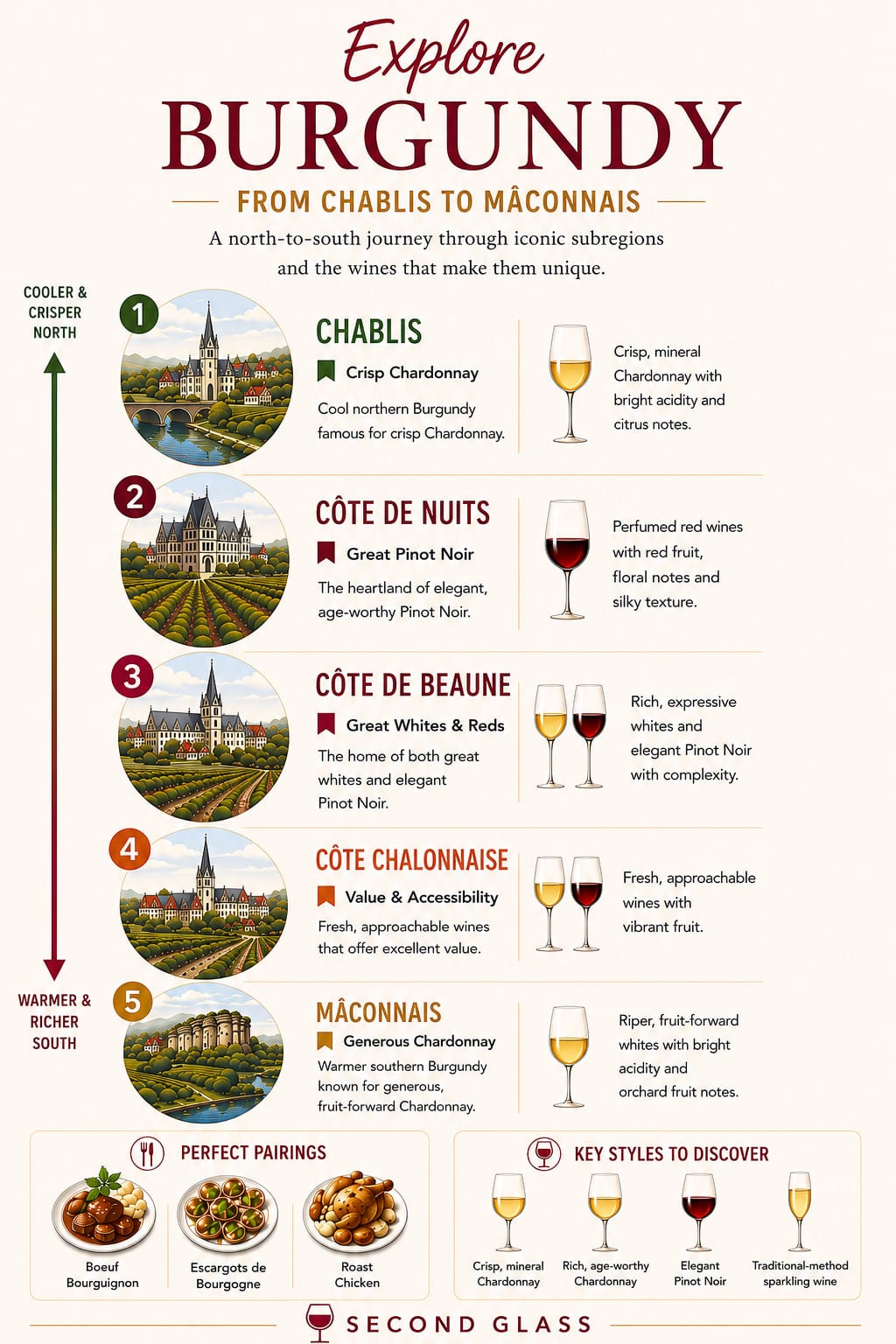
Burgundy is divided into several distinct subregions, each producing wines with its own character. Chablis is known for crisp Chardonnay, the Côte d'Or for some of the world's finest Pinot Noir and Chardonnay, and the southern regions for approachable, value-driven wines. Understanding these differences is one of the best ways to begin exploring Burgundy.
The Burgundy names worth recognising
Côte de Nuits
Memory hook: Burgundy's most serious Pinot Noir country.
Known for: Structured, age-worthy red Burgundy from villages such as Gevrey-Chambertin and Vosne-Romanée.
Why it matters: Many of Burgundy's most famous grand cru red wines come from this narrow northern strip.
Côte de Beaune
Memory hook: Great Chardonnay and graceful Pinot Noir.
Known for: Complex white Burgundy from names such as Meursault, Puligny-Montrachet and Chassagne-Montrachet.
Why it matters: It contains some of Burgundy's most celebrated white-wine villages, alongside important red-wine areas such as Pommard and Volnay.
Chablis
Memory hook: Lean, mineral Chardonnay from Burgundy's northern outpost.
Known for: Crisp, unoaked or lightly oaked Chardonnay with citrus, green apple and stony freshness.
Why it matters: Chablis shows how precise and refreshing Chardonnay can be when grown in a cool climate on limestone-rich soils.
Côte Chalonnaise
Memory hook: Fresh, approachable Burgundy with excellent value.
Known for: Pinot Noir and Chardonnay from slightly warmer continental conditions south of the Côte d'Or.
Why it matters: It often offers some of Burgundy's best-value wines while keeping the region's freshness and elegance.
Mâconnais
Memory hook: Generous, approachable Chardonnay.
Known for: Fruit-forward Chardonnay with ripe citrus, orchard fruit and floral notes.
Why it matters: It produces some of Burgundy's most accessible Chardonnay, including Pouilly-Fuissé and Saint-Véran.
What to eat with Burgundy
Regional specialities
Boeuf Bourguignon works beautifully with Pinot Noir because the wine's acidity refreshes the palate while its savoury notes complement slow-cooked beef.
Coq au Vin pairs naturally with red Burgundy due to shared earthy and savoury flavours.
Escargots de Bourgogne suit mineral-styled or lightly oaked Chardonnay, whose freshness balances garlic and butter.
Everyday local pairings
- Roast chicken and white Burgundy
- Mushroom risotto and Pinot Noir
- Soft cheeses and Chardonnay
- Charcuterie and lighter red Burgundy
Pairings to approach carefully
Very spicy dishes can sometimes overwhelm Burgundy's subtle aromatics, although fruitier red Burgundies and richer white styles can work well with moderate spice. Very sweet desserts can also make dry Burgundy wines taste austere and unbalanced.
Similar wine regions to explore
| Region | Similar | Difference |
|---|---|---|
| Oregon | Premium Pinot Noir and Chardonnay with strong site expression. | Typically shows riper fruit and broader textures. |
| Central Otago | High-quality Pinot Noir with freshness and precision. | Usually displays darker fruit and greater intensity. |
| Champagne | Cool climate and limestone soils. | Focused primarily on sparkling wines. |
| Sonoma Coast | Premium Chardonnay and Pinot Noir. | More maritime influence and broader fruit expression. |
| Alto Adige | Precision and freshness. | Greater focus on aromatic whites and alpine conditions. |
| Germany's Baden | Cool-climate Pinot Noir and Chardonnay. | Generally softer and less driven by vineyard hierarchy. |
Buying Wines From the Region
Budget (£15–£30)
Expect Bourgogne appellation wines and regional Chardonnay. These are generally fresh, approachable and intended for earlier drinking.
Mid-Range (£30–£75)
Village wines and quality examples from the Mâconnais and Côte Chalonnaise become available. Greater concentration, complexity and site character emerge.
Premium (£75–£250+)
Premier Cru and Grand Cru wines can deliver remarkable depth, longevity and complexity. Prices rise substantially because of limited production and global demand.
FAQs
What is Burgundy best known for?
Burgundy is best known for Pinot Noir and Chardonnay. The region's reputation rests on producing wines that express small differences in vineyard location with exceptional clarity and complexity.
Is Burgundy always expensive?
No. While prestigious Grand Cru wines can be extremely expensive, many excellent regional wines and bottles from the Mâconnais and Côte Chalonnaise remain relatively affordable.
What grapes are grown in Burgundy?
Pinot Noir and Chardonnay dominate. Aligoté and Gamay also play important supporting roles and contribute additional diversity.
Do Burgundy wines age well?
Many do. Premium red and white Burgundy wines can develop additional complexity over many years, although simpler regional wines are often best enjoyed young.
Is Chablis part of Burgundy?
Yes. Chablis is the northernmost major wine district of Burgundy and is celebrated for crisp, high-acidity Chardonnay often described as mineral.
What foods pair best with Burgundy?
Roast chicken, mushrooms, pork, creamy dishes and classic Burgundian recipes pair particularly well because the wines emphasise freshness and savoury complexity.
If you are new to Burgundy
Start with Chablis and Bourgogne Pinot Noir, then compare wines from different villages and subregions to understand how climate, soils and site influence style.
Final Thoughts
Burgundy is one of the world's most fascinating wine regions because it demonstrates how place shapes wine. From crisp Chablis to profound Pinot Noir and Chardonnay from the Côte d'Or, Burgundy rewards curiosity and invites lifelong exploration.