Quick answer
What to know first
Champagne is a cool-climate region in north-east France producing some of the world’s most famous bottle-fermented sparkling wines. But Champagne is not a single style—it’s a system built on three grapes, key styles and a patchwork of vineyard areas that each taste different.
Key Takeaways
- Champagne is a region, not just a type of sparkling wine.
- Chardonnay, Pinot Noir and Meunier define almost everything in Champagne.
- Most Champagne is blended across grapes, vineyards and often multiple years.
- Blanc de Blancs, Blanc de Noirs and rosé are the simplest ways to understand style differences — and also the easiest way to start asking “which one sounds like me?”
- The main vineyard areas (Côte des Blancs, Montagne de Reims, Vallée de la Marne, Côte des Bar and Côte de Sézanne) explain why Champagnes taste different.
- Champagne is one of the most food-versatile wines in the world.
How Champagne usually feels
What Does Champagne Taste Like?
If you only remember one section, make it this one.
Young Champagne typically tastes like lemon, green apple, pear, citrus peel and sometimes subtle floral notes. These flavours are associated with youthful expression, while the wine’s high acidity and fine, persistent bubbles create a sense of freshness and energy on the palate. The mousse (the bubbles) adds a creamy yet lively texture that shapes how those flavours are perceived.
As Champagne ages, it develops a second layer of flavour that comes from time spent on the lees (spent yeast cells) and from bottle maturation. This introduces notes of brioche, toast, pastry, biscuit, roasted nuts and sometimes honeyed or baked apple and pear characteristics. In more developed wines, you may also find hints of spice, dried fruit or subtle caramel-like tones.
This contrast is central to understanding Champagne:
- Fresh fruit = youthful expression
- High acidity = structural freshness and tension
- Brioche/toast = influence of lees ageing and winemaking style
- Nutty, honeyed notes = bottle maturity and time in cellar
The texture is just as important as flavour. Champagne is defined by high acidity, persistent bubbles and a structure shaped by grape composition, dosage and time on lees. Together, these elements create a wine that feels both refreshing and layered.
How Champagne Is Made
Champagne becomes much easier to understand once you see the process.
- Grapes are harvested (Chardonnay, Pinot Noir, Meunier)
- Base wines are made (still, dry wines)
- Blending happens (grapes, vineyards and often different years are combined)
- Second fermentation in bottle begins (this creates the bubbles)
- Lees ageing (wine rests on spent yeast, building brioche and toast flavours)
- Riddling and disgorgement (yeast is removed from the bottle)
- Dosage is added (a small sugar addition to balance acidity and shape final texture)
- Final corking and release
That second fermentation in bottle is a defining part of Champagne production and is shared by many other traditional-method sparkling wines, including Cava, Franciacorta, Trentodoc, English sparkling wine and Crémant.
In Champagne, this sequence is central to the style, but the final character of the wine comes from a combination of factors: grape composition, acidity, lees ageing, cellar maturation, pressure and winemaking choices.
Important grapes in Champagne
| Grape | Style | Typical flavours | Explore if you like |
|---|---|---|---|
| Chardonnay | Light, linear and elegant; brings freshness, precision and acidity, developing toast, nuts and pastry with age; often associated with the Côte des Blancs. | Lemon, green apple and white flowers. | Crisp, precise wines with a clean, high-acid structure. |
| Pinot Noir | Fuller, more powerful and more structured; brings body, depth, weight and backbone; common in the Montagne de Reims and Côte des Bar. | Red apple, cherry and subtle red fruit. | Richer, more structured wines with presence. |
| Pinot Meunier | Softer, rounder and more fruit-driven; brings immediate fruit, roundness and approachability; strongly associated with the Vallée de la Marne. | Pear, apple and plum. | Soft, fruit-forward wines that feel generous and easy. |
| Minority grapes | Historic varieties including Arbane, Petit Meslier, Pinot Blanc and Pinot Gris, plus very limited experimental or recently authorised plantings such as Voltis; found mainly in small-batch, specialist cuvées. | Varied and producer-dependent, with unusual aromatic profiles, distinctive acidity and textural differences. | Rare grapes, viticultural diversity and experimental or heritage-focused Champagne. |
The Champagne Styles You Need to Know
Once you understand the grapes, styles become much easier — and more personal.
Instead of just categories, think of them as taste directions:
Brut Champagne
The standard style. Dry, fresh and balanced. Most Champagne you will encounter is Brut.
Blanc de Blancs
Made from white grapes — in Champagne, this almost always means Chardonnay.
- Leaner
- More citrus-driven
- Often more mineral and precise
- Explore this if you like: crisp, focused wines
Blanc de Noirs
Made from black grapes (Pinot Noir and/or Meunier), but pressed gently so the wine stays white.
- Fuller-bodied
- More structured
- More red-fruit character
- Explore this if you like: richer wines with weight and structure
Rosé Champagne
Made either by blending or limited skin contact.
- Strawberry, raspberry and red cherry notes
- Can range from delicate to powerful
- Explore this if you like: red-fruited, expressive wines
Vintage Champagne
Made from a single harvest year.
- Often more structured
- Commonly more complex
- Frequently shows strong ageing potential, though this depends heavily on producer, site and maturation time
Importantly, vintage designation does not automatically mean a wine is older or more developed. Many of Champagne’s most mature flavours — brioche, toast, nuts and savoury depth — come from extended lees ageing and bottle maturation, not from the fact that a wine is vintage. A well-aged multi-vintage Champagne can easily show more development than a young vintage release.
Prestige Cuvée
A producer’s flagship or prestige bottling.
- Often from carefully selected parcels or long-established vineyard sources
- Frequently given extended ageing before release
- Typically represents rare selections and the most ambitious expression of a producer’s style
- May highlight specific vineyards, vintages or long-term blending decisions, depending on the house or grower philosophy
Dosage (Why Champagne Isn’t Just “Dry” or “Sweet”)
After disgorgement, producers add a small amount of sugar solution called dosage.
This step is one of the final decisions in Champagne production and is used to fine-tune balance after ageing and yeast removal. Its role is not simply to make wine sweet, but to integrate acidity, soften structure and shape overall harmony.
- Brut Nature: no sugar added, very dry
- Extra Brut: very low sugar, very dry
- Brut: standard style (most common), balanced and versatile
- Demi-Sec: noticeably sweeter, usually for richer or dessert pairings
Dosage is best understood as a finishing adjustment rather than a structural guarantee. A Brut Nature can be broad and generous, while an Extra Brut can be extremely austere — or the reverse, depending on producer style, grape composition and vintage conditions.
What to eat with Champagne
Classic pairings
- Oysters and shellfish with Blanc de Blancs
- Roast chicken with Pinot-led Brut or Blanc de Noirs
- Duck with rosé Champagne
- Aged Comté with mature Champagne
Unexpected pairings that work
- Fish and chips
- Fried chicken
- Sushi
- Salted crisps
Regional specialities
Jambon de Reims, Chaource cheese, andouillette and escargot are useful regional pairings. Their savoury, salty and creamy profiles work well with Champagne's acidity, bubbles, body and dosage.
Pairings to avoid
Very sweet desserts can make dry Champagne taste sharply acidic, while extremely hot chilli and powerful sweet-and-sour sauces can overwhelm delicate styles.
Where Champagne Comes From
Champagne is not one continuous vineyard. It is a patchwork of villages and slopes spread across north-east France, about 145 km from Paris.
The region includes around 34,000 hectares and more than 300 villages.
The most important idea is not geography itself, but variation: neighbouring villages can produce noticeably different wines because of soil, slope and grape choice.
Five Vineyard Areas, Five Useful Starting Points
Côte des Blancs
Location: South of Épernay
Climate: Cool, strongly influenced by chalk soils and slope exposure
Signature grapes: Chardonnay
Typical style: Precise, citrus-driven, high-acid Champagne with strong mineral tension
Distinguishing features: Deep chalk subsoils and benchmark Chardonnay villages
Explore if you like: Blanc de Blancs and crisp, linear Chardonnay styles
Montagne de Reims
Location: North and west of Épernay, around Reims
Climate: Cool, with varied slope orientations and forest influence
Signature grapes: Pinot Noir (dominant)
Typical style: Structured, powerful, age-worthy Champagne
Distinguishing features: Pinot Noir stronghold with wide stylistic variation
Explore if you like: Structured wines and Pinot Noir-driven depth
Vallée de la Marne
Location: Along the Marne River west of Épernay
Climate: Cool valley climate with frost risk in some sites
Signature grapes: Meunier (dominant)
Typical style: Fruit-driven, soft, approachable Champagne
Distinguishing features: Meunier heartland with supple, generous styles
Explore if you like: Soft, fruit-forward Champagne
Côte des Bar
Location: Southern Champagne (Aube)
Climate: Slightly warmer and more continental
Signature grapes: Pinot Noir (dominant)
Typical style: Riper, more vinous Champagne with generous fruit
Distinguishing features: Distinct southern expression, with Kimmeridgian limestone and marl important in parts of the area
Explore if you like: Richer Pinot Noir styles and generous fruit profiles
Côte de Sézanne
Location: South of Côte des Blancs
Climate: Slightly warmer and more sheltered
Signature grapes: Chardonnay
Typical style: Softer, fruitier Chardonnay-led Champagne
Distinguishing features: Transitional style between Côte des Blancs and southern Champagne
Explore if you like: Rounder Chardonnay styles with a softer edge
Similar sparkling wine styles to explore
| Style | Region | Similar | Difference |
|---|---|---|---|
| English sparkling | Sussex, Kent, Hampshire also Surrey. | Cool-climate traditional-method sparkling wine commonly based on Chardonnay, Pinot Noir and Meunier, with high acidity and strong structural similarities to Champagne. | England has a younger sparkling-wine tradition and a distinctly maritime climate. |
| Cava | Spain, Catalonia. | Traditional-method sparkling wine capable of extended lees ageing, fresh acidity and considerable complexity. | Spanish grapes such as Macabeo, Xarel·lo and Parellada and a more Mediterranean climate create a different flavour profile. |
| Franciacorta | Lombardy, Italy. | Traditional-method sparkling wine with Chardonnay and Pinot Noir, lees ageing and an emphasis on premium production. | Its warmer Lombardy climate generally produces broader textures and riper fruit. |
| Trentodoc | Trentino, Italy. | Traditional-method sparkling wine based largely on Chardonnay and Pinot Noir with high acidity and ageing potential. | Alpine elevation has a much greater influence on freshness and style. |
| Crémant | Alsace, Burgundy, Loire, Bordeaux,Jura, Languedoc, Rhône, Savoie. | French traditional-method sparkling wine that can show fresh acidity, lees-derived complexity and regional character. | Crémant comes from regions outside Champagne and uses different permitted grapes, climates and appellation rules. |
How to Read a Champagne Label
A few key terms unlock most bottles:
- Brut / Extra Brut / Demi-Sec → dosage level (balance, not just sweetness)
- Blanc de Blancs / Blanc de Noirs → whether the wine is made from white grapes or black grapes
- Vintage → single-year Champagne
- RM / NM → producer category (grower vs house, broadly speaking)
- Grand Cru / Premier Cru → village classification
- Disgorgement date → when the wine was separated from its lees
Once you recognise these, buying Champagne becomes much easier.
Buying Champagne
Price tells you what is available to explore; style tells you what you are likely to enjoy.
Budget (£25–£40 / $35–$55)
Reliable entry-level Brut Champagne from established houses, cooperatives, or supermarket own-label selections.
At this level, wines are typically non-vintage blends designed for consistency rather than complexity. Expect a focus on freshness and drinkability rather than depth or long ageing.
What you’ll usually find:
- Citrus and green apple flavours
- Light brioche or biscuit notes from basic lees ageing
- High acidity with a clean, straightforward finish
- A lively mousse that supports freshness
Mid-range (£40–£80 / $55–$110)
This is the most important discovery zone for Champagne and the range where stylistic diversity becomes much clearer.
You’ll find both large houses and grower-producers, with increasing variation in grape expression, vineyard character and winemaking approach.
What becomes noticeable here:
- Clearer differences between Chardonnay, Pinot Noir and Meunier styles
- Greater variation in texture, length and lees character
- More defined fruit character and complexity from ageing
- Broader stylistic diversity across producers
Key styles to explore:
- Grower Champagne
- Blanc de Blancs
- Blanc de Noirs
- Rosé Champagne
- Entry-level vintage Champagne in good years
Premium (£80+ / $110+)
High-end Champagne where selection, ageing and access to rare bottlings become more important.
This category includes vintage wines, prestige cuvées and more site-specific bottlings from both houses and growers.
What defines this level:
- Access to rare selections and limited vineyard sources
- Extended ageing that builds complexity (brioche, nuts, spice, dried fruit)
- More deliberate winemaking choices and longer élevage
- Greater opportunity to explore distinctive producer, vintage or site expressions
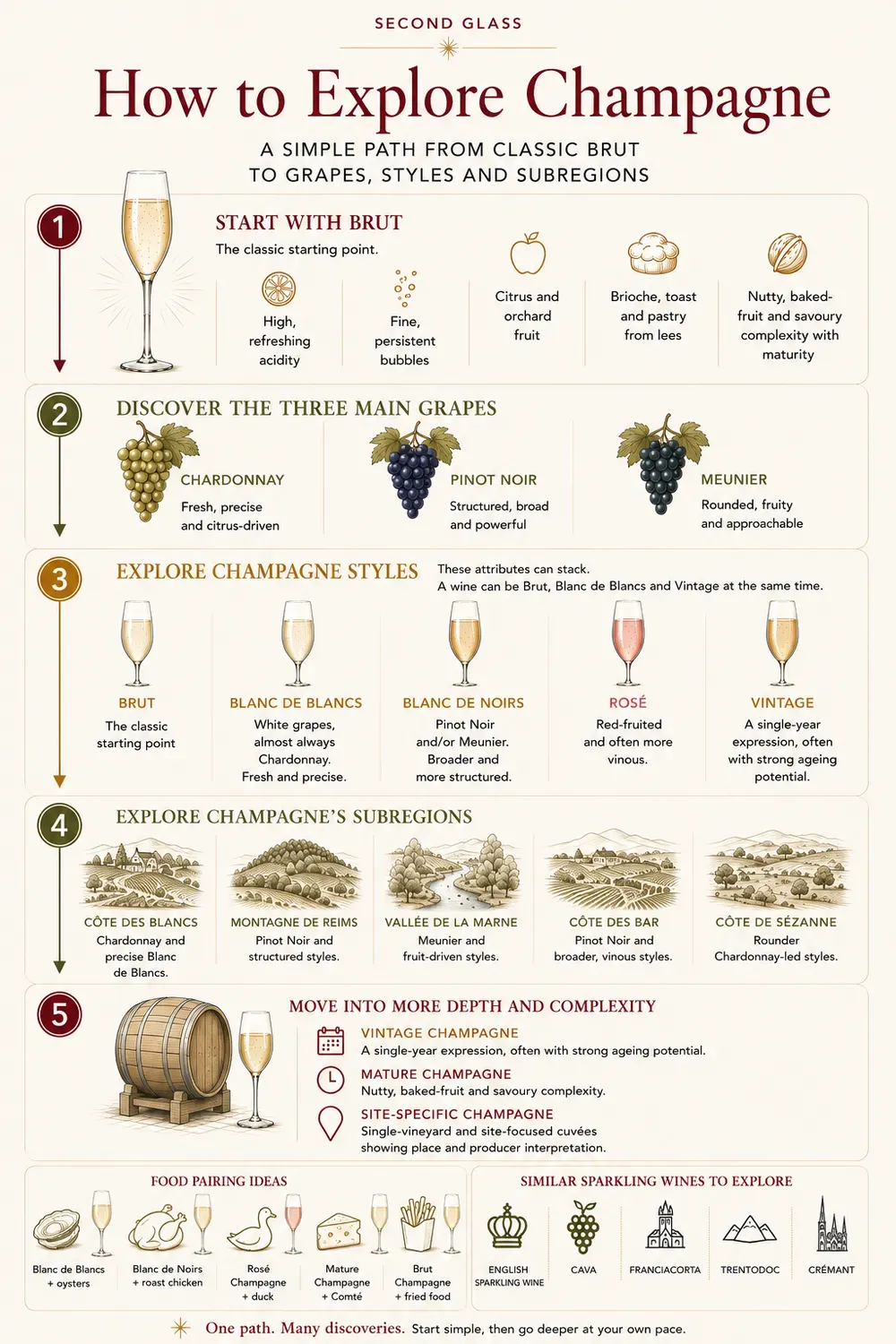
How to Start Exploring Champagne
This is a structured tasting curriculum — designed to build understanding step by step.
-
Step 1: Start with Brut Champagne
Get a baseline for acidity, bubbles and structure.
-
Step 2: Compare Blanc de Blancs vs Blanc de Noirs
Understand whether you prefer wines made from white grapes or black grapes.
-
Step 3: Add Rosé
Explore red-fruit expression and texture.
-
Step 4: Compare grape-led styles
Chardonnay vs Pinot Noir vs Meunier.
-
Step 5: Compare regions
Côte des Blancs vs Vallée de la Marne vs Montagne de Reims.
-
Step 6: Compare producers
See how different producers interpret grapes, vineyards, blending and ageing.
-
Step 7: Compare young and mature Champagne
Understand how time in bottle and on lees changes structure and flavour, and how vintage and non-vintage wines can both evolve in different ways.
At this point, Champagne stops being a category and starts becoming a map of personal taste.
Find Your Champagne Style
This is the simplest way to move from ‘I like Champagne’ to ‘I know what I like in Champagne.’
If you likeCrisp, citrus-driven wines
Explore
If you likeRicher, structured wines
Explore
If you likeSoft, fruit-forward wines
Explore
If you likeVery dry, incisive styles
Explore
If you likeBrioche, toast and nutty complexity
ExploreMature or extended-aged Champagne, including but not limited to
If you likePlace-driven expression
Explore
Questions about Champagne
What grapes are used in Champagne?
Chardonnay, Pinot Noir and Meunier dominate Champagne production. Chardonnay typically brings freshness, citrus character and precision; Pinot Noir adds structure, body and depth; and Meunier contributes fruitiness and roundness. Historic minority varieties including Arbane, Petit Meslier, Pinot Blanc and Pinot Gris also survive in very small quantities and are mainly found in specialist cuvées.
What is the difference between Champagne and Prosecco?
Champagne is produced in the Champagne region of France using secondary fermentation in bottle. Prosecco comes primarily from north-eastern Italy, is based mainly on Glera and is usually made using tank fermentation. Champagne generally emphasises acidity, structure and lees-derived flavours such as brioche and toast, while Prosecco usually focuses more strongly on fresh, aromatic fruit.
Is Champagne always sparkling?
Champagne AOC is sparkling wine, but the wider Champagne vineyard region also produces small quantities of still wine under separate appellations such as Coteaux Champenois. These wines are comparatively rare, so for most drinkers Champagne is effectively synonymous with the region's bottle-fermented sparkling wines.
What is Grower Champagne?
Grower Champagne generally refers to Champagne made by producers who cultivate vineyards and make wine from their own grapes, often under the Récoltant-Manipulant or RM category. Growers may still blend parcels, villages and vintages. Larger houses typically work with fruit from a broader network of vineyards and often place greater emphasis on maintaining a consistent house style.
What is Blanc de Blancs versus Blanc de Noirs?
Blanc de Blancs is made from white grapes and in Champagne is usually Chardonnay, producing styles that tend towards citrus, high acidity and precision. Blanc de Noirs is made from black grapes such as Pinot Noir and Meunier but vinified as a white wine. These Champagnes are often broader, more structured and more strongly marked by orchard or red-fruit flavours.
What does dosage mean in Champagne?
Dosage is an addition made after disgorgement that helps fine-tune a Champagne's final balance. It affects perceived sweetness, texture and the relationship between fruit and acidity. Brut Nature has no added sugar in the dosage, Extra Brut is very dry, Brut is the most common category, and Demi-Sec is noticeably sweeter. Dosage alone does not determine the overall richness of a wine.
Can non-vintage Champagne age well?
Yes. Vintage status is not the only guide to ageing potential. A well-made multi-vintage Champagne can develop substantial brioche, toast, nutty and savoury complexity through lees ageing and bottle maturation. Producer style, grape composition, acidity, cellar ageing and storage conditions all matter, so a mature multi-vintage Champagne can show more development than a young vintage release.
Where should a beginner start with Champagne?
Begin with a good Brut Champagne to understand the region's basic combination of acidity, bubbles, fruit and lees character. Then compare Blanc de Blancs and Blanc de Noirs, add rosé, and explore Chardonnay, Pinot Noir and Meunier-led wines. After that, compare areas such as Côte des Blancs, Vallée de la Marne and Montagne de Reims before exploring producer and maturity differences.
What glass should I use for Champagne?
A coupe is a no. A traditional Champagne flute, as Émile Peynaud highlighted, is designed to showcase and preserve the bubbles. However, it does so at the expense of aroma and overall expression. A small white-wine glass is often the best alternative if you want a more complete wine experience, allowing the Champagne to open up and show its complexity. At the end of the day, it comes down to what you prefer: preserving the bubble and visual effervescence with a flute, or enjoying Champagne as a proper glass of wine with fuller aroma and texture.
Final Thoughts
Champagne is not one flavour or one style.
It is a system built from three grapes, a handful of key styles and a patchwork of vineyard areas that each taste slightly different.
Once you understand those layers, everything else — from dosage to prestige cuvées — becomes much easier to understand and place in context.
You can then move from simply recognising labels to understanding why a Blanc de Blancs feels different from a Blanc de Noirs, or why wines from the Côte des Blancs taste so distinct from those in the Vallée de la Marne.
At that point, Champagne stops being confusing and starts becoming one of the most logical and rewarding wine regions in the world.