
Blanc de Blancs vs Blanc de Noirs
Which differences matter most to you?
Wine style
Blanc de Blancs Champagne
Grape-colour definition Made only from white-skinned grapes.
Main varieties Usually Chardonnay; other permitted white varieties can be used.
Wine style
Blanc de Noirs Champagne
Grape-colour definition Made only from black-skinned grapes.
Main varieties Pinot Noir, Meunier or a blend of both.
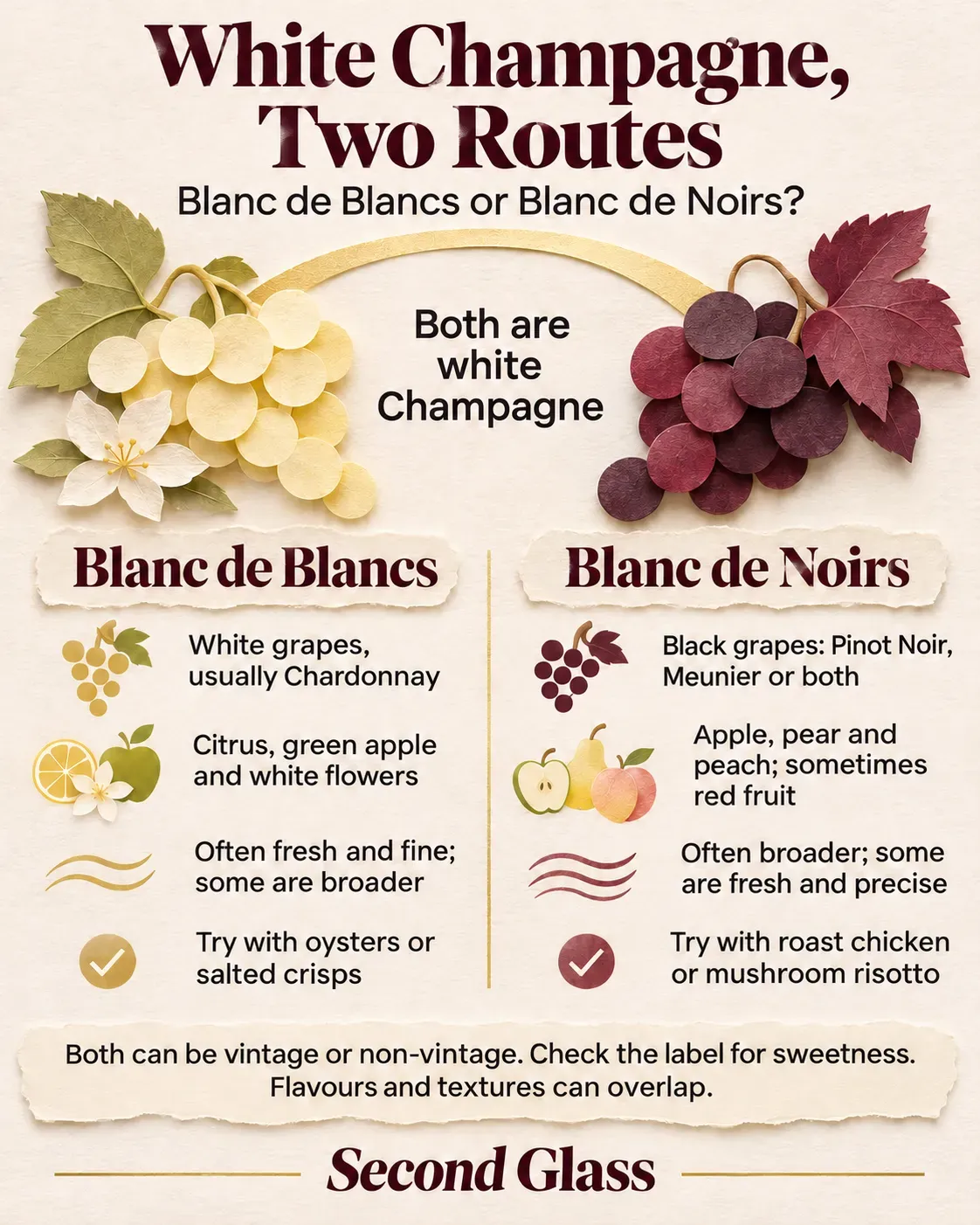
| Compare | Blanc de Blancs Champagne | Blanc de Noirs Champagne |
|---|---|---|
| Grape-colour definition | Made only from white-skinned grapes. | Made only from black-skinned grapes. |
| Main varieties | Usually Chardonnay; other permitted white varieties can be used. | Pinot Noir, Meunier or a blend of both. |
| How it stays white | Made from white grapes. | Pressing limits juice contact with coloured skins. |
| Possible young-fruit cues | Lemon, grapefruit, green apple, pear and sometimes white flowers. | Apple, pear and peach; red-fruit notes are also possible. |
| Possible structure | Often fresh and fine; some examples are broader or more textured. | Often broader or more vinous; some examples are fresh and precise. |
| Regional clues | Chardonnay is strongly associated with the Côte des Blancs and also grown elsewhere in Champagne. | Pinot Noir is prominent in the Côte des Bar; Meunier is widely grown in the Marne Valley. |
| A useful first choice if… | You enjoy citrus, freshness and a fine feel. | You enjoy ripe fruit and Champagne with potential breadth at the table. |
Key Takeaways
- Blanc de Blancs Champagne is made only from white-skinned grapes, usually Chardonnay.
- Blanc de Noirs Champagne is made only from black-skinned grapes: Pinot Noir, Meunier or both.
- Blanc de Noirs is white wine: careful pressing limits the colour extracted from black grape skins.
- Blanc de Blancs can lean towards citrus and a fine, fresh feel; Blanc de Noirs can feel broader and more vinous.
- These are tendencies, not rules. A broad Blanc de Blancs and a fresh, precise Blanc de Noirs are both possible.
- Both styles can be vintage or non-vintage; check the separate sweetness category on the label, such as Brut or Extra Brut.
Introduction
Blanc de Blancs and Blanc de Noirs are both white Champagne, named for the colour of the grapes used. The distinction gives you a useful starting clue, but not a complete prediction of flavour: grape proportions, vineyard origin, vintage, producer and ageing all shape the wine.
This guide focuses on Champagne. The terms can also appear on sparkling wines from other regions, where different grape rules may apply. Here, we’ll compare the grape and production choices, the styles you might find, and how to choose and taste the wines.
What Is Blanc de Blancs?
Blanc de Blancs means “white from whites”. In Champagne, it identifies a white wine made exclusively from white-skinned grape varieties. Chardonnay is the grape most commonly used; other permitted white varieties, including Pinot Blanc, Pinot Gris, Arbane and Petit Meslier, can also appear.
The Côte des Blancs is particularly associated with Chardonnay, which is also grown elsewhere in Champagne. A place name on the label can help you understand a wine’s origin.
What Is Blanc de Noirs?
Blanc de Noirs means “white from blacks”. In Champagne, it identifies a white wine made exclusively from black-skinned grapes: Pinot Noir, Meunier or both. The flesh and juice are pale; careful pressing limits contact with the skins and helps keep the wine white.
Pinot Noir is prominent in the Côte des Bar and Montagne de Reims; Meunier is widely grown in the Marne Valley. Blanc de Noirs is distinct from rosé Champagne, which is pink and can also use black grapes.
What Do They Have in Common?
Both styles undergo a second fermentation in the bottle. The wine then ages on its lees—the spent yeast cells left after fermentation—which can contribute texture and notes such as toast or pastry.
The Main Differences
Origin and Identity
Blanc de Blancs and Blanc de Noirs are grape-composition terms, not separate Champagne regions. Either can come from different areas within Champagne, and a bottle may combine grapes from more than one site.
The regional associations are useful clues: Côte des Blancs for Chardonnay, Côte des Bar and Montagne de Reims for Pinot Noir, and the Marne Valley for Meunier. They can help you interpret a named origin, but do not reveal every grape or vineyard in a cuvée.
Grapes and Production
Chardonnay is the usual grape in Blanc de Blancs. It is often associated with freshness and citrus or floral character. Blanc de Noirs uses Pinot Noir, Meunier or both: Pinot Noir can contribute body and structure, while Meunier can bring roundness and fruit.
For Blanc de Noirs, careful pressing limits colour from the black grape skins. The finished Champagne remains white, while its particular balance of fruit and structure depends on the grapes and production choices.
Flavour and Structure
Aromas and fruit
A young Blanc de Blancs may suggest lemon, grapefruit, green apple or pear, sometimes with white flowers or a saline impression. Some examples develop toast, nuts, honey or ripe-apple notes with time.
Blanc de Noirs may show apple, pear or peach, with red-fruit, citrus or floral notes also possible. Some examples gain toast, pastry, spice or savoury character as they age.
Freshness and acidity
Both styles can have lively acidity. Blanc de Blancs may come across as crisp or fine, especially when young. Blanc de Noirs can combine ripe fruit and a rounded impression with refreshing acidity.
Compare how the freshness sits alongside the fruit, body and texture in each wine.
Body and texture
Blanc de Noirs is often described as broader, more structured or more vinous than Champagne made with white grapes. Some Blanc de Blancs are lighter and finer; others have more breadth and texture.
These are tendencies, not dependable tests: a fresh Blanc de Noirs and a broad, mature Blanc de Blancs are both possible.
Styles and Ageing
Either style can be non-vintage or vintage-dated. Blanc de Blancs and Blanc de Noirs describe grape colour; “vintage” describes a declared harvest year.
The sweetness category is separate too. Brut and Extra Brut describe the finished wine’s sugar level, with Extra Brut generally lower in sugar than Brut. Dosage is the finishing addition used to help achieve the intended balance.
Both styles can develop with time, but the name alone cannot predict a bottle’s ageing potential or readiness to drink. Some examples gain toast, pastry, nuts or savoury notes; others are intended to be enjoyed young. Look for information about the producer’s ageing choices, disgorgement or release, and follow specific bottle guidance where available.
Grape balance and place also create variation within each style. A Blanc de Noirs made mainly from Pinot Noir may differ from one made mainly from Meunier; Chardonnay from different parts of Champagne can vary too.
How To Tell Them Apart
The label provides the dependable clue: Blanc de Blancs means white-skinned grapes only; Blanc de Noirs means black-skinned grapes only. In Champagne, Chardonnay is the main grape in Blanc de Blancs, while Blanc de Noirs uses Pinot Noir, Meunier or both. A label may not state the exact proportions.
Tasting can suggest a style, but it cannot confirm the grape composition. Citrus and a fine, lively impression may suggest Blanc de Blancs; ripe orchard or possible red-fruit notes and a broader feel may suggest Blanc de Noirs. Use the separate sweetness category on the label to judge sweetness.
Food Pairing Comparison
Blanc de Blancs can suit oysters, simply dressed shellfish, scallops and grilled or poached white fish. Freshness and bubbles work well with briny flavours, while a rounder example can stand up to lightly buttered scallops. A mature or broader bottle can also pair with roast chicken or aged hard cheese such as Comté.
Blanc de Noirs can work especially well with roast chicken or turkey, creamy mushroom risotto, savoury pastry and fried food. Its possible breadth can meet the weight of a richer dish, while acidity and bubbles refresh the palate. A fruit-forward example can also suit roast pork.
Either style can work with roast chicken, seafood or salted crisps; match the wine to the dish’s preparation as well as its style. Very sweet desserts can make a dry Champagne taste lean, while strong chilli and vinegar-heavy dressings can make the pairing less comfortable.
How to serve Blanc de Blancs vs Blanc de Noirs
Sparkling
Blanc de Blancs Champagne
8–11°C 46–52°F
Serve chilled but not ice-cold; let it warm gently in the glass if its aromas seem muted.
Sparkling
Blanc de Noirs Champagne
8–11°C 46–52°F
Serve chilled but not ice-cold; let it warm gently in the glass so its fruit and structure can show.
Follow your taste in Champagne
Start with the fruit and texture you enjoy, then explore the producer. These are useful tendencies: origin, grape balance and ageing can bring either style closer to your taste.
Buying Guide
Prices below are approximate guidance for 750 ml bottles; availability, retailer, location and taxes affect the final price. These ranges are not guarantees of quality or ageing potential.
Budget
A useful shared discovery range is about £25–£50 in the UK or $50–$90 in the US, though some Blanc de Noirs options may cost less. Look for a non-vintage Brut with the style and sweetness category clearly stated. Expect a straightforward introduction, often focused on freshness and fruit rather than extended complexity. This tier is a good place to find out which style you prefer.
Mid-Range
Allow roughly £50–£100 in the UK or $90–$170 in the US for a wider choice of grape compositions, origins and ageing details. Look for named villages, vintage information or producer notes that explain the cuvée. These details can help you explore differences in texture and maturity. This tier is useful when you want to compare more specific expressions of either style.
Premium
Premium examples generally begin around £100 in the UK or $170 in the US, with some bottles costing considerably more. Look for a distinctive cuvée, named origin, vintage or extended ageing details that interest you. Read the producer’s notes to understand what distinguishes the bottle from a less expensive example. Choose this tier when you already know which style or expression you want to explore.
How to compare Blanc de Blancs and Blanc de Noirs
Choose two Champagnes at a similar price and maturity, with the same sweetness category if possible. Serve them at the same temperature in matching tulip-shaped glasses. Smell and taste each, comparing fruit, freshness, body, texture and finish. Try both with the same dish and decide which you prefer. Differences reflect grape composition alongside producer, site, vintage and ageing.
How To Experiment
- Step 1 — Read the labels for style, sweetness category, vintage status and any named grapes or origin.
- Step 2 — Choose bottles at a similar price and maturity, with the same sweetness category.
- Step 3 — Smell each wine, then compare fruit, floral or savoury notes.
- Step 4 — Taste both and compare freshness, body, texture and finish.
- Step 5 — Try them with the same food and note which you prefer.
Questions about Blanc de Blancs and Blanc de Noirs
Is Blanc de Noirs Champagne red?
No. Blanc de Noirs is white Champagne made from black-skinned grapes. Careful pressing limits contact between the juice and coloured skins. Rosé Champagne is pink and is a different style.
Is Blanc de Blancs always 100% Chardonnay?
No. Chardonnay is the most common grape, but Blanc de Blancs Champagne can include other permitted white-skinned varieties.
Which style is sweeter?
Neither term indicates sweetness. Check the separate category on the label, such as Brut or Extra Brut; Extra Brut generally has less sugar than Brut.
Which style is fuller-bodied?
Blanc de Noirs is often broader or more structured, while Blanc de Blancs can feel finer and more citrus-led. These are tendencies; grape balance, site, producer and ageing influence both.
Can both styles be vintage or non-vintage?
Yes. The style names describe grape colour; vintage status describes whether the label declares a harvest year.
Do the names guarantee particular flavours?
No. They identify grape colour, not a fixed tasting profile. Site, vintage, producer choices and ageing also shape the wine.
Should I serve Blanc de Blancs colder than Blanc de Noirs?
No. Serve both around 8–11°C (46–52°F), chilled but not ice-cold. Let them warm gently in the glass if you want the aromas to show more clearly.
Final Thoughts
Choose a similar pair of Blanc de Blancs and Blanc de Noirs, then compare them at the same sweetness and maturity. Notice which fruit and texture you prefer, and try both with the same food. That will give you a more useful guide to your own taste than the style names alone.