Quick answer
What to know first
Chablis is a northern Burgundy region known for dry white wines made from Chardonnay. Its cool climate and varied vineyard sites produce wines that are typically fresh, citrus-fruited and savoury, with four appellation levels ranging from Petit Chablis to Grand Cru.
Introduction
Chablis offers one of the clearest ways to understand how climate, vineyard site and winemaking can shape different expressions of the same grape. Every wine in its four-level appellation hierarchy is made from Chardonnay, yet Petit Chablis, Chablis, Premier Cru and Grand Cru can differ significantly in body, texture, concentration and ageing potential.
The region is often associated with crisp acidity, citrus fruit and mineral-like character, but its wines are not defined by a single flavour profile. Producer choices, vintage conditions, vineyard position and bottle age all influence the final style. Tasting different Chablis side by side, rather than relying on generalisations, offers a more useful and revealing way to understand the variation within this focused wine region.
Key Takeaways
- Chablis lies around the town of Chablis in the Yonne department of northern Burgundy, France.
- All four Chablis appellations produce dry white wine exclusively from Chardonnay.
- The cool climate helps preserve acidity and limits overtly ripe or tropical flavours.
- Kimmeridgian limestone and marl are important to the region’s identity, but soil is only one part of terroir.
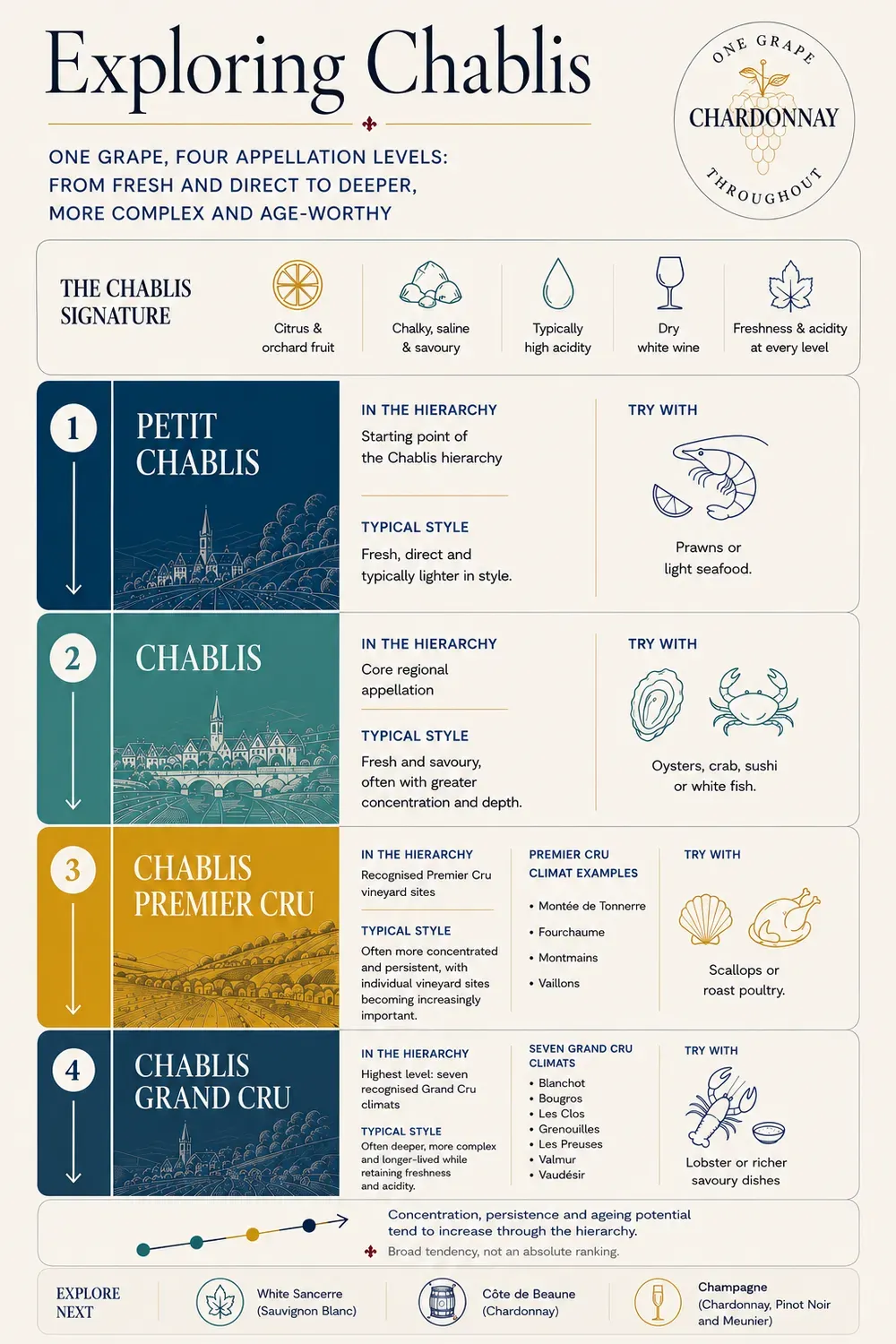
- The hierarchy runs from Petit Chablis to Chablis, Chablis Premier Cru and Chablis Grand Cru.
- Premier Cru and Grand Cru refer to recognised vineyard sites, or climats, rather than simply warmer or better-exposed slopes.
- Chablis Grand Cru comprises seven officially recognised climats: Blanchot, Bougros, Les Clos, Grenouilles, Les Preuses, Valmur and Vaudésir.
- Chablis is a useful region for seeing how one grape can produce different wines according to site, vintage and winemaking.
How Chablis usually feels
Where Is Chablis?
Chablis is in northern Burgundy’s Yonne department, around the town of Chablis and close to Auxerre. Its vineyards extend across several communes surrounding the Serein Valley.
It lies considerably farther north than Burgundy’s Côte d’Or and Mâconnais. The landscape consists of rolling hills, slopes and plateaux, with vineyard exposure affecting how much warmth and sunlight grapes receive.
This location helps explain Chablis’s style. Its cool growing conditions preserve acidity, while slope, aspect, drainage, mesoclimate, vintage and winemaking influence how ripe and textured the wines become.
Spring frost is a significant vineyard risk because Chardonnay buds early. Vintage conditions therefore matter: warmer years can produce broader, riper wines, while cooler years often emphasise sharper acidity and restraint.
Why Is Chablis Famous?
Chablis has a long association with dry white wine and a particularly focused identity: one permitted grape variety, four appellation levels and a detailed system of recognised vineyard sites.
Its reputation comes from Chardonnay that combines freshness with restrained fruit and savoury complexity. The wines are often described as mineral, but this is a tasting term rather than evidence that minerals pass directly from soil into the wine. It may refer to impressions of chalk, wet stone, oyster shell, flint or salinity.
Different vineyards, vintages and producers can create noticeably different wines from the same grape. That variation is central to Chablis’s appeal.
Climate and Terroir
Soils
The geological term most closely associated with Chablis is Kimmeridgian. These limestone and marl formations originated from ancient marine sediments and are particularly associated with many established vineyard slopes.
Petit Chablis is broadly associated with higher sites and younger limestone formations, including Portlandian or Portlandien geology. This is a general association, not an absolute boundary: geological formations overlap and vary across the wider area.
Soil alone does not determine the wine. Slope, aspect, drainage, vineyard position, mesoclimate, viticulture, vintage and winemaking all contribute.
Premier Cru status refers to specifically delimited recognised vineyard sites, or climats. Many occupy favourable slopes, but the classification is not simply a ranking of the warmest or best-exposed land.
Important grapes in Chablis
| Grape | Style | Flavour profile | Structure | Food pairings |
|---|---|---|---|---|
| Chardonnay | Fresh, dry white wine ranging from light and approachable to concentrated and age-worthy. | Lemon, green and yellow apple, pear, white flowers, chalk, oyster shell and saline notes. | Light to medium body with fresh to high acidity, becoming broader and more concentrated at Premier Cru and Grand Cru level. | Oysters, shellfish, white fish, escargots, gougères and roast chicken. |
How Does Chablis Taste?
Chablis is generally dry, fresh and savoury. Young wines often show citrus, green or yellow apple, pear and restrained floral character. Mineral-like descriptions may suggest chalk, wet stone, oyster shell, saline notes or a subtle smoky impression.
Compared with Chardonnay from warmer regions, Chablis is usually less tropical, buttery or overtly oaky. Oak may be absent, subtle or more noticeable, depending on the producer and vessel. Stainless steel, concrete, large-format wood and older barrels can all be used.
The style tends to become deeper and more textural as the appellation level rises: Petit Chablis is often direct and light, Chablis adds regional depth, Premier Cru brings greater concentration and persistence, and Grand Cru can be broad, layered and long-lived.
These are broad tendencies rather than fixed rules. Bottle age can also add savoury complexity, while basic wines are commonly enjoyed young and serious Premier Cru and Grand Cru can develop for a decade or more.
How to serve Chablis
White
Petit Chablis
8–10°C 46–50°F
Serve well chilled but not ice-cold. Around 8–10°C preserves the freshness of this lighter style while allowing its citrus, orchard-fruit and restrained floral character to remain perceptible.
White
Chablis
9–12°C 48–54°F
Serve cool rather than very cold. Around 9–12°C keeps the wine fresh while allowing its citrus, orchard-fruit, savoury character and texture to emerge. Fuller or more mature examples can be served towards the warmer end of the range.
White
Chablis Premier Cru
10–13°C 50–55°F
Serve slightly warmer than simpler Chablis, particularly when the wine has bottle age or greater texture. Around 10–13°C helps reveal its mid-palate depth, savoury complexity and persistence without losing freshness.
White
Chablis Grand Cru
11–14°C 52–57°F
Serve cool rather than heavily chilled. Around 11–14°C allows the greater concentration, texture and aromatic complexity of Grand Cru Chablis to show clearly. Mature bottles generally benefit from the warmer end of the range.
Wine Styles and Appellation Hierarchy
Chablis is fundamentally a dry white wine region. Red, rosé, sparkling and sweet wines are not meaningful categories within this appellation hierarchy.
Petit Chablis
Petit Chablis is often the lightest and most immediately approachable level. It tends to offer lively acidity, modest body and straightforward fruit, making it a useful introduction to the region.
Many examples are best enjoyed relatively young, although individual bottles can vary considerably.
Chablis
Chablis is the core regional appellation. It usually offers more depth than Petit Chablis while retaining the region’s freshness and restrained style.
Body and texture can range from light to moderately full. Oak may be absent, subtle or more apparent, depending on the producer. Standard Chablis is often ready to drink young, but better examples can develop additional savoury and honeyed complexity.
Chablis Premier Cru
Premier Cru wines come from recognised and delimited vineyard sites within Chablis. Compared with standard Chablis, they often have a broader mid-palate, more texture and a longer finish.
Some are lean and precise; others are creamy or powerful. Lees ageing may add a waxy or creamy texture, while oak can contribute toast or spice, but Premier Cru is not necessarily oaked.
Premier Cru often offers the best balance between site expression, complexity and price. Names worth recognising include Montée de Tonnerre, Fourchaume, Montmains and Vaillons.
Chablis Grand Cru
Grand Cru is the highest appellation level. Chablis Grand Cru comprises seven officially recognised climats: Blanchot, Bougros, Les Clos, Grenouilles, Les Preuses, Valmur and Vaudésir. They form a connected group on the right bank of the Serein near Chablis.
Grand Cru wines often have greater depth, concentration and persistence than lower-appellation wines. Their distinction is not simply weight: precision, balance, texture and site expression can be equally important.
Oak and lees ageing may be used, but Grand Cru is not necessarily oaked. Serious examples can develop for a decade or considerably longer, particularly when well stored.
You may also encounter La Moutonne. It is not an eighth Grand Cru climat; it is a historic named site and monopole spanning parts of the Grand Cru climats Vaudésir and Les Preuses. Its wines may appear as “La Moutonne” on Chablis Grand Cru labels.
The Chablis names worth recognising
Petit Chablis
Memory hook: The lightest and most approachable entry point to Chablis.
Known for: Fresh, dry Chardonnay with lively acidity, modest body and straightforward fruit.
Why it matters: It provides a useful starting point for comparing how the Chablis appellation hierarchy affects body, concentration and persistence.
Chablis
Memory hook: The core regional expression.
Known for: Dry Chardonnay combining fresh acidity, restrained citrus and orchard fruit with savoury character.
Why it matters: It establishes the regional reference against which Petit Chablis, Premier Cru and Grand Cru can be compared.
Chablis Premier Cru
Memory hook: Where recognised vineyard sites become central.
Known for: More textural and persistent Chardonnay from recognised and delimited Premier Cru climats.
Why it matters: Premier Cru provides a practical way to explore differences between individual sites while remaining below Grand Cru level.
Chablis Grand Cru
Memory hook: The highest appellation level in Chablis.
Known for: Concentrated, complex and potentially long-lived Chardonnay from seven officially recognised Grand Cru climats.
Why it matters: The seven climats form a connected group on the right bank of the Serein and represent the highest level of the Chablis appellation hierarchy.
Understanding the Vineyard Names
Once the appellation hierarchy is clear, vineyard names become a way of comparing individual sites rather than another set of quality levels.
Names such as Vaillons, Montmains, Fourchaume and Montée de Tonnerre identify Premier Cru climats, while Les Clos and Vaudésir are among the seven Grand Cru climats. They matter because vineyard position, exposure, slope and local geology can influence how a wine feels, even when the grape and broad regional climate are the same.
These names should not be treated as guarantees of a single flavour profile. They are useful reference points for exploring site expression, but the finished wine also reflects the grower’s choices and the conditions of the vintage.
Food Pairing Guide
What to eat with Chablis
Regional specialities
Jambon à la Chablisienne is a natural regional match, particularly with fuller Chablis. Escargots de Bourgogne suit the wine's acidity alongside garlic, parsley and butter, while gougères make an easy aperitif pairing.
Everyday pairings
- Oysters with young Chablis
- Prawns with Petit Chablis
- Crab with Chablis
- Sushi with Chablis
- White fish with Chablis
- Scallops with Chablis Premier Cru
- Roast poultry with Chablis Premier Cru
- Lobster with fuller Premier Cru or Chablis Grand Cru
- Mushrooms with mature Chablis
- Goat's cheese with Chablis
Pairings to avoid
Very sweet dishes can make dry Chablis seem sharply acidic, while heavy chilli heat and intensely smoky or sugary sauces can overwhelm its restrained fruit. Powerful red meat dishes are generally less natural partners than seafood, poultry and savoury vegetable dishes.
Similar wine regions to explore
| Region | Similar | Difference |
|---|---|---|
| Sancerre | Freshness, citrus character and savoury or mineral-like impressions. | White Sancerre is made from Sauvignon Blanc and is generally more herbal and aromatic. |
| Côte de Beaune | Chardonnay, limestone-influenced vineyards and a detailed hierarchy of sites. | White Côte de Beaune wines are often broader, richer and more visibly shaped by oak and lees ageing. |
| Mâconnais | Chardonnay and a shared Burgundian identity. | Its warmer southern location generally produces riper fruit, rounder texture and softer-feeling acidity. |
| Champagne | Cool northern conditions, limestone or chalk geology and Chardonnay capable of retaining high acidity. | Champagne is primarily a sparkling-wine region and commonly uses Pinot Noir and Meunier alongside Chardonnay. |
| Tasmania | Cool-climate Chardonnay with strong acidity, citrus character and restrained fruit. | Tasmanian Chardonnay often shows somewhat riper fruit and comes from different geological settings. |
| Mornington Peninsula | Chardonnay combining acidity, citrus character and savoury complexity. | Styles are often more textural, with oak and lees ageing sometimes playing a more visible role. |
| Willamette Valley | Cool-climate Chardonnay with acidity, restraint and an increasing emphasis on site expression. | Fruit can be broader and riper, and the region has no direct equivalent to Chablis's Premier Cru and Grand Cru hierarchy. |
Buying Wines From the Region
Prices vary substantially by producer, vintage, vineyard, retailer and market. The following ranges are illustrative only and should not be treated as reliable indicators of appellation level.
Budget (£12–£25 / $18–$35)
Look primarily for Petit Chablis and entry-level Chablis.
These wines are often straightforward, fresh and intended for earlier drinking, although individual bottles vary.
Mid-Range (£25–£50 / $35–$70)
This is often a rewarding part of the market. Good Chablis and accessible Premier Cru wines may offer more texture and persistence without Grand Cru pricing.
Producer matters increasingly at this level.
Premium (£50–£150+ / $70–$200+)
This range may include serious Premier Cru and Grand Cru, as well as sought-after producers at lower appellation levels.
Higher prices can buy greater concentration, complexity and ageing potential, but they do not guarantee a better match for every drinker or meal. Storage and bottle condition also remain important.
If You Are New to Chablis
Begin with a straightforward Chablis AOP and taste it without food if possible. Note its acidity, weight, texture and finish before focusing on individual aromas.
How To Start Exploring Chablis
-
Step 1 — Establish the regional reference.
Taste a Chablis AOP and record your first impressions of freshness, body, texture and persistence.
-
Step 2 — Compare Petit Chablis with Chablis.
Taste the wines side by side, ideally from the same producer. Ask which feels lighter, which has more depth and how the finishes differ.
-
Step 3 — Compare two Premier Crus.
Try sites such as Vaillons and Fourchaume, or Montmains and Montée de Tonnerre. Focus on differences in shape, texture and length rather than trying to identify a fixed flavour associated with each name.
-
Step 4 — Finish with Grand Cru.
Taste Les Clos, Vaudésir or Valmur alongside one of the Premier Crus. Look for added depth, concentration and persistence, while also considering balance and precision.
-
Step 5 — Repeat with a different vintage or producer.
Return to the same appellation levels and note which differences remain consistent and which change. This is the most practical way to separate site character from vintage and winemaking style.
Common Misconceptions
Chablis Is a Grape Variety
Chablis is a region and appellation, not a grape variety. Its wines are made exclusively from Chardonnay.
All Chablis Is Completely Unoaked
Chablis is often made in stainless steel or neutral vessels, but producers may also use older barrels, new oak or other vessels. The appellation name does not reveal the full élevage regime.
Chablis Always Tastes Extremely Lean
Freshness is central, but some Premier Cru and Grand Cru wines can be broad, concentrated and textural, especially in warmer vintages.
Kimmeridgian Soil Alone Creates the Wine
Kimmeridgian limestone and marl are important to Chablis’s identity, but climate, slope, aspect, drainage, vintage, vineyard work and winemaking also shape the wine.
Grand Cru Is Always the Best Choice
Grand Cru is the highest appellation level, but Premier Cru may offer better value, standard Chablis may be more versatile with food and Petit Chablis may be ideal for immediate drinking. Producer and vintage matter at every level.
Questions about Chablis
Is Chablis part of Burgundy?
Yes. Chablis is part of Burgundy, although it lies well north of the Côte d'Or in the Yonne department. Its cooler climate, distinctive geology and geographical separation give it a recognisable identity within Burgundy.
Is Chablis a dry wine?
Yes. Chablis is a dry white wine made from Chardonnay. Its fresh acidity and restrained fruit can make it feel particularly crisp, especially at Petit Chablis and Chablis level, although Premier Cru and Grand Cru examples may be broader and more textural.
Is Chablis Chardonnay?
Chablis is a wine region, not a grape. Its wines are made exclusively from Chardonnay, so every Chablis is Chardonnay, but most Chardonnay produced elsewhere is not Chablis.
Is Chablis oaked?
It can be. Producers may use stainless steel, concrete, large-format wood, older barrels, new oak or combinations of vessels. Oak influence therefore varies considerably by producer and wine, and the Chablis appellation name alone does not reveal the élevage regime.
What is the best type of Chablis?
There is no single best level for every occasion. Grand Cru is the highest appellation level, but Premier Cru often balances complexity and price particularly well. Standard Chablis is versatile, while Petit Chablis is commonly fresh, direct and approachable.
How long can Chablis age?
Many Petit Chablis and standard Chablis wines are enjoyed young, while serious Premier Cru and Grand Cru can develop for a decade or considerably longer. Exact longevity depends on the vineyard, producer, vintage, winemaking and storage conditions.
What food goes best with Chablis?
Seafood is the classic choice, especially oysters, prawns, crab, sushi and white fish. Fuller Premier Cru and Grand Cru can accompany scallops, lobster, roast poultry and creamy sauces. The most useful approach is to match the weight and texture of the dish with the wine.
Is Petit Chablis lower quality than Chablis?
Petit Chablis sits lower in the appellation hierarchy, but that does not mean it is poor wine. It generally offers a lighter and more immediate expression of Chardonnay and can provide both good value and a useful introduction to the wider Chablis region.
Is Chablis good value?
It can be, particularly at standard Chablis and Premier Cru level. Producer, vintage and vineyard all influence quality and price, so comparing producers within the same appellation level is generally more useful than assuming classification or price alone determines quality.
What is Kimmeridgian soil, and why is it important in Chablis?
Kimmeridgian soil is named after Kimmeridge in Dorset, England, where the geological formation was first identified and described. It is a limestone-and-marl formation containing fossilised marine shells. It is especially associated with Chablis and is often linked with the region’s fresh acidity, chalky texture and saline, oyster-shell character, although climate, vineyard site and winemaking also play important roles.