
Quick answer
What to know first
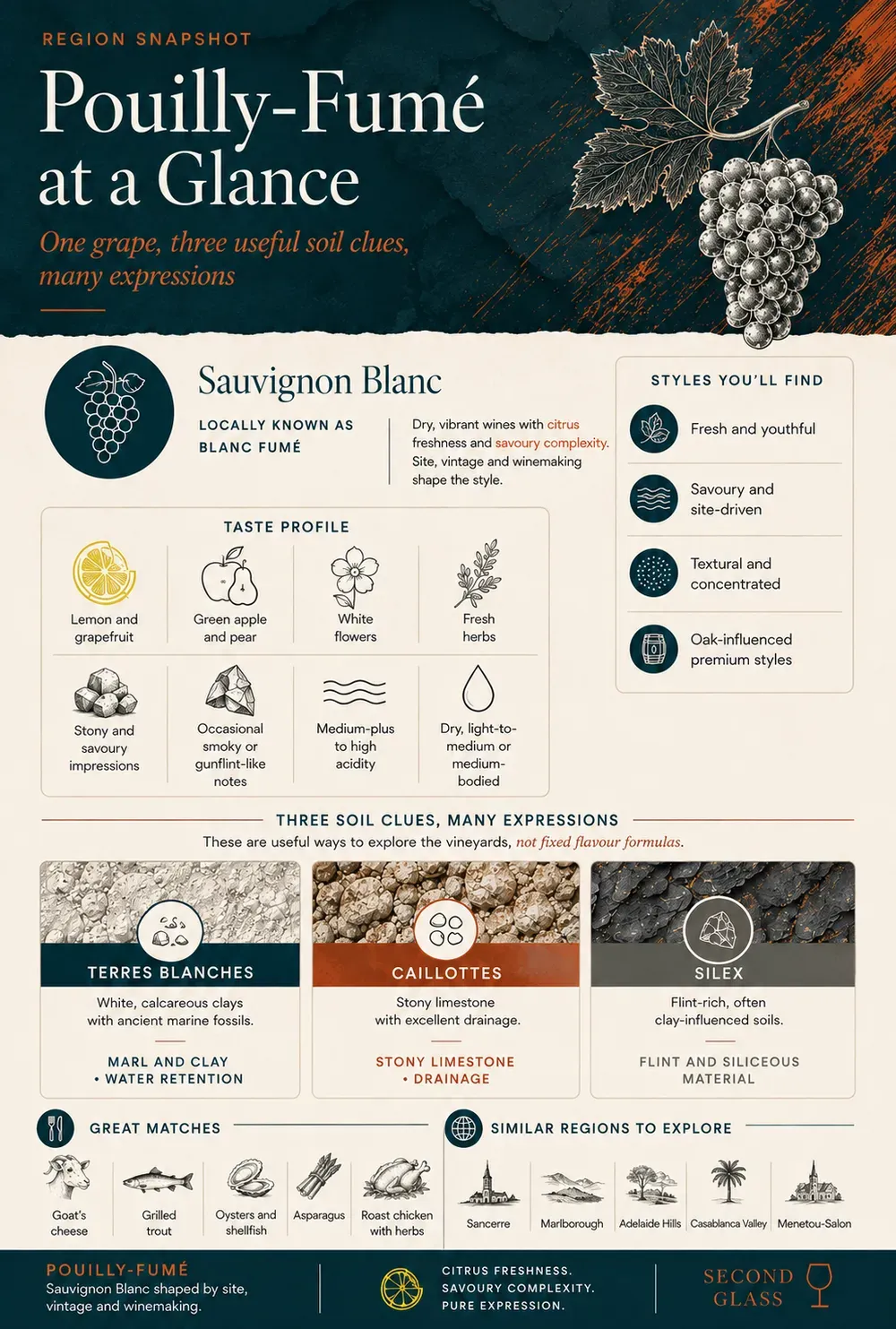
Pouilly-Fumé is a dry Centre-Loire Sauvignon Blanc known for citrus, fresh acidity, floral notes and stony or smoky impressions. “Fumé” does not mean smoked, and flint does not directly flavour the wine; these descriptions reflect the combined influence of site, vintage, farming and winemaking.
Introduction
Pouilly-Fumé has one of the most evocative names in wine. It suggests smoke, fire and struck stone, and its reputation has long been tied to the idea of flinty Sauvignon Blanc.
That reputation is useful, but it can also be misleading. Not every Pouilly-Fumé tastes smoky, and not every bottle is obviously flinty. The more interesting story is that Pouilly-Fumé gives Sauvignon Blanc a setting in which freshness, restrained fruit, texture and savoury complexity can matter as much as aromatic intensity.
It is also one of the Loire's most frequently misunderstood wines. Is it basically Sancerre from across the river? Is it related to Pouilly-Fuissé? Why does it cost more than ordinary Sauvignon Blanc? And when a tasting note says “gunflint,” what is actually being described?
This guide answers those questions while showing how to explore Pouilly-Fumé beyond its famous name.
Key Takeaways
- Pouilly-Fumé is a white-wine appellation in the Centre-Loire, on the right bank of the Loire around Pouilly-sur-Loire in the Nièvre department.
- Pouilly-Fumé AOP wines are made exclusively from Sauvignon Blanc, traditionally called Blanc Fumé locally.
- Wines are dry, fresh and often light-to-medium or medium-bodied, combining citrus and orchard fruit with floral, herbal and savoury or mineral descriptors.
- The local terms terres blanches, caillottes and silex are useful ways to begin exploring the vineyards, but they are not simple flavour formulas.
- “Fumé” does not mean the wine has been smoked, and flint does not directly flavour the wine. “Flinty,” “stony” and “mineral” are tasting descriptions shaped by the interaction of site, vine growth, vintage and winemaking.
- Pouilly-Fumé is frequently compared with Sancerre, immediately across the Loire, but producer, site, vintage, farming and winemaking can matter as much as the appellation name.
- Most bottles are excellent when young, while more concentrated examples can develop greater savoury, waxy and complex flavours with bottle age.
- Despite its name, Pouilly-Fumé is unrelated to Pouilly-Fuissé, the Chardonnay-based Burgundy appellation.
How Pouilly-Fumé usually feels
- Colour
- White wine, typically pale yellow to light gold
- Fruit
- Lemon, Grapefruit, Citrus peel, Green apple, Pear, Occasional stone fruit and Preserved citrus in mature wines
- Floral
- White flowers and Subtle blossom
- Savoury
- Fresh herbs, Occasional grassy notes, Chalk, Wet stone, Crushed stone, Flint-associated impressions, Occasional smoky or gunflint-like notes and Beeswax, dried herbs and nuts with bottle age
Where Is Pouilly-Fumé?
Pouilly-Fumé sits in central France in the eastern Loire Valley, usually grouped within the Centre-Loire vineyards. The appellation stretches for roughly 20 kilometres along the right bank of the Loire in the Nièvre department, close to the boundary between the Loire wine country and Burgundy.
The vineyard centres on Pouilly-sur-Loire and the hill of Saint-Andelain, with vines spread across seven communes: Garchy, Mesves-sur-Loire, Pouilly-sur-Loire, Saint-Andelain, Saint-Laurent-l'Abbaye, Saint-Martin-sur-Nohain and Tracy-sur-Loire.
Across the river lies Sancerre, Pouilly-Fumé's most obvious neighbour and comparison point. Together, they form one of the world's reference areas for cool-climate Sauvignon Blanc.
How to serve Pouilly-Fumé
White
Pouilly-Fumé
8–11°C 46–52°F
Serve youthful Pouilly-Fumé around 8–10°C to preserve its citrus, floral and herbal freshness. More concentrated or mature examples can be served closer to 10–11°C and allowed to warm gently in the glass, helping reveal texture, preserved citrus and savoury complexity.
Why Is Pouilly-Fumé Famous?
Winegrowing around Pouilly has a much longer history, but Pouilly-Fumé was formally recognised as an appellation of origin in 1937.
Its reputation rests almost entirely on Sauvignon Blanc. The grape is traditionally known here as Blanc Fumé, a name associated with the greyish bloom that can cover ripe grapes. The appellation also connects fumé with the smoky or gunflint-like aromas traditionally associated with some of its wines.
Depending on the vineyard and producer, wines can range from bright, citrus-led and floral to broader, more textured expressions showing stone, herbs, ripe orchard fruit and savoury complexity. “Flinty,” “stony” and “mineral” are tasting descriptions rather than proof of a simple geological cause.
Enthusiasts seek out Pouilly-Fumé because the appellation combines the immediate refreshment of Sauvignon Blanc with a capacity for subtle site expression.
Important grapes in Pouilly-Fumé
-
Sauvignon Blanc
- Style
- Dry, fresh and savoury
- Flavour profile
- Citrus, orchard fruit, herbs and stone
- Structure
- Light to medium body with high acidity
- Food pairings
- Goat's cheese, seafood and herb-led dishes
What Does Pouilly-Fumé Taste Like?
Classic Pouilly-Fumé typically combines citrus, orchard fruit, white flowers and fresh herbs with a dry, refreshing structure.
You may find lemon, grapefruit, green apple, pear and occasionally riper stone fruit. Floral notes can sit alongside subtle grassy or herbal characters. More savoury examples can suggest chalk, crushed stone or the distinctive struck-flint character long associated with the appellation.
INAO specifically describes citrus, floral and mineral aromas, including the traditional pierre-à-fusil or gunflint association.
Structurally, expect medium-plus to high acidity, usually moderate alcohol and a light-to-medium or medium body.
Many straightforward wines are at their most expressive within roughly two to five years of the vintage, although some inexpensive examples are best enjoyed even younger. More concentrated wines from strong producers and sites can evolve for considerably longer, developing flavours such as preserved citrus, beeswax, dried herbs, smoke and nuts.
Vintage matters. Cooler years can emphasise acidity, citrus and herbal notes, while warmer seasons can bring riper fruit and a broader texture. Producer and vineyard differences remain crucial.
Climate & Terroir
Pouilly-Fumé has a cool, moderately continental climate with Atlantic influence. The Loire itself helps moderate local conditions and drain cold air from surrounding valleys. Official appellation information describes annual rainfall at roughly 600 millimetres.
Warm days followed by cooler nights can help grapes ripen while retaining the acidity and aromatic freshness that define the wines.
For beginners, the most useful local soil vocabulary is terres blanches, caillottes and silex. These are practical vineyard terms rather than perfectly separate geological categories. Kimmeridgian marl contains substantial limestone, while limestone and flint-rich materials can occur in varied combinations.
Soil can influence drainage, water availability, vine vigour, temperature and ripening, but it does not dictate a wine's flavour. The same soil term can produce different wines under different conditions, and the same sensory impression can arise from several interacting causes.
Terres blanches
Terres blanches are marl-rich soils, notably including Kimmeridgian marl. They are especially widespread around Pouilly-sur-Loire and Saint-Andelain.
Wines from these areas are sometimes described as relatively structured or substantial, but that impression also depends on ripeness, vine age, yields, élevage and producer style.
Caillottes
Caillottes are stony limestone soils, particularly important towards the north-east of the appellation.
Wines from these sites are often described as bright, precise or citrus-led, although those characteristics are stylistic associations rather than reliable consequences of limestone alone.
Silex
Silex refers to flint-rich, often clay-influenced soils, particularly associated with Saint-Andelain. Siliceous clay soils are also found towards Tracy-sur-Loire.
Wines from these areas are traditionally described as firm, stony or sometimes smoky. These impressions reflect a long-established tasting vocabulary and the combined effects of site, vine growth, ripeness and winemaking.
Wine Styles
Pouilly-Fumé is deliberately narrow in style: the appellation is for still, dry white wine. There are no Pouilly-Fumé reds, rosés, sparkling wines or sweet appellation styles.
Within that narrow definition, however, considerable variation exists.
Fresh and youthful
These wines emphasise citrus, flowers, crisp orchard fruit and refreshing acidity. They are often best enjoyed young, when their aromatic lift and clean finish are most vivid.
Mineral and site-driven
These wines may show less obvious fruit and more chalk, wet stone, flint, herbs and savoury complexity. The descriptors refer to sensory impressions, not direct evidence that a particular mineral has transferred into the wine.
Textural and concentrated
Riper fruit, older vines, lower yields or longer ageing can produce a broader, more substantial wine. These examples may feel less immediately aromatic but more persistent and layered.
Oak-influenced
Oak-influenced Pouilly-Fumé exists, particularly among ambitious cuvées. Oak is generally most successful when it supports rather than overwhelms Sauvignon Blanc's freshness and site character.
The best wines are not necessarily the most obviously smoky or intense. Often, quality shows in balance: fruit, acidity, texture and savoury detail working together without any one element dominating.
What to eat with Pouilly-Fumé
Regional specialities
Crottin de Chavignol and other goat's cheeses are natural partners for Pouilly-Fumé because the wine's acidity and freshness complement the cheese's salt, tang and texture. Freshwater fish such as trout also works well, while more textured examples can handle pike or pike-perch with a light butter sauce.
Everyday pairings
- Goat's cheese salad with herbs
- Grilled asparagus
- Roast chicken with lemon and tarragon
- Grilled sea bass
- Oysters and shellfish
- Smoked trout
- Courgette and herb tart
- Sushi and sashimi
- Green vegetable risotto
Pairings to avoid
Very sweet dishes can make dry Pouilly-Fumé taste sharply acidic, while heavy red-meat dishes and rich reductions can overwhelm its fruit. Extremely hot chilli can make the wine seem hotter and sharper, and strongly bitter or vegetal dishes may clash unless preparation and seasoning soften those flavours.
The Pouilly-Fumé names worth recognising
-
Saint-Andelain
Memory hook: Pouilly-Fumé's prominent hill and an important area for silex.
Known for: Sauvignon Blanc that can show structure, citrus, savoury detail and stony or smoky impressions.
Why it matters: Saint-Andelain is particularly associated with flint-rich silex soils, although Kimmeridgian marl also occurs. Its wines illustrate why soil terms are useful starting points rather than fixed flavour formulas.
-
Pouilly-sur-Loire
Memory hook: The riverside heart of the Pouilly-Fumé appellation.
Known for: Sauvignon Blanc ranging from fresh and citrus-led to more textured and structured expressions.
Why it matters: Kimmeridgian terres blanches are important around Pouilly-sur-Loire, and the commune also gives its name to the separate Pouilly-sur-Loire AOP associated with Chasselas.
-
Tracy-sur-Loire
Memory hook: The western, Loire-facing side of the appellation.
Known for: Fresh and precise Sauvignon Blanc with fruit, herbal and stony characteristics depending on site and producer.
Why it matters: Siliceous and sometimes clay-influenced soils are particularly associated with this part of the appellation.
-
North-eastern limestone sites
Memory hook: Pouilly-Fumé's stony caillottes country.
Known for: Sauvignon Blanc often described as bright, precise and citrus-led.
Why it matters: Stony Oxfordian limestone soils known locally as caillottes are particularly prominent here, although their sensory associations should not be treated as fixed geological rules.
Similar wine regions to explore
| Entity | Shared thread | How it differs |
|---|---|---|
| Sancerre | Neighbouring Centre-Loire Sauvignon Blanc with limestone, marl and flint-influenced vineyard areas | Sancerre covers a larger and more varied area and also produces Pinot Noir-based red and rosé wines, while Pouilly-Fumé is exclusively dry Sauvignon Blanc |
| Marlborough | A major international reference for Sauvignon Blanc with fresh acidity and pronounced aromatic character | Marlborough often shows more overt passion fruit, gooseberry and herbaceous intensity, although its producers also make restrained, oak-aged and lees-aged styles |
| Adelaide Hills | Cool-climate Sauvignon Blanc can combine citrus, herbal flavours and refreshing acidity | The region has a diverse range of elevations and mesoclimates and often produces riper fruit profiles and a broader range of oak and lees-influenced styles |
| Casablanca Valley | Cool Pacific-influenced conditions can produce Sauvignon Blanc with bright acidity, citrus and herbal freshness | Casablanca Valley can show riper fruit and a more overt maritime character than the moderately continental setting of Pouilly-Fumé |
| Menetou-Salon | Nearby Centre-Loire Sauvignon Blanc with fresh acidity and important limestone influence | Menetou-Salon is generally less internationally famous and can offer more accessible pricing while retaining its own balance of fruit, freshness and savoury character |
Buying Guide
Pouilly-Fumé is rarely the cheapest route into Sauvignon Blanc. Its reputation, restricted geographical origin and vineyard economics mean that even entry-level bottles generally command a premium over generic Sauvignon Blanc.
Prices vary substantially by producer, vintage, merchant and market, so these are indicative retail ranges rather than fixed categories.
Budget (£12-£22 / $20-$30)
Expect straightforward, youthful wines centred on lemon, apple, herbs and fresh acidity. These are usually designed for relatively early drinking.
At the lowest end of the market, neighbouring Centre-Loire appellations can sometimes offer better value than choosing Pouilly-Fumé purely for its famous name.
Mid-range (£22–£40 / $30–$55)
This is often Pouilly-Fumé's sweet spot. Better producers and more carefully selected sites can bring greater concentration, texture and length, with clearer stony, chalky or savoury characteristics.
These wines can also become more interesting with a few years in bottle.
Premium (£40–£80+ / $55–$100+)
Premium examples may come from particular parcels, older vines or lower-yielding vineyards and may receive longer élevage.
Look for greater depth, persistence and complexity, although price and prestige do not guarantee those qualities. Some excellent producers deliberately make restrained wines. The best examples can combine citrus and orchard fruit with layered savoury flavours, substantial length and an ability to evolve in bottle.
If You Are New to Pouilly-Fumé
Start with a classic, unoaked or subtly handled appellation-level Pouilly-Fumé from a reliable producer. Look for citrus, apple, herbs, fresh acidity and a stony finish before seeking out more concentrated, site-specific bottles.
A particularly useful tasting is to put Pouilly-Fumé alongside Sancerre and Marlborough Sauvignon Blanc. The contrast makes it easier to recognise differences between restrained Loire Sauvignon and a typically more fruit-forward New World expression.
How to Start Exploring Pouilly-Fumé
-
Step 1 — Learn the baseline
Choose a youthful Pouilly-Fumé in the £18–£25 or $25–$35 range. Focus on its acidity, citrus fruit, herbs and dry finish.
-
Step 2 — Compare across the Loire
Taste it beside Sancerre at a similar price. Look beyond “which is better” and compare texture, fruit intensity, acidity and savoury character.
-
Step 3 — Explore soil and site
Try wines associated with terres blanches, caillottes and silex, ideally from the same vintage. Treat any differences as observations rather than proof that one soil caused a particular flavour. Compare texture, aromatic intensity, freshness and the character of the finish while keeping producer and winemaking in mind.
-
Step 4 — Test bottle age
Open a younger bottle beside one with several years of age, if possible. Look for the shift from fresh citrus, flowers and herbs towards preserved citrus, beeswax, dried herbs and savoury complexity.
-
Step 5 — Move to a premium cuvée
Choose an older-vine, single-parcel or longer-aged Pouilly-Fumé from a respected producer. Give it a larger glass and compare it with the simpler wine from Step 1. A strong premium example may offer greater depth, persistence and complexity, although restrained style can also be a mark of quality.
Common Misconceptions
Pouilly-Fumé is smoky because of flint — and “fumé” means the wine is smoked
Neither idea is quite right. Some wines have smoky or struck-flint aromas, but flint does not directly flavour the wine, and the wine has not been smoked. The name is traditionally connected with Sauvignon Blanc's local identity, the greyish bloom on ripe grapes and the gunflint-like character found in some wines.
All Pouilly-Fumé should taste flinty
No. Pouilly-Fumé can be citrus-led, floral, herbal, orchard-fruited, stony, savoury or smoky. Producer, site, vintage and winemaking all influence the final wine.
Pouilly-Fumé is basically Sancerre from across the river
They are close neighbours and both produce their white wines from Sauvignon Blanc, but they are separate appellations. Sancerre also produces Pinot Noir-based red and rosé wines, while Pouilly-Fumé is exclusively dry white Sauvignon Blanc.
Pouilly-Fumé and Pouilly-Fuissé are related
They are not. Pouilly-Fumé comes from the Loire Valley and is made from Sauvignon Blanc. Pouilly-Fuissé comes from the Mâconnais in Burgundy and is made from Chardonnay.
Pouilly-Fumé must be drunk young
Most straightforward bottles are enjoyable young, but better examples can age for five to ten years or longer. With time, fresh citrus and floral notes can develop into preserved citrus, beeswax, dried herbs, smoke and nutty complexity.
Questions about Pouilly-Fumé
What grape is Pouilly-Fumé made from?
Pouilly-Fumé is made exclusively from Sauvignon Blanc. The grape has traditionally been called Blanc Fumé locally. The appellation produces dry white wines that typically combine citrus and orchard fruit with floral, herbal and savoury or mineral characteristics.
What is the difference between Pouilly-Fumé and Sancerre?
Both are famous Centre-Loire expressions of Sauvignon Blanc, but they are separate appellations on opposite sides of the Loire. Pouilly-Fumé is exclusively dry white Sauvignon Blanc, while Sancerre also produces Pinot Noir-based red and rosé wines. Producer, site, vintage and winemaking can matter as much as the appellation name.
Why is Pouilly-Fumé called Fumé?
The name is traditionally linked with Sauvignon Blanc's local identity, the greyish bloom that develops on ripe grapes and the smoky or gunflint-like aromas historically associated with some wines. It does not mean the wine has been smoked, nor that flint in the soil directly transfers a smoky flavour into the wine.
Does flint soil make Pouilly-Fumé taste smoky?
Not in a simple direct sense. Flint-rich soils can affect drainage, water availability, vine growth and ripening, but rocks do not simply transfer their flavour into wine. Flinty, smoky and mineral are sensory descriptions shaped by the interaction of vineyard site, vintage, vine growth, farming and winemaking.
Is Pouilly-Fumé always dry?
Yes. Pouilly-Fumé AOP is a still dry white wine appellation. Some warmer-vintage or more concentrated wines can taste relatively rich or ripe, but fruit richness and texture should not be confused with sweetness.
Can Pouilly-Fumé age?
Yes, particularly more concentrated examples from strong producers and sites. Many straightforward wines are most expressive within roughly two to five years, while more ambitious bottles can develop for five to ten years or longer, gaining preserved citrus, beeswax, dried herbs, smoky notes and nutty complexity.
What food goes best with Pouilly-Fumé?
Goat's cheese, seafood, fish and herb-led dishes are excellent starting points. Pouilly-Fumé's acidity complements the salt and richness of cheese and fish, while its citrus and herbal character works naturally with fresh herbs and selected green vegetables. Try Crottin de Chavignol, grilled trout, oysters or roast chicken with tarragon.
Is Pouilly-Fumé better than Sauvignon Blanc from New Zealand?
Neither is inherently better; they show different expressions of Sauvignon Blanc. Pouilly-Fumé often emphasises citrus, restrained fruit, acidity and savoury detail, while Marlborough frequently shows more overt tropical fruit and herbaceous aromas. Both regions also contain substantial producer and stylistic variation.
Is Pouilly-Fumé the same as Pouilly-Fuissé?
No. Pouilly-Fumé comes from the Loire Valley and is made from Sauvignon Blanc, while Pouilly-Fuissé comes from the Mâconnais in Burgundy and is made from Chardonnay. Their similar names refer to different places and do not indicate a stylistic or geographical relationship.
Is Pouilly-Fumé the same as Pouilly-sur-Loire?
No. Pouilly-Fumé is made from Sauvignon Blanc, while the neighbouring Pouilly-sur-Loire AOP is associated with Chasselas. The two appellations share the same broad geographical area around Pouilly-sur-Loire but represent different grapes and wine identities.
How should a beginner explore Pouilly-Fumé?
Begin with a youthful appellation-level bottle, then compare it with Sancerre and Marlborough Sauvignon Blanc. Next taste wines associated with terres blanches, caillottes and silex without assuming soil alone explains the differences. After that, compare young and mature bottles before moving to an older-vine or single-parcel premium cuvée.
Final Thoughts
Pouilly-Fumé is more than a synonym for smoky Sauvignon Blanc.
Its identity comes from a simple formula with considerable complexity behind it: one grape, a cool Loire setting and a varied mixture of marl, limestone, flint and siliceous soils.
The name gives you a useful starting question: what does “fumé” actually mean? The answer is not that the wine has been smoked or that rocks make it taste like rocks. It is that Pouilly-Fumé has developed a distinctive vocabulary of citrus, freshness, stone, savoury detail and occasional smoke, shaped by place and people together.
Start with its citrus, freshness and unmistakable Sauvignon character. Then compare producers, vintages and the local soil terms of terres blanches, caillottes and silex. That is where Pouilly-Fumé becomes considerably more interesting.