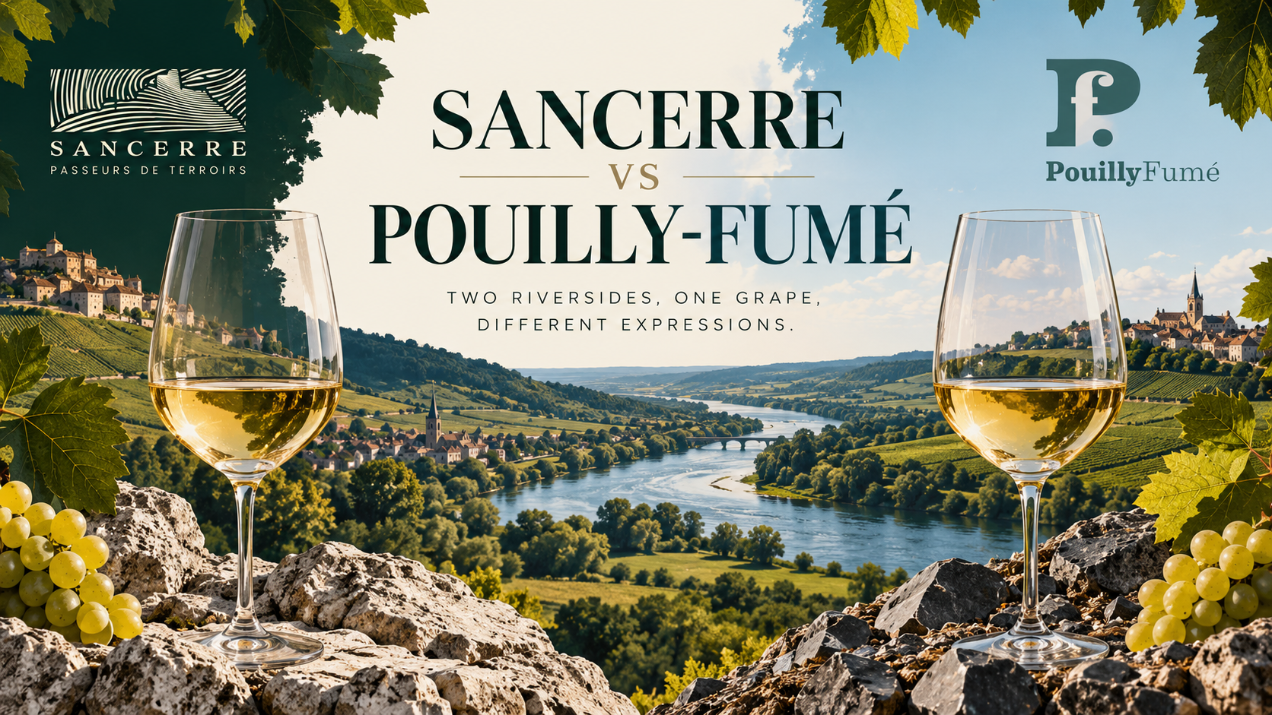
Quick answer
What to know first
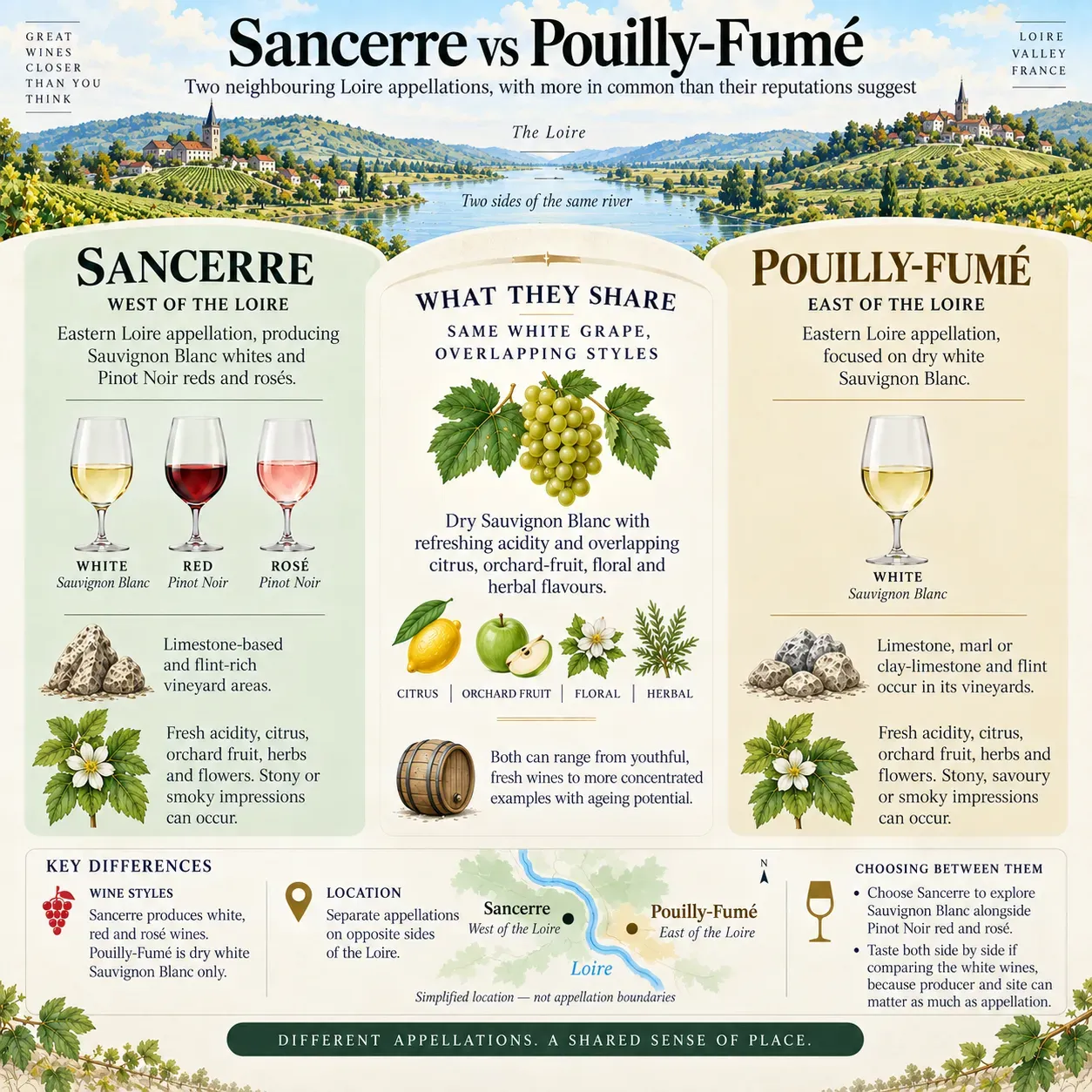
Sancerre and Pouilly-Fumé are neighbouring Loire appellations famous for dry Sauvignon Blanc. Their flavours overlap considerably, so producer and site often matter as much as appellation. Sancerre also makes Pinot Noir red and rosé.
Introduction
Sancerre and Pouilly-Fumé are two of the Loire Valley's best-known names for Sauvignon Blanc. Grown on opposite sides of the Loire in neighbouring appellations, their white wines share enough in flavour and structure to make the differences surprisingly difficult to pin down.
The clearest distinctions are geographical and legal rather than a simple contrast in taste. Sancerre also produces red and rosé wines from Pinot Noir, while Pouilly-Fumé is devoted to dry white Sauvignon Blanc. When comparing their white wines, producer, vineyard site, vintage and winemaking can matter as much as the appellation on the label.
This guide compares what Sancerre and Pouilly-Fumé have in common, where they genuinely differ and how to choose between them — without relying on the misleading shortcut that Sancerre is simply citrusy while Pouilly-Fumé is smoky.
Key Takeaways
- Sancerre and Pouilly-Fumé are separate appellations in the eastern Loire Valley, on opposite sides of the Loire.
- White Sancerre and Pouilly-Fumé are both Sauvignon Blanc, typically combining fresh acidity with citrus, orchard fruit and herbal or floral notes.
- Producer, vineyard site, vintage and winemaking can matter as much as the appellation name when comparing individual bottles.
- Sancerre also produces red and rosé from Pinot Noir, while Pouilly-Fumé is exclusively dry white Sauvignon Blanc.
- Both regions include limestone-based and flint-rich vineyard areas, although their geology is not identical.
- Flinty, stony or smoky impressions can occur in either appellation and are not reliable identifiers.
- Most examples are enjoyable young, while more concentrated wines from both appellations can gain texture and savoury complexity with age.
Sancerre vs Pouilly-Fumé
| Compare | Sancerre | Pouilly-Fumé |
|---|---|---|
| Location | Eastern Loire Valley, west of the Loire. | Eastern Loire Valley, east of the Loire. |
| Grapes | Sauvignon Blanc and Pinot Noir. | Sauvignon Blanc. |
| Wine styles | Dry white, red and rosé. | Dry white. |
| Typical flavour | Citrus, orchard fruit, herbs and flowers; sometimes stony or smoky. | Citrus, orchard fruit, herbs and flowers; sometimes stony, savoury or smoky. |
| Structure | White wines are typically light to medium-bodied with high acidity. | Typically light to medium-bodied, sometimes fuller, with medium-plus to high acidity. |
| Vineyard soils | Clay-limestone, stony limestone and flint among the principal soil families. | Marl or clay-limestone, limestone and flint among the principal soil families. |
| Ageing | Most whites suit early drinking; concentrated examples can develop well. | Most suit early drinking; concentrated examples can develop well. |
| Serving | Around 8–10°C for white Sancerre. | Around 8–11°C. |
| Best identifier | Appellation and wine colour on the label. | Pouilly-Fumé on the label. |
What Is Sancerre?
Sancerre is a wine appellation in the eastern Loire Valley of central France. Its vineyards surround the hilltop town of Sancerre and extend through neighbouring communes on slopes west of the Loire.
Sauvignon Blanc dominates production and is responsible for the dry white wines that made Sancerre internationally famous. Pinot Noir has a smaller but established role, producing Sancerre Rouge and Sancerre Rosé.
White Sancerre is typically dry, fresh and high in acidity, with a light to medium body. Lemon, grapefruit, green apple and pear are common reference points, alongside white flowers, fresh herbs and, in some wines, chalky, stony or smoky impressions.
Three broad soil families — terres blanches, caillottes and silex — are traditionally used to understand its vineyard landscape. Soil is only part of the picture, however: slope, exposure, vine age, vintage and winemaking choices can all influence an individual wine.
What Is Pouilly-Fumé?
Pouilly-Fumé is a white-wine appellation across the Loire from Sancerre. Its vineyards stretch along the river's eastern bank in the Nièvre département, centred on Pouilly-sur-Loire and the hill of Saint-Andelain.
It is made from Sauvignon Blanc, traditionally known locally as Blanc Fumé. The wines are dry and usually light to medium-bodied, sometimes becoming fuller in more concentrated examples, with medium-plus to high acidity.
Typical flavours include lemon, grapefruit, green apple and pear alongside white flowers and fresh herbs. Some wines develop more savoury impressions of chalk, stone, smoke or struck flint.
The word fumé does not mean the wine has been smoked, nor does flint in a vineyard literally pass a smoky flavour into the finished wine. Flinty, stony and smoky are sensory descriptions, shaped by a more complicated interaction of site, vine growth, vintage and winemaking.
Pouilly-Fumé should not be confused with Pouilly-Fuissé, a Chardonnay appellation in Burgundy.
What Do They Have in Common?
Quite a lot. They are neighbouring eastern Loire appellations and both are reference points for cool-climate Sauvignon Blanc.
Compare a white Sancerre with a Pouilly-Fumé and the structural foundations can be very similar: dry wine, refreshing acidity, restrained rather than overtly tropical fruit, and flavours built around citrus, orchard fruit, flowers and herbs.
Their vineyards also share some geological features. Limestone-based soils, marl or clay-limestone and flint occur across the area, although not in identical proportions or configurations. These categories can help explain vineyard variation but should not be treated as simple flavour formulas.
Both appellations range from straightforward, youthful wines to more concentrated and textural expressions. Vineyard position, vintage, vine age, farming and winemaking can therefore create substantial variation within each region.
The Main Differences
Origin and Identity
The clearest difference is geographical. Sancerre lies primarily west of the Loire, while Pouilly-Fumé lies east of it around Pouilly-sur-Loire. They are legally separate appellations with their own defined production areas and rules.
Their scope also differs. Sancerre produces white wine from Sauvignon Blanc and red and rosé wines from Pinot Noir, while Pouilly-Fumé is focused solely on white Sauvignon Blanc.
Grapes and Production
For white Sancerre versus Pouilly-Fumé, the grape does not distinguish them: both are Sauvignon Blanc. The comparison is therefore primarily about place and individual wine rather than grape variety.
Production methods do not create a neat dividing line either. Producers in both appellations can make fresh, direct wines or more concentrated and textural expressions. Fermentation vessel, maturation and lees contact can all influence the result.
Two individual producers can consequently make wines that differ more noticeably than an appellation stereotype would suggest.
Does Sancerre Taste Different From Pouilly-Fumé?
Sometimes, but there is considerable overlap.
White Sancerre is typically dry, high in acidity and light to medium-bodied, with citrus, green apple, pear, flowers and herbs among its common flavours. Pouilly-Fumé occupies much the same spectrum, generally with medium-plus to high acidity and a light to medium body, although concentrated examples can feel fuller.
Stony, chalky, savoury or smoky impressions can appear in either. A citrus-led Pouilly-Fumé may be more direct than a textured Sancerre, while a Sancerre from a flint-rich site can display aromas some drinkers associate with Pouilly-Fumé.
For that reason, “Sancerre = citrus, Pouilly-Fumé = smoky” is not a dependable distinction. Treat flavour descriptions as tendencies within individual wines rather than appellation rules.
Styles and Ageing
Both appellations produce fresh Sauvignon Blanc designed to show well relatively young, as well as more concentrated wines capable of developing for longer.
With bottle age, primary fruit can become less prominent while preserved citrus, waxy, nutty, smoky or savoury characteristics emerge. Site, concentration, vintage and producer decisions are more useful indicators of ageing potential than appellation alone.
Sancerre's red and rosé wines are the one obvious stylistic category without a Pouilly-Fumé equivalent.
How To Tell Them Apart
Start with the label. Sancerre and Pouilly-Fumé are geographical appellation names, making this the reliable way to identify them.
When both wines are white, blind tasting is much less definitive. Compare fruit ripeness, aromatic intensity, acidity, body, texture and savoury character, but expect substantial overlap.
A smoky or flinty aroma may be an interesting clue in an individual wine, but it cannot identify Pouilly-Fumé on its own. The most useful tasting exercise is therefore comparison rather than trying to memorise a rigid regional formula.
Food Pairing Comparison
Both wines work particularly well when a dish benefits from freshness and acidity. Goat's cheese, seafood, white fish and herb-led dishes are natural common ground.
White Sancerre has a famous regional partnership with Crottin de Chavignol goat's cheese and also suits oysters, shellfish, grilled fish, asparagus and other green vegetables.
Pouilly-Fumé works along similar lines. More concentrated examples can also have enough texture for salmon, roast chicken and richer fish preparations.
Cooking method matters too. Simply cooked seafood lets the freshness of either wine remain prominent, while grilling can complement wines with more savoury character. Very sweet dishes or powerful sauces are generally less comfortable matches for lighter examples.
How to serve Sancerre vs Pouilly-Fumé
White
Sancerre Blanc
8–10°C 46–50°F
Serve cool rather than ice-cold. If kept in a normal fridge, let it warm slightly so its citrus, herbal and floral aromas remain expressive.
White
Pouilly-Fumé
8–11°C 46–52°F
Serve youthful Pouilly-Fumé around 8–10°C to preserve its citrus, floral and herbal freshness. More concentrated or mature examples can be served closer to 10–11°C and allowed to warm gently in the glass.
A standard white-wine glass suits both, and there is no useful reason to serve one appellation systematically warmer or in different glassware.
Most youthful examples do not require decanting. If a concentrated wine seems closed, time in the glass or opening it a little earlier may be enough; mature bottles should be treated individually.
Choose the right Loire wine
Use these preferences as a starting point rather than an absolute rule; producer, vineyard site, vintage and winemaking can matter as much as appellation.
If you likeYou want to explore beyond white Sauvignon Blanc
Explore
If you likeYou want an appellation focused entirely on dry Sauvignon Blanc
Explore
If you likeYou enjoy fresh, citrus- and orchard-fruited Sauvignon Blanc
Explore
If you likeYou enjoy stony or savoury character
Explore
If you likeYou want a wine for goat's cheese or seafood
Explore
If you likeYou want to understand the difference for yourself
Explore
Buying Guide
The price bands below reproduce the indicative retail ranges used in the individual Second Glass guides. They differ slightly between the two appellations and can vary by producer, vintage, merchant and market.
Budget — Sancerre £15–25 / $20–35; Pouilly-Fumé £12–22 / $20–30
At this level, expect youthful Sauvignon Blanc built around freshness, citrus, orchard fruit and acidity rather than long ageing. Sancerre's international recognition can keep entry prices relatively high, while Pouilly-Fumé may offer slightly lower starting prices but can be less widely stocked. Look for freshness and balance rather than expecting strong site expression. Spending more becomes worthwhile if you want greater concentration, texture and length.
Mid-Range — Sancerre £25–45 / $35–65; Pouilly-Fumé £22–40 / $30–55
This is a particularly useful range for exploring both appellations. Wines can show more texture, concentration and vineyard character, with some gaining useful ageing potential. For a side-by-side tasting, choose bottles at roughly equivalent prices rather than matching the bands exactly. Paying more should bring greater depth or persistence, not simply a more famous appellation name.
Premium — Sancerre £45–100+ / $65–130+; Pouilly-Fumé £40–80+ / $55–100+
Premium bottles increasingly emphasise individual sites, vine age, concentration and producer interpretation. The best examples from either appellation can develop considerable savoury and textural complexity with age. Higher prices are most worthwhile when you want to explore site expression or bottle development rather than simply fresh Sauvignon Blanc. Neither appellation has an automatic quality advantage at this level.
How to compare Sancerre and Pouilly-Fumé
Choose one white Sancerre and one Pouilly-Fumé from the same or a similar vintage and price range, then serve them side by side at about 10°C in identical glasses.
How To Compare Them Step by Step
- Read the labels and confirm the appellations, choosing the same or a similar vintage and price.
- Serve both wines together in identical white-wine glasses at around 10°C.
- Compare citrus, orchard fruit, flowers, herbs and savoury impressions without assigning them to a region in advance.
- Compare acidity, body and texture, noting whether either wine feels lighter, broader or more concentrated.
- Choose your preference, then reveal the labels; producer and site may explain your preference as much as appellation.
Questions about Sancerre and Pouilly-Fumé
Is Pouilly-Fumé the same as Sancerre?
No. They are separate eastern Loire appellations on opposite sides of the river. Their white wines are both Sauvignon Blanc and can taste quite similar, but their production areas and appellation rules are distinct.
Is Sancerre always Sauvignon Blanc?
No. White Sancerre is Sauvignon Blanc, while the appellation also produces smaller amounts of red and rosé from Pinot Noir.
Is Pouilly-Fumé always Sauvignon Blanc?
Yes. Pouilly-Fumé is dry white Sauvignon Blanc. Do not confuse it with Pouilly-Fuissé, which is a Chardonnay appellation in Burgundy.
Is Pouilly-Fumé smokier than Sancerre?
Not necessarily. Smoky, flinty and stony impressions can occur in both appellations, so they are not reliable identifiers.
Which has higher acidity, Sancerre or Pouilly-Fumé?
Both are typically fresh and high in acidity. Vintage, site, ripeness and winemaking make a simple appellation-wide ranking misleading.
Which is better with goat's cheese?
Both work well. Sancerre has the famous local partnership with Crottin de Chavignol, but Pouilly-Fumé's dry, fresh Sauvignon Blanc is also a natural match.
Can Sancerre and Pouilly-Fumé age?
Yes. Most everyday bottles favour youthful freshness, while more concentrated examples from either appellation can develop greater savoury and textural complexity.
Which is better, Sancerre or Pouilly-Fumé?
Neither is inherently better. For white wines, producer, vineyard site, vintage and style can matter as much as appellation, so choose according to the individual bottle and your preferences.
Final Thoughts
Sancerre and Pouilly-Fumé are better understood as neighbours than opposites. Their white wines share Sauvignon Blanc, refreshing acidity and a broad flavour range spanning citrus, orchard fruit, herbs, flowers and sometimes stony or savoury impressions.
Their clearest differences are geographical and legal rather than a simple contrast in taste. For white wine, the overlap is substantial enough that producer, vineyard and vintage deserve as much attention as the appellation name.
The best next step is to taste one white Sancerre and one Pouilly-Fumé from the same vintage and similar price range side by side. Rather than looking for a winner, notice which individual expression of Loire Sauvignon Blanc you prefer.