Quick answer
What to know first
France's Loire Valley stretches from the Atlantic inland. Expect crisp Muscadet, Chenin Blanc, Sauvignon Blanc and Cabernet Franc, with styles ranging from bone-dry to sweet and sparkling.
Introduction
The Loire Valley is one of France's most varied wine regions. Rather than producing one recognisable house style, it offers a broad collection of wines shaped by changing climates, soils, grapes and traditions from west to east.
The region is best known for fresh white wines, especially Muscadet, Sauvignon Blanc and Chenin Blanc, but it also produces distinctive Cabernet Franc reds, rosé, traditional-method sparkling wines and some of France's most age-worthy sweet wines. Understanding the Loire becomes easier when you connect each major grape with its principal subregion and typical style.
Key Takeaways
- The Loire Valley is a long chain of wine regions rather than one uniform area.
- Melon de Bourgogne makes Muscadet near Nantes; Chenin Blanc is central to Vouvray, Savennières and Anjou-Saumur; Cabernet Franc defines many reds around Chinon and Saumur; Sauvignon Blanc dominates Sancerre and Pouilly-Fumé.
- The region produces dry white, red, rosé, sparkling and sweet wines.
- Fresh acidity is a common thread, but body, sweetness and ageing potential vary widely.
- The Loire offers both affordable, food-friendly bottles and highly age-worthy wines.
How Loire Valley usually feels
Where Is the Loire Valley?
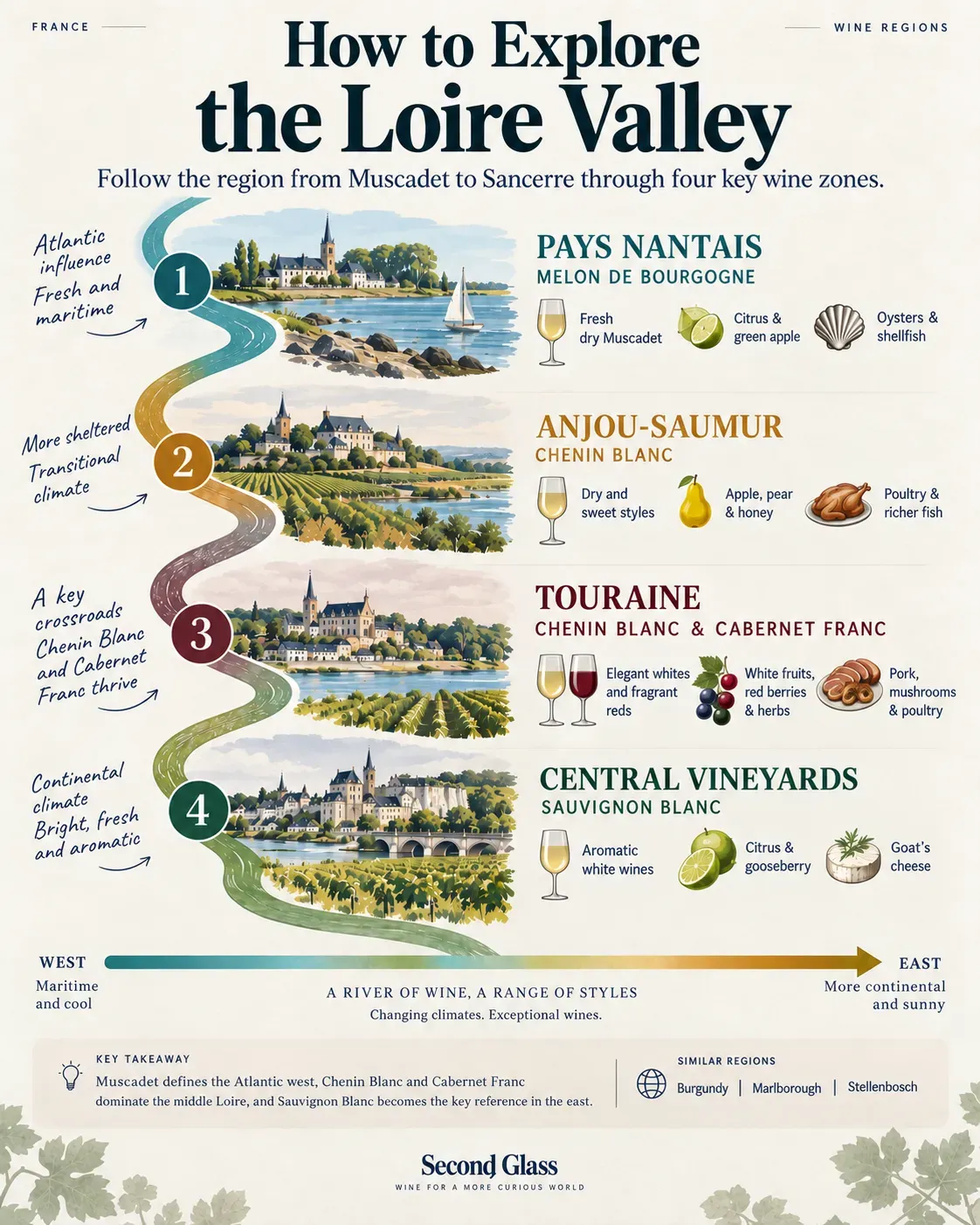
The Loire Valley follows the Loire River and its tributaries from the Atlantic coast around Nantes through Angers, Saumur and Tours towards the vineyards of central France.
Its principal wine zones are usually grouped as the Pays Nantais, Anjou-Saumur, Touraine and the Central Vineyards. Around Nantes, the Atlantic brings a maritime climate. Farther inland, rolling hills, river valleys, limestone slopes and terraces become more prominent. Around Sancerre, vineyards occupy pronounced hillsides with varied exposure.
This geography explains why the Loire produces such a broad range of wines within one region.
Why Is the Loire Valley Famous?
The Loire is famous for its variety and freshness. It produces Muscadet, Sauvignon Blanc, dry and sweet Chenin Blanc, Cabernet Franc reds, rosé, traditional-method sparkling wine and some of France's most long-lived sweet wines.
The region's acidity gives many wines an energetic character and helps the best Chenin Blanc, Cabernet Franc and Sauvignon Blanc develop with age. Differences between appellations can be especially clear, making the Loire a rewarding region to explore comparatively.
Climate and Terroir
The Loire has no single climate.
Near Nantes, Atlantic conditions are mild and damp, while granite and schist soils are common. Around Anjou and Saumur, the climate becomes more sheltered and geology shifts from ancient rocks towards limestone. Touraine is more continental, with limestone, clay, gravel, sand and flint appearing in different sites. The Central Vineyards around Sancerre are more continental still, with limestone-rich, clay-limestone and flinty soils.
For drinkers, the practical lesson is simple: where a Loire wine comes from matters. Climate, slope, exposure, vineyard work, winemaking and geology all influence ripeness, texture and aroma. Soil can contribute to a wine's identity, but it does not determine flavour on its own.
Important grapes in Loire Valley
| Grape | Style | Flavour profile | Structure | Food pairings |
|---|---|---|---|---|
| Chenin Blanc | Dry, off-dry, sweet and sparkling white wine. | Apple, pear, quince, citrus and white flowers, with honeyed, waxy and savoury notes possible with age. | Light to medium body with fresh to high acidity; sweetness ranges from dry to intensely sweet. | Roast chicken, richer fish, pork, creamy cheeses, blue cheese, fruit desserts and pâté. |
| Sauvignon Blanc | Fresh, dry aromatic white wine. | Citrus, green apple, gooseberry, herbs and sometimes floral, stony or smoky notes. | Light to medium body with fresh to high acidity. | Goat's cheese, shellfish, white fish, asparagus, green vegetables and herb-led dishes. |
| Cabernet Franc | Fresh, aromatic dry red wine ranging from light and juicy to structured. | Redcurrant, raspberry, cherry, violet and leafy herbal notes. | Light to medium body with fresh acidity and low to moderate tannin. | Pork, duck, sausages, charcuterie, mushrooms and lentils. |
| Melon de Bourgogne | Light, dry, fresh white wine, including lees-aged Muscadet. | Citrus, orchard fruit, floral notes and occasional saline impressions. | Light body with high freshness; sur lie examples can have additional texture. | Oysters, mussels, prawns, shellfish and simply cooked fish. |
| Pinot Noir | Fresh red and rosé wine. | Red cherry, raspberry and subtle savoury notes. | Light to medium body with fresh acidity and gentle tannin. | Poultry, charcuterie, mushrooms and lighter pork dishes. |
| Gamay | Juicy, light-bodied red wine. | Raspberry, cherry, violet and gentle spice. | Light body with fresh acidity and low tannin. | Charcuterie, chicken, sausages and simple savoury dishes. |
| Cabernet Sauvignon | Supporting red and rosé blending grape, particularly in parts of Anjou. | Darker fruit and savoury notes. | Adds tannin, body and structure to blends. | Roast meats, pork and richer savoury dishes. |
Wine Styles of the Loire Valley
Dry White Wine
Dry whites range from light, subtle Muscadet to citrusy Sauvignon Blanc and broader, more textured Chenin Blanc. Savennières and serious Vouvray can be particularly concentrated and long-lived.
Red Wine
Cabernet Franc is the main reference point, producing wines from fragrant and early-drinking to structured and age-worthy. Pinot Noir and Gamay provide lighter alternatives.
Rosé
Anjou and Touraine produce rosé ranging from dry and crisp to noticeably fruity and sweet. Check the specific appellation rather than assuming all Loire rosé has the same level of sweetness.
Sparkling Wine
Crémant de Loire, Saumur and Vouvray offer fresh sparkling wines with flavours of apple, citrus, quince, flowers and, with age, toast or nuts. Chenin Blanc's acidity makes it especially well suited to sparkling wine.
Sweet Wine
Sweet Chenin Blanc from Anjou can be made from late-harvested grapes and, in suitable conditions, grapes affected by noble rot. Coteaux du Layon is an important appellation to look for in this style. These wines may show quince, apricot, honey and citrus peel while retaining balancing acidity.
What Do Loire Wines Taste Like?
There is no single Loire flavour, but freshness is a useful connecting thread.
White wines may show lemon, green apple, pear, quince, herbs or honey. Reds often offer raspberry, redcurrant, cherry, violet and leafy or earthy notes. Acidity is usually fresh to high, while red wines generally have moderate tannin and alcohol.
Ageing potential varies. Simple Sauvignon Blanc, Gamay and rosé are usually enjoyed young, although good Muscadet can develop. Fine Chenin Blanc and structured Cabernet Franc can mature for a decade or much longer.
Vintage matters most when weather affects ripeness and harvest conditions. Warmer years may bring broader fruit and softer acidity; cooler years often emphasise citrus, herbs and freshness.
How to serve Loire Valley
White
Loire Muscadet
8–11°C 46–52°F
Serve cool rather than ice-cold. This preserves Muscadet's freshness while allowing its subtle citrus, orchard-fruit and lees-derived texture to show.
White
Loire Sauvignon Blanc
9–12°C 48–54°F
Serve chilled but not extremely cold so that citrus, herbal, floral and site-derived aromas remain expressive.
White
Loire Dry Chenin Blanc
10–13°C 50–55°F
Serve moderately chilled. More concentrated or mature examples can be allowed to warm slightly in the glass to reveal greater texture, waxy notes and savoury complexity.
Red
Loire Cabernet Franc
14–17°C 57–63°F
Serve lighter examples slightly cool. More structured or mature Cabernet Franc can be served a little warmer to show its red fruit, floral, herbal and savoury character.
Sparkling
Loire Sparkling Wine
7–10°C 45–50°F
Serve well chilled but not frozen. Slightly warmer serving temperatures can help more mature examples show apple, quince, floral, toast and nutty notes.
White
Loire Sweet Chenin Blanc
8–11°C 46–52°F
Serve chilled enough to keep the wine refreshing, but not so cold that quince, apricot, honey and citrus-peel aromas are suppressed.
The Loire Valley names worth recognising
Muscadet and Muscadet Sèvre et Maine
Memory hook: The Atlantic end of the Loire.
Known for: Fresh, dry Melon de Bourgogne, including sur lie wines.
Why it matters: It provides one of the clearest introductions to the Loire's maritime influence and its classic shellfish-friendly white wines.
Anjou
Memory hook: The Loire's crossroads of grapes and styles.
Known for: Dry and sweet Chenin Blanc, Cabernet-based reds and rosé, and sparkling wine.
Why it matters: Its varied geology, climate and grape mix make it one of the Loire's most stylistically diverse areas.
Savennières
Memory hook: Serious dry Chenin Blanc.
Known for: Structured, concentrated and age-worthy dry Chenin Blanc.
Why it matters: It demonstrates the depth, texture and longevity that Loire Chenin Blanc can achieve in a dry style.
Saumur
Memory hook: Tuffeau, Chenin Blanc and Cabernet Franc.
Known for: Dry white wine, Cabernet Franc reds and sparkling wine.
Why it matters: It combines important limestone landscapes with several of the Loire's defining grapes and styles.
Chinon
Memory hook: Cabernet Franc beside the Vienne.
Known for: Fresh, aromatic Cabernet Franc ranging from light and juicy to structured.
Why it matters: It is one of the Loire's benchmark appellations for understanding Cabernet Franc.
Vouvray
Memory hook: One grape, many styles.
Known for: Still and sparkling Chenin Blanc ranging from dry to sweet.
Why it matters: It shows Chenin Blanc's unusual ability to produce very different styles while retaining firm acidity.
Sancerre
Memory hook: Sauvignon Blanc on the eastern hills.
Known for: Dry Sauvignon Blanc plus red and rosé Pinot Noir.
Why it matters: It is one of the world's best-known reference points for cool-climate Sauvignon Blanc.
Pouilly-Fumé
Memory hook: Sauvignon Blanc across the Loire from Sancerre.
Known for: Dry, fresh and aromatic Sauvignon Blanc.
Why it matters: Comparing it with Sancerre helps show how neighbouring appellations can produce overlapping yet distinct expressions of the same grape.
Coteaux du Layon
Memory hook: The Loire's classic sweet Chenin Blanc.
Known for: Sweet Chenin Blanc with high acidity and concentrated fruit.
Why it matters: It is an important appellation for understanding the Loire's long-lived sweet-wine tradition.
What to eat with Loire Valley wine
Regional specialities
- Muscadet with oysters, mussels, prawns and other shellfish
- Sauvignon Blanc with goat's cheese, white fish, asparagus and herb-led dishes
- Cabernet Franc with pork, duck, charcuterie, sausages, mushrooms and lentils
- Dry Chenin Blanc with richer fish, poultry, creamy sauces and soft cheeses
- Sweet Chenin Blanc with blue cheese, fruit desserts and pâté
- Sparkling Loire with salty snacks, fried appetisers, soft cheeses and seafood
Everyday local pairings
- Muscadet and simply cooked fish
- Sauvignon Blanc and goat's cheese salad
- Cabernet Franc and sausages
- Dry Chenin Blanc and roast chicken
- Sparkling Loire and fried appetisers
Pairings to avoid
Powerful charred meat can overwhelm lighter Loire reds, while very sweet or heavily spiced sauces can overpower delicate Muscadet. Bone-dry Sauvignon Blanc may taste sharp beside dessert, and very tannic reds can clash with delicate shellfish.
Similar wine regions to explore
| Region | Similar | Difference |
|---|---|---|
| Burgundy | Freshness, strong site identity and important cool-climate wines. | Centres primarily on Chardonnay and Pinot Noir rather than the Loire's wider range of grapes and styles. |
| Alsace | Fresh, aromatic white wines with clear varietal character. | Riesling, Gewurztraminer and Pinot Gris are much more important than Chenin Blanc or Sauvignon Blanc. |
| Bordeaux | Shares Cabernet Franc and Sauvignon Blanc. | Relies more heavily on blends and fuller Merlot- and Cabernet Sauvignon-based red wines. |
| Marlborough | High-acid, aromatic Sauvignon Blanc. | Typically shows more overt fruit and pungent aromatics than classic Central Loire Sauvignon Blanc. |
| Finger Lakes | Cool-climate freshness, strong acidity and serious white wines. | Riesling rather than Chenin Blanc or Sauvignon Blanc is the principal white-wine reference. |
| Willamette Valley | Cool-climate freshness and increasing emphasis on individual vineyard sites. | Pinot Noir and Chardonnay dominate its premium wine identity. |
| Stellenbosch | Provides useful comparisons for Chenin Blanc and Cabernet Franc. | Warmer conditions generally produce riper fruit, broader body and higher potential alcohol. |
Buying Guide
Price bands are approximate and vary by country, retailer, vintage and appellation.
Budget £8–£15 / $12–$20
Look for Muscadet, Touraine Sauvignon Blanc, Gamay-based reds and broader Anjou wines. Expect straightforward, fresh, food-friendly bottles for early drinking. Spend more when you want greater site detail, texture or ageing potential.
Mid-Range £15–£30 / $20–$40
This is an excellent range for Vouvray, Chinon, Saumur, Muscadet crus and more specific Cabernet Franc or Sauvignon Blanc. Wines usually offer more texture, length and regional character, with some potential to develop over several years.
Premium £30–£100+ / $40–$130+
Premium bottles include top Chenin Blanc, Cabernet Franc, Sauvignon Blanc and limited-production wines from strong sites or producers. Look for greater depth, length and layers of fruit, flowers, herbs, wax or earth rather than simply more fruit. Fine Chenin and serious Cabernet Franc can reward cellaring.
How To Start Exploring the Loire Valley
The easiest way into the Loire is not to memorise dozens of appellations. Learn the region through four grapes and places: Melon de Bourgogne in Muscadet, Chenin Blanc in Vouvray, Cabernet Franc in Chinon and Sauvignon Blanc in Sancerre or a more affordable neighbouring appellation.
These styles are widely distributed and sufficiently different to make comparison useful. Once you recognise them, smaller appellations become much easier to place within the wider Loire landscape.
-
Step 1 — Begin with freshness
Try Muscadet Sèvre et Maine, preferably alongside shellfish or simple fish, to understand the Atlantic end of the Loire.
-
Step 2 — Compare the major whites
Taste a Sauvignon Blanc from Sancerre or Touraine beside a dry Chenin Blanc from Vouvray. Focus on aroma, texture and acidity rather than trying to identify every flavour.
-
Step 3 — Move to Cabernet Franc
Compare Chinon with Saumur-Champigny or Bourgueil. Look for differences in red fruit, herbal character, tannin and weight.
-
Step 4 — Explore more serious, site-specific wines
Finish with a serious Savennières, single-site Chenin Blanc, mature Cabernet Franc, Muscadet cru or top or structured Central Vineyards Sauvignon Blanc from a strong producer or site to see how concentration, site and ageing expand the region's possibilities.
Common Misconceptions
The Loire Valley Produces Only White Wine
It also produces important reds, rosés, sparkling wines and sweet wines. Cabernet Franc is central to the region's red-wine identity.
Sancerre Is a Grape
Sancerre is an appellation. White Sancerre is Sauvignon Blanc; red and rosé Sancerre are Pinot Noir. Pouilly-Fumé is also an appellation, not a grape.
Muscadet Is Made From Muscat
Muscadet is made from Melon de Bourgogne. Muscat is a different, more aromatic grape family.
All Loire Wine Is Light and Simple
Many wines are fresh and moderate in body, but serious Chenin Blanc, Cabernet Franc, Savennières, sweet wines and some Muscadet crus can be concentrated and long-lived.
Loire Wine Is Always Dry
Dry wines are common, but Chenin Blanc and some rosé styles can be off-dry or sweet. Sparkling wines are also important.
Sancerre and Pouilly-Fumé Are the Same Wine
Both are eastern Loire Sauvignon Blanc appellations, but they are separate regions with different sites, producers and geological details.
Loire Wine Must Be Expensive
Affordable Muscadet, Touraine Sauvignon Blanc, Gamay and Anjou wines can offer excellent value.
Questions about Loire Valley wine
What wine is the Loire Valley best known for?
The Loire Valley is best known for Muscadet, Sauvignon Blanc, Chenin Blanc and Cabernet Franc, alongside important sparkling and sweet wines.
What is the main grape of the Loire Valley?
There is no single main grape. Melon de Bourgogne leads in Muscadet, Chenin Blanc in Anjou-Saumur and Vouvray, Cabernet Franc in many central reds, and Sauvignon Blanc in Sancerre and Pouilly-Fumé.
Is Loire Valley wine sweet or dry?
Both. Muscadet, Sancerre, Savennières and many Cabernet Franc wines are dry, while Chenin Blanc can range from bone-dry to intensely sweet.
Can Loire Valley wine age?
Yes. Everyday wines are usually enjoyed young, but fine Chenin Blanc, structured Cabernet Franc, serious Sauvignon Blanc and some Muscadet can develop for years.
What food goes best with Loire wine?
Seafood, goat's cheese, poultry, pork, vegetables and soft cheeses are reliable choices. Sweet Loire wines can work particularly well with blue cheese, fruit desserts and pâté.
Is Sancerre always Sauvignon Blanc?
No. White Sancerre is Sauvignon Blanc, but the appellation also produces red and rosé wines from Pinot Noir.
Is Muscadet the same as Muscat?
No. Muscadet is made from Melon de Bourgogne, while Muscat is a separate family of aromatic grape varieties.
Where should a beginner start with Loire wine?
Start with Muscadet, Sauvignon Blanc from Sancerre or Touraine, Chenin Blanc from Vouvray and Cabernet Franc from Chinon or Saumur. These four wines provide a clear introduction to the region's principal grapes and styles.
Final Thoughts
The Loire Valley is best understood as a journey from west to east. Start with Melon de Bourgogne in Muscadet, move through Chenin Blanc and Cabernet Franc country, and finish with Sauvignon Blanc around Sancerre.
Its greatest strength is range: fresh seafood whites, age-worthy Chenin, fragrant reds, sparkling wines and sweet wines all belong to the same region while retaining distinct local identities.