
Quick answer
What to know first
Muscadet is a dry white wine from the Loire Valley near Nantes, made from Melon de Bourgogne. It is usually fresh and lively, with citrus, orchard fruit and sometimes a saline finish.
Introduction
Muscadet is a Loire Valley wine with a strong sense of place and a reputation that extends well beyond its role as an oyster-bar favourite. Most Muscadet is a crisp, dry white made from one grape, Melon de Bourgogne, but the wines range from light and straightforward to layered, textured bottles that can develop with age.
This guide explains what Muscadet tastes like, where it comes from, how its appellations and lees-ageing styles differ, what to eat with it, and how to choose a bottle that suits your taste and budget.
How Muscadet usually feels
- Colour
- Dry still white wine
- Fruit
- Lemon, Green apple, Pear and Orchard fruit
- Floral
- White flowers
- Savoury
- Herbs, Briny or saline impressions and Subtle savoury notes
Key Takeaways
- Muscadet comes from the Nantes vineyards in western France, near the Atlantic and the mouth of the Loire.
- The wines are dry whites made from Melon de Bourgogne.
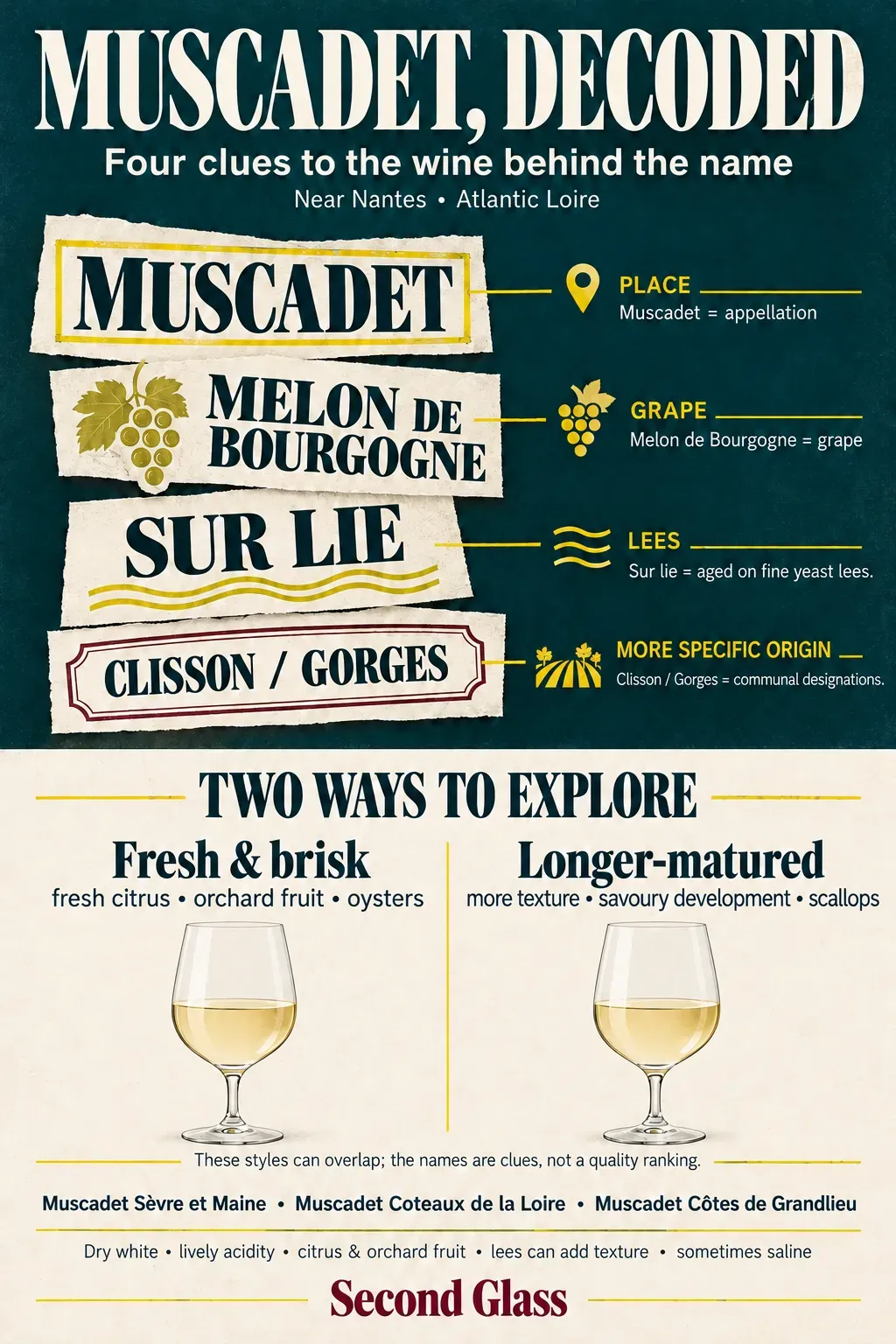
- “Sur lie” refers to maturation on fine yeast lees, which can add texture and complexity.
- Muscadet Sèvre et Maine is the best-known subregional appellation; its cru communaux offer more site-specific, often age-worthy wines.
- Muscadet pairs naturally with seafood, but it also works with vegetables, fish, chicken and some richer dishes.
- Serve everyday Muscadet well chilled; give fuller, longer-aged crus a little more warmth in the glass.
What Does Muscadet Taste Like?
Many Muscadets taste fresh and dry, with lively acidity and a light to medium body. Common notes include lemon, apple, pear and other orchard fruit, sometimes with white flowers or herbs. A saline or subtly savoury impression may also appear.
A fresh, young Muscadet often shows bright fruit and brisk acidity, while a longer-aged wine can have a fuller texture and more developed aromas. The grape is not especially aromatic, so these wines tend to favour quiet detail over powerful perfume. Vintage, site, lees contact and time in bottle all make a difference.
Where Is Muscadet?
Muscadet is made in the Pays Nantais, the westernmost part of France’s Loire Valley wine region. Its vineyards lie around Nantes, between the Loire River and the Atlantic coast, with vines growing along the Sèvre and Maine rivers, around Lake Grandlieu and on the slopes beside the Loire.
This is a maritime-influenced landscape. The Atlantic moderates temperatures, while the Loire and its tributaries shape the region’s valleys and slopes. Muscadet’s vineyard area sits on the Armorican Massif, an ancient geological formation with varied rocks and soils.
Why Is Muscadet Famous?
Muscadet became an appellation in 1937, following the recognition of Muscadet Sèvre et Maine in 1936. Its identity is closely tied to Melon de Bourgogne, a grape that became established in the Nantes vineyards and is now rarely grown elsewhere.
The name is best known internationally for fresh, dry wines that pair well with seafood. Muscadet also has a more complex side: ageing on fine lees can add texture and aromatic depth, while the cru communal wines of Muscadet Sèvre et Maine are made for more extended maturation and can reward patience.
Climate and Terroir
Muscadet’s western location brings Atlantic influence, with a generally temperate maritime climate. The growing season can vary from year to year, and vintage conditions affect ripeness, freshness and the weight of the finished wine. Melon de Bourgogne’s naturally fresh character suits the region, but no single climate feature guarantees a particular flavour.
The underlying geology is varied. Around the Nantes vineyards, bedrock includes granite, gneiss, mica schist, gabbro and other igneous or metamorphic rocks; there are also areas with sand, clay and sediment. Muscadet Sèvre et Maine alone contains a mix of gneiss, orthogneiss, granite, schist and gabbro. Soil, slope, vine age, harvest decisions and winemaking all contribute to a wine’s character, so “mineral” notes should be understood as a sensory description rather than a direct taste of a particular rock.
Important grapes in Muscadet
-
Melon de Bourgogne
- Style
- Dry white wines ranging from fresh and youthful to textured and longer-aged.
- Flavour profile
- Lemon, green apple, pear, white flowers, herbs and sometimes a briny impression.
- Structure
- Usually light to medium in body, with lively acidity and restrained fruit; lees ageing can add texture and complexity.
- Food pairings
- Oysters, mussels, prawns, grilled fish, vegetables and chicken; match fuller lees-aged wines with richer sauces.
Wine Styles
Muscadet is a dry, still white wine appellation. What changes in the glass is mainly the wine’s fruit profile, texture, concentration and development, shaped by lees contact, site, vine yields and time in bottle.
- Fresh, young Muscadet: Usually light to medium in body, with citrus and orchard-fruit notes, lively acidity and a clean finish. These wines are generally made for early drinking.
- Muscadet sur lie: Maturation on fine lees can add roundness, savoury detail and a broader, more textured palate. Some wines retain a slight natural spritz. When “sur lie” appears on a Muscadet label, it is a regulated mention with specific maturation and bottling requirements. The term alone does not predict the exact taste.
- Longer-aged or more concentrated Muscadet: Extended lees ageing, lower yields, older vines and time in bottle can produce greater weight, complexity and length. These wines may show more developed floral, savoury or mineral impressions and can reward patience.
The Muscadet names worth recognising
-
Muscadet Sèvre et Maine
Memory hook: The largest and best-known subregional appellation.
Known for: Dry Melon de Bourgogne wines, including sur lie and cru communal styles.
Why it matters: Located south-east of Nantes between the Sèvre and Maine rivers and their tributaries.
-
Muscadet Coteaux de la Loire
Memory hook: Muscadet from slopes beside the Loire.
Known for: Dry white wines from the smaller appellation north-east of Nantes.
Why it matters: Champtoceaux is identified in the article as a named communal designation within this appellation.
-
Muscadet Côtes de Grandlieu
Memory hook: The appellation around Lake Grandlieu.
Known for: Dry Melon de Bourgogne wines from south-west of Nantes.
Why it matters: Its lake-side setting distinguishes it from the river appellations.
-
Muscadet communal wines
Memory hook: Named origins to explore within the regional appellations.
Known for: Clisson, Gorges, La Haye Fouassière, Le Pallet, Goulaine, Château-Thébaud, Monnières–Saint-Fiacre, Mouzillon–Tillières, Vallet and Champtoceaux.
Why it matters: The names identify specific origins; they do not guarantee a single flavour profile.
How to serve Muscadet
White
Muscadet
7–10°C 45–50°F
Serve chilled to emphasise its light body, acidity and saline freshness; avoid over-chilling.
White
Loire Muscadet
8–11°C 46–52°F
Serve cool rather than ice-cold, allowing citrus, orchard-fruit and lees-derived texture to show.
Fresh Muscadet with seafood and more
Regional specialities
Pair Muscadet with oysters, mussels, prawns, cockles or grilled fish. Its acidity refreshes the palate, while its understated fruit and occasional saline notes complement seafood. A cru communal can suit scallops or fish with creamy lemon sauce.
Everyday pairings
- Mussels marinière with fresh Muscadet
- Fish and chips with a straightforward, crisp bottle
- Grilled white fish with a light, fresh style
- Prawn cocktail with a crisp wine to balance the creamy sauce
- Grilled vegetables with fresh Muscadet
- Cold chicken with a textured, lees-aged example
Pairings to approach carefully
Very sweet, hot or heavily spiced dishes can make a delicate dry Muscadet seem thin or sharp. For richer food, choose a more structured, lees-aged bottle. Creamy sauces can work when they include lemon or herbs.
Similar wines to explore
| Entity | Shared thread | How it differs |
|---|---|---|
| Rías Baixas | Like Muscadet, it is Atlantic-influenced and known for whites that pair well with seafood. | Rías Baixas is best known for aromatic Albariño; Muscadet is usually more restrained. |
| Vinho Verde | Both offer fresh whites suited to seafood and casual drinking. | Vinho Verde can be more aromatic and lightly spritzy; Muscadet is usually more restrained. |
| Picpoul de Pinet | Both are fresh French whites with a reputation for seafood pairings. | Picpoul comes from a warmer Mediterranean setting and is made from Piquepoul Blanc. |
| Chablis | Both can be dry, lively whites with subtle rather than strongly perfumed aromas. | Chablis is Chardonnay from northern Burgundy and can show more body, texture or oak influence. |
| Sancerre | Both are Loire appellations with crisp whites that work with seafood and lighter dishes. | White Sancerre is Sauvignon Blanc and is typically more aromatic and herbal. |
| Entre-Deux-Mers | Both regions produce dry French whites suited to everyday drinking. | Entre-Deux-Mers whites are blends, commonly led by Sauvignon Blanc and Sémillon. |
Buying Guide
Prices vary by retailer, vintage, country and availability. The UK price bands below are indicative retail ranges; prices vary between markets, so check local listings. Current UK listings show entry-level Muscadet around £10–15, while more developed or cru communal examples can cost more.
Budget
About £10–15 / US$13–20. Look for a young regional Muscadet or Muscadet Sèvre et Maine with citrus, orchard fruit, lively acidity and a clean finish. It is generally best within a few years of release. Spend at this level for an aperitif, casual seafood or an easy introduction to the grape.
Mid-Range
About £15–25 / US$20–30. Look for Muscadet Sèvre et Maine, especially a bottle marked “sur lie” or from a more specific site. Expect more texture, length and savoury detail than a basic bottling. Some examples can improve for several years; check the producer or retailer before cellaring. Spend more for a fuller wine suited to a complete meal.
Premium
About £25–40+ / US$30–40+. Look for a named communal wine, such as Clisson, Gorges, Le Pallet or Château-Thébaud, with longer lees ageing and greater concentration. Expect more complex texture and developed savoury, floral or mineral notes. These wines can age for years, but follow producer guidance and treat cellaring as bottle-specific. Spend more for a special meal, comparative tasting or a more developed style.
Common Misconceptions
Muscadet is a sweet wine
Despite the name, Muscadet is generally a dry white wine. Its fresh acidity and restrained fruit can sometimes make it seem fruity, but that does not mean it contains noticeable sweetness.
Muscadet tastes salty because it is made near the sea
Muscadet can have a saline or briny impression, but it is not literally flavoured by seawater or sea air. That character may reflect the interaction of grape variety, site, acidity, lees ageing and winemaking. Not every bottle tastes salty, and coastal location alone does not guarantee a saline finish.
All Muscadet is simple and should be drunk immediately
Many Muscadets are light, fresh wines intended for early drinking, but the category also includes concentrated, longer-aged examples. Cru communal wines and carefully made bottles from older vines or distinctive sites can develop texture and complexity. The appellation name alone does not determine whether a wine is simple or age-worthy.
“Sur lie” means the wine is cloudy or unfiltered
Sur lie describes maturation on fine lees, not whether the wine is filtered or clear. A sur lie Muscadet may be bright and polished, while another bottle may retain more visible sediment or haze depending on the producer’s choices. The term refers to the wine’s ageing process rather than its appearance.
Muscadet must be served ice-cold
Young Muscadet is often refreshing when well chilled, but excessive cold can mute its aromas and make the acidity seem harder. More structured or longer-aged bottles are usually better served slightly warmer, allowing their texture and savoury detail to show. The ideal temperature depends on the style.
Muscadet and Melon de Bourgogne are interchangeable names
Muscadet is the appellation and wine; Melon de Bourgogne is the grape. The grape is used to make Muscadet, but not every wine made from Melon de Bourgogne is necessarily labelled Muscadet. Keeping the two terms separate makes wine labels easier to understand.
Muscadet is only suitable for oysters
Oysters are a classic pairing, but Muscadet also works with mussels, prawns, grilled fish, vegetables, chicken and richer dishes when the bottle has enough texture. Its versatility comes from its dry profile and acidity, not from a rule that limits it to shellfish.
A higher price guarantees a better Muscadet
Price can reflect lower yields, older vines, longer ageing, a named cru, producer reputation or market availability, but it does not guarantee that a bottle will suit your taste. A simple, fresh Muscadet may be the best choice for a hot day or delicate seafood, while a premium cru may be better for a richer meal or slow tasting.
Questions about Muscadet
What grape is used in Muscadet wine?
Muscadet is an appellation name, and its wines are made from Melon de Bourgogne. The grape tends to give dry whites with fresh acidity and delicate aromas. For a first bottle, the appellation name tells you where the wine comes from; the producer, vintage and any site designation can help you explore further.
What food goes best with Muscadet?
Oysters and other seafood are classic choices. A light Muscadet suits a simple fish dish, while a fuller lees-aged bottle can work with scallops or fish in a creamy lemon sauce. See the food pairing guide above for more everyday ideas.
Can Muscadet age?
Some concentrated, longer-aged examples, including cru communal wines, can develop in bottle. A young regional Muscadet is usually bought for its immediate freshness. Ask the merchant or producer about a specific bottle before cellaring it; its appellation or price alone cannot tell you how long to keep it.
Does “sur lie” mean Muscadet is sparkling?
No. Muscadet is a still wine, although some bottles have a slight natural spritz. The regulated “sur lie” mention tells you about the wine’s maturation on fine lees and bottling, rather than a sparkling-wine production method.
Is Muscadet the same as Moscato or Muscat?
No. Muscadet is a dry white wine appellation from the Loire Valley, made from Melon de Bourgogne. Moscato is the Italian name commonly used for wines made from Muscat grapes, which are often aromatic and may be sweet or lightly sparkling, although styles vary. Muscat is the grape family; Moscato is a name used for wines made from it. If you want a crisp, dry seafood wine, look for Muscadet rather than Moscato or Muscat.
How To Start Exploring Muscadet
-
Step 1 — Begin with a young Muscadet Sèvre et Maine sur lie
Taste it with oysters, prawns or a simple fish dish, noting its bright fruit, brisk acidity and clean finish.
-
Step 2 — Compare it with a longer-matured communal bottling
Taste the wines side by side and look for changes in fruit, texture, savoury development and finish.
-
Step 3 — Explore the subregions
Try Muscadet Sèvre et Maine alongside a Coteaux de la Loire or Côtes de Grandlieu bottling.
-
Step 4 — Use the label as a guide
Note the appellation, communal name, vintage and producer, then compare how those details shape the wine.
Final Thoughts
Muscadet offers a range of dry whites, from brisk everyday bottles to more textured, longer-aged wines. Compare a young Muscadet Sèvre et Maine sur lie with a longer-matured communal bottling and notice how fruit, texture, savoury development and finish change in the glass.