
Quick answer
What to know first
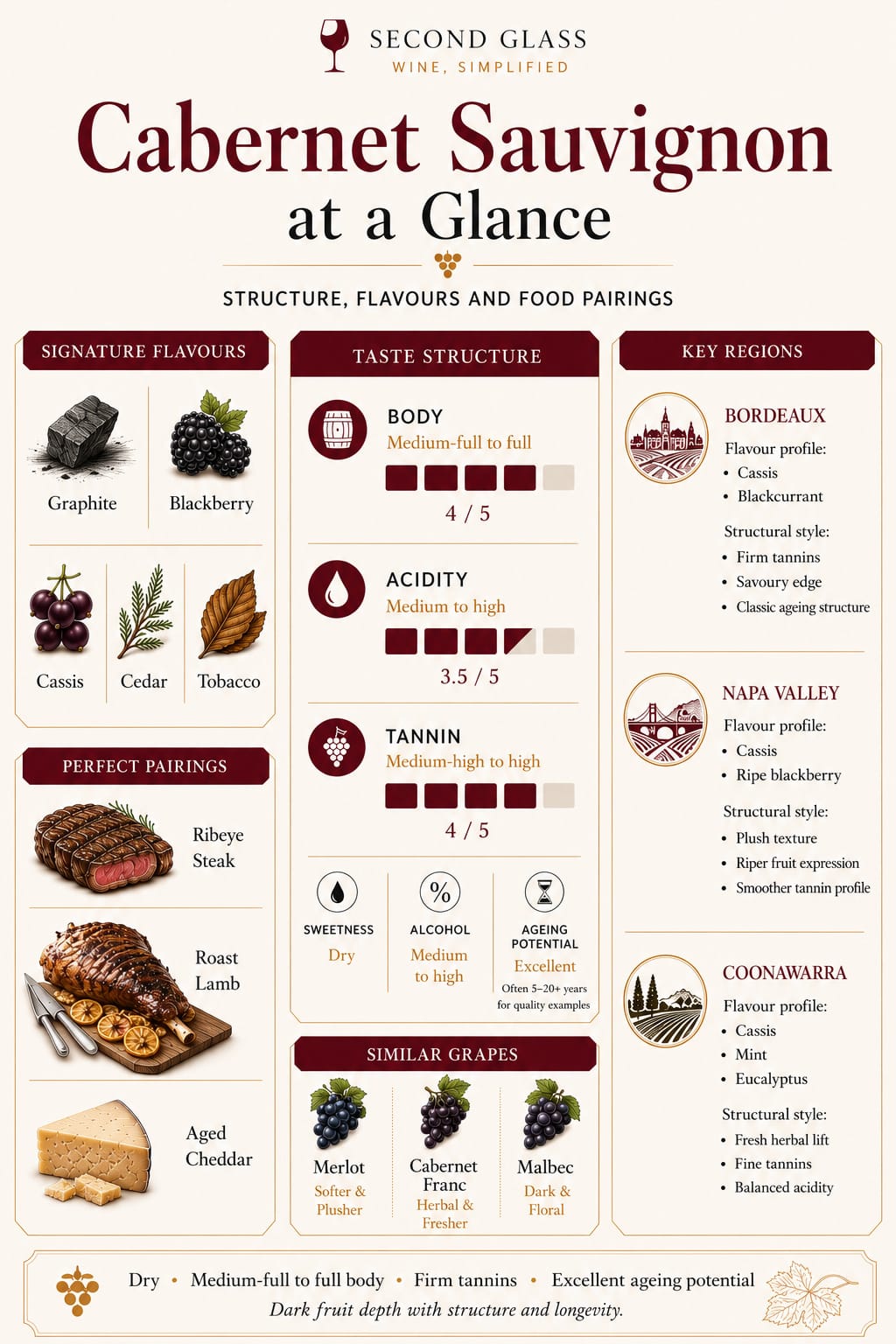
Cabernet Sauvignon is a red grape variety that typically produces medium-full to full-bodied wines known for blackcurrant flavours, firm tannins and excellent ageing potential. It is famous in Bordeaux and Napa Valley, but is grown throughout the world.
How Cabernet Sauvignon usually feels
Key Takeaways
- One of the world's most widely planted red grapes.
- Produces structured, age-worthy wines.
- Typically dry with pronounced tannins.
- Famous in Bordeaux and Napa Valley.
- Flavours often include blackcurrant, blackberry and cedar.
- Usually pairs best with rich, savoury foods.
- Style changes noticeably according to climate and winemaking.
What Is Cabernet Sauvignon?
Cabernet Sauvignon is a red grape variety created naturally by a crossing between Cabernet Franc and Sauvignon Blanc in south-west France. It rose to prominence in Bordeaux, where it became a key component of some of the world's most celebrated wines.
Today, Cabernet Sauvignon is grown in nearly every major wine-producing country. Its popularity comes from its adaptability and ability to produce wines that range from approachable everyday bottles to some of the world's finest and longest-lived reds.
What Does Cabernet Sauvignon Taste Like?
Cabernet Sauvignon is defined by a core set of dark fruit flavours supported by herbal and savoury notes.
Fruit Flavours
- Blackcurrant
- Blackberry
- Black cherry
- Plum
Warmer regions tend to emphasise riper, more jam-like fruit.
Floral Notes
- Violet
- Dried flowers
Herbal and Savoury Notes
- Mint
- Eucalyptus
- Green pepper
- Cedar
- Tobacco
- Graphite
Cabernet Sauvignon’s structure comes from its naturally thick skins, which contribute colour and tannin. These tannins are further shaped by winemaking choices such as skin contact and oak ageing.
Its flavour profile is also strongly influenced by ripeness at harvest. Cooler conditions preserve acidity and herbal notes, while warmer conditions enhance fruit richness and body.
How Ageing Changes Cabernet Sauvignon
Bottle Ageing
Cabernet Sauvignon often develops beautifully in bottle, with fruit evolving into more savoury, complex aromas.
Oak Ageing
Oak ageing is extremely common and often contributes:
- Vanilla
- Cedar
- Spice
- Toast
- Occasional cocoa or mocha notes
Lees Ageing
Lees ageing is not typically a defining characteristic of Cabernet Sauvignon production.
Micro-Oxygenation
Controlled oxygen exposure can soften tannins and make young wines more approachable.
Ageing Potential
Quality Cabernet Sauvignon frequently ages well for many years, and exceptional examples can continue developing for decades, although many are also enjoyable when young.
Body, Acidity and Tannin
Cabernet Sauvignon is a structured wine with medium-full to full body, medium to high acidity and firm tannins. This combination gives it a powerful mouthfeel and strong ageing potential.
Where Is Cabernet Sauvignon Grown?
Cabernet Sauvignon is grown in almost every major wine-producing country, thriving in a wide range of climates from cool continental regions to warm, sun-drenched valleys, with standout expressions found in both Old World regions such as Bordeaux, where it is often blended for structure and longevity, and New World regions like Napa Valley, Coonawarra, Chile’s Maipo Valley, and parts of South Africa, where it is frequently produced as a bold, fruit-forward varietal wine.
World-Class Cabernet Sauvignon Regions
Bordeaux, France
Bordeaux is the historic benchmark for Cabernet Sauvignon-based blends. The region’s maritime climate and gravel-rich soils create a cooler growing environment, resulting in structured, savoury wines with firm tannins, high ageing potential and flavours of blackcurrant, blackberry, cedar, tobacco leaf and graphite. With age, they often develop earthy, cigar box complexity. Cabernet Sauvignon is usually blended with Merlot and Cabernet Franc, which softens its structure and adds aromatic lift.
Napa Valley, USA
Napa Valley is a global benchmark for Cabernet Sauvignon due to its warm climate and diverse soils, which allow full ripening while maintaining structure. It is especially known for powerful, concentrated wines with polished textures, ripe fruit and excellent ageing potential. Flavours typically include cassis, blackberry, black cherry, vanilla, mocha and sweet baking spice from new oak.
Bolgheri, Tuscany, Italy
Bolgheri benefits from its coastal position along the Tyrrhenian Sea, which moderates heat and extends the growing season. This allows Cabernet Sauvignon to achieve both ripeness and freshness, producing structured wines with depth, savoury complexity and a distinctive coastal character. Expect black cherry, plum, dried herbs, leather and refined spice.
Coonawarra, Australia
Coonawarra is defined by its “terra rossa” red clay over limestone soils, which help produce structured yet elegant Cabernet Sauvignon. The cooler climate compared to much of Australia preserves freshness and aromatic lift. Wines typically show blackcurrant, dark plum, mint, eucalyptus and subtle cocoa, with fine tannins and a distinctive herbal edge.
Alto Maipo, Chile
Single-vineyard Cabernet Sauvignon from the Andean foothills benefits from high altitude, intense sunlight and cool nights. This slows ripening and preserves freshness while building deep colour and firm structure. The result is a precise, structured style with clarity, tension and strong ageing potential.
Maipo Valley, Chile
Maipo Valley is one of Chile’s most classic Cabernet Sauvignon regions, offering a balanced expression of the grape. Warm days and cool nights support both ripe fruit development and fresh acidity. Wines commonly show blackcurrant, blackberry, red plum and gentle herbal notes, with hints of graphite and spice. The style is smooth, fruit-driven and excellent value.
Stellenbosch, South Africa
Elevated vineyards and decomposed granite soils give Cabernet Sauvignon strong structure and concentration. Warm days balanced by cooling ocean influence preserve freshness, resulting in wines that combine ripe cassis fruit, firm tannins and savoury spice, often with notes of fynbos and cedar.
Washington State, USA
Washington produces structured Cabernet Sauvignon with a balance of ripe dark fruit and herbal complexity. Warm, dry conditions in key AVAs like Red Mountain and Columbia Valley create concentrated wines with blackberry, cassis, plum and graphite, supported by firm tannins and fresh acidity.
Margaret River (Wilyabrup), Australia
This coastal region is shaped by maritime influence and gravelly soils, creating ideal conditions for slow, even ripening. Cabernet Sauvignon here is typically elegant and restrained, with blackcurrant, bay leaf, fine tannins and a distinctive herbal, almost Bordeaux-like structure.
What to eat with Cabernet Sauvignon
Ideal pairings
- Ribeye steak
- Roast lamb
- Beef Wellington
- Aged cheddar
- Venison
These dishes match the wine's tannins and richness.
Everyday pairings
- Burgers
- Roast beef sandwiches
- Barbecue dishes
- Mushroom pie
- Mature hard cheeses
Pairings to approach carefully
- Delicate white fish
- Very spicy dishes
- Light salads
- Sweet desserts
The wine's intensity can overwhelm delicate flavours and accentuate heat or sweetness.
Similar grapes to try
| Grape | Similar | Difference |
|---|---|---|
| Merlot | Black fruit and Bordeaux heritage. | Softer tannins and more plush texture. |
| Cabernet Franc | Herbal notes and freshness. | Lighter body and less tannic structure. |
| Malbec | Dark fruit and full body. | Softer acidity and floral characteristics. |
| Syrah | Full body and ageing potential. | More pepper and savoury spice. |
| Petit Verdot | Deep colour and powerful tannins. | More floral and intensely structured. |
| Tannat | Firm tannins and age-worthiness. | Usually even more tannic and rustic. |
Buying Guide
Budget (£8–£15 / $10–$19)
At this price point, expect approachable Cabernet Sauvignon with straightforward black fruit flavours such as blackcurrant and blackberry, moderate tannins and limited oak influence. Wines from Chile and South Africa often offer particularly strong value, while some entry-level California producers also provide enjoyable everyday options.
Mid-Range (£15–£35 / $19–$44)
Mid-range bottles typically deliver greater concentration of fruit, more refined tannins and better integration of oak. Expect additional layers of flavour, including cedar, tobacco and subtle spice, along with improved balance and complexity. This category includes many high-quality wines from Bordeaux, Napa Valley and premium regions in Australia.
Premium (£35+ / $44+)
Premium Cabernet Sauvignon offers exceptional depth, structure and ageing potential. These wines often display intense dark fruit, savoury notes, finely textured tannins and impressive length on the palate. Top examples from prestigious regions such as classified Bordeaux estates and leading Napa Valley producers can age gracefully for decades and may range from around £35 to several hundred pounds per bottle.
Common Misconceptions
Cabernet Sauvignon Is Always Heavy
Climate and winemaking can produce surprisingly elegant examples.
Cabernet Sauvignon Must Be Expensive
Excellent bottles are available from numerous regions and price points.
It Needs Decades of Ageing
Many wines are enjoyable when young.
It Is Always Oaky
Oak use varies considerably by producer and style.
It Is Too Tannic for Beginners
Food pairing and modern winemaking often make Cabernet Sauvignon approachable.
Questions about Cabernet Sauvignon
Is Cabernet Sauvignon always blended?
No. Cabernet Sauvignon can be bottled alone or blended. Bordeaux commonly blends it with Merlot and Cabernet Franc, while many New World producers bottle it as a single-varietal wine.
Why does Cabernet Sauvignon taste like blackcurrants?
The grape naturally develops aroma compounds that many people perceive as blackcurrant and dark berry notes. Climate and ripeness influence how pronounced these characteristics become.
Why are the tannins so noticeable?
Cabernet Sauvignon has thick skins that naturally contain significant tannins. These compounds, together with tannins extracted from the seeds and sometimes influenced by oak ageing, contribute structure and ageing potential.
Can Cabernet Sauvignon age well?
Yes. Its combination of acidity, tannins and fruit concentration makes it one of the world's most age-worthy red grapes.
Does Cabernet Sauvignon always taste of oak?
No. Oak is common but not universal. Unoaked examples tend to emphasise fruit and freshness.
Is Cabernet Sauvignon suitable for beginners?
Yes. Although structured, its familiar fruit flavours and broad availability make it an excellent grape for exploration.
Is Cabernet Sauvignon dry or sweet?
Cabernet Sauvignon is a dry red wine. It contains very little residual sugar, so it is not sweet. Its flavour comes from dark fruit, tannins and oak influence rather than sweetness.
If you are new to Cabernet Sauvignon
Start with a fruit-forward Cabernet Sauvignon from Chile or California before exploring more structured examples from Bordeaux.
Final Thoughts
Cabernet Sauvignon has earned its global reputation through its distinctive combination of dark fruit, structure and ageing potential. Whether discovered through Bordeaux, Napa Valley or emerging regions, it remains one of the most rewarding grapes for beginners and experienced wine lovers alike.