
Quick answer
What to know first
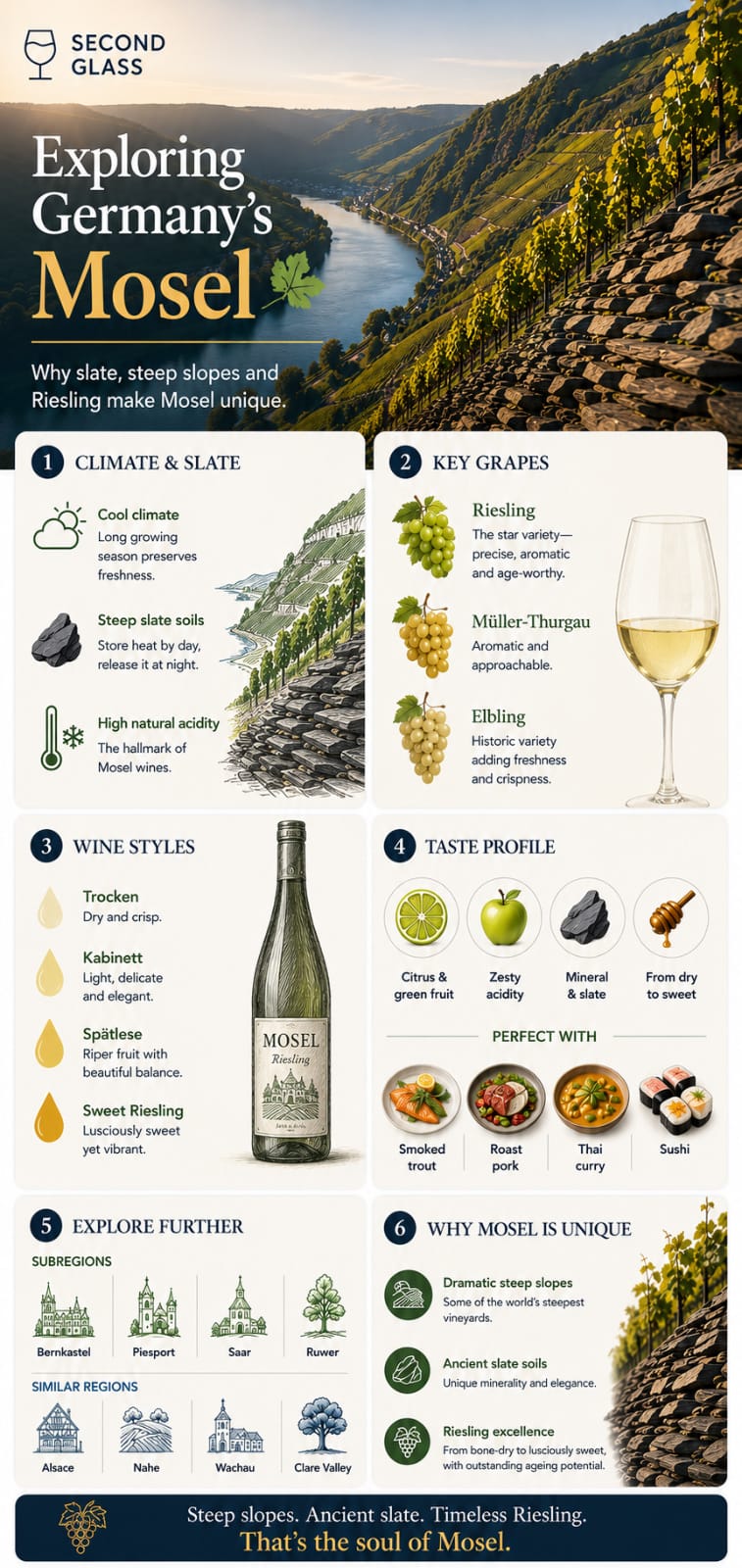
Germany's Mosel is renowned for steep slate vineyards producing elegant Riesling with vibrant acidity, citrus, stone fruit and remarkable ageing potential, ranging from bone dry to lusciously sweet.
Key Takeaways
- Mosel is widely regarded as one of Germany's most famous Riesling regions, particularly internationally.
- Steep slate vineyards define both the landscape and wine style.
- Wines are typically light-bodied with high acidity and low to moderate alcohol.
- Riesling dominates, though Pinot varieties are becoming more common.
- Styles range from dry (Trocken) to some of the world's finest sweet wines.
- Vintage conditions influence ripeness and style, though producers also control final sweetness.
- Excellent food wines thanks to their freshness and balance.
How Mosel usually feels
Where Is Mosel?
Mosel lies in western Germany, following the winding Mosel River from the French and Luxembourg borders towards Koblenz, where it joins the Rhine.
The vineyards occupy some of Europe's steepest slopes, many exceeding 60% gradients, overlooking dramatic river bends. Numerous historic villages, castles and terraced vineyards contribute to one of Germany's most recognisable wine landscapes.
The cool continental climate makes ripening challenging, but the river reflects sunlight while steep south-facing slopes maximise exposure. These conditions allow grapes to ripen slowly, preserving acidity while developing complex aromas.
Mosel is one of Germany's most historic and internationally recognised wine regions and remains synonymous with world-class Riesling.
Why Is Mosel Famous?
Mosel has produced wine for over two thousand years, with Roman settlers establishing vineyards that continue to influence today's landscape.
Its international reputation comes from Riesling grown on Devonian slate soils, including blue, grey and red variations. Few regions express this grape with such purity, elegance and longevity.
Wine enthusiasts value Mosel for its remarkable balance between sweetness, acidity and low alcohol. Even sweeter styles remain refreshing rather than heavy.
Many of Germany's most collectible wines originate from famous vineyard sites throughout the region.
Climate and Terroir
Climate
Mosel has one of Germany's coolest wine-growing climates.
Long growing seasons encourage gradual ripening, allowing grapes to retain vivid acidity while developing delicate aromatic complexity.
Warm vintages generally make it easier to achieve riper fruit and produce dry wines, while cooler years often create lighter, more delicate expressions. However, skilled producers can make excellent dry wines in a wide range of vintages.
Soils
The defining soil is Devonian slate.
Blue slate is particularly associated with some of the region's most famous sites, though excellent wines are also produced from grey and red slate.
Slate stores daytime warmth and releases it overnight, helping grapes ripen despite the cool climate.
Elevation and Topography
Many vineyards are planted on dramatic river-facing slopes.
Steep gradients maximise sunshine and drainage but require almost all work to be carried out by hand.
These extreme sites contribute significantly to wine quality but also make production expensive.
How Terroir Shapes Wine Style
The cool climate, slate soils and long ripening season produce wines with:
- high natural acidity
- bright citrus flavours
- delicate floral aromas
- a distinctive sense of minerality (a tasting descriptor rather than a literal flavour from the soil)
- excellent ageing potential
- relatively low alcohol
Together these create Mosel's unmistakably elegant style.
Important grapes in Mosel
| Grape | Style | Flavour profile | Structure | Food pairings |
|---|---|---|---|---|
| Riesling | Dry, off-dry and sweet white wines. | Lime, green apple, peach, apricot, white flowers and mineral-like stony notes. | Light-bodied with high acidity, low to moderate alcohol and exceptional ageing potential. | Smoked trout, sushi, pork and spicy Asian cuisine. |
| Müller-Thurgau | Fresh everyday white wines. | Apple, pear and delicate floral notes. | Light-bodied with soft acidity. | Salads and light seafood. |
| Elbling | Crisp dry white wines. | Green apple, citrus and herbs. | Very light-bodied with refreshing acidity. | Oysters and mussels. |
| Pinot Blanc (Weissburgunder) | Dry textured white wines. | Pear, apple and almond. | Medium-bodied with balanced acidity. | Chicken and creamy sauces. |
| Pinot Noir (Spätburgunder) | Elegant red wines. | Cherry, raspberry and subtle spice. | Light to medium-bodied with silky tannins. | Duck and mushrooms. |
Wine Styles of Mosel
Red
Small quantities of elegant Pinot Noir with bright fruit and refined tannins.
White
The region's speciality, ranging from bone dry Trocken wines through off-dry styles to rich noble sweet wines.
Rosé
Limited production, generally fresh and fruit-driven.
Sparkling
Quality Sekt is increasingly produced from Riesling and Pinot varieties.
Sweet
Among the world's finest sweet wines, including Spätlese, Auslese, Beerenauslese, Trockenbeerenauslese and Eiswein when conditions permit.
What Do Wines From Mosel Taste Like?
Fruit Characteristics
- Lime
- Green apple
- Peach
- Apricot
- Pear
- Citrus zest
Floral Characteristics
- White blossom
- Jasmine
- Honeysuckle
Herbal and Savoury Characteristics
- Stony or flinty minerality
- Fresh herbs
- Subtle petrol notes with bottle age
Structural Characteristics
Typically light-bodied with vibrant acidity.
Alcohol often ranges from around 7.5% in sweeter wines to approximately 12.5% in dry styles.
Sweetness is balanced by remarkable freshness.
Ageing Characteristics
Quality Riesling develops honey, toast, beeswax and the distinctive petrol aromas prised by many enthusiasts while retaining freshness for decades.
Vintage Variation
Cool years produce lighter, higher-acid wines.
Warm years often deliver riper fruit, fuller body and make dry styles easier to produce, though winemaking choices remain important.
Exceptional vintages combine concentration with vibrant acidity.
The Mosel names worth recognising
Bernkastel
Memory hook: The classic heart of Mosel Riesling.
Known for: Steep slate vineyards and elegant ageworthy Riesling.
Why it matters: Bernkastel is home to many of Germany's most famous vineyard sites.
Piesport
Memory hook: Home of Goldtröpfchen.
Known for: Generous fruit with vibrant acidity.
Why it matters: Piesport is one of Mosel's benchmark villages.
Ürzig
Memory hook: Red slate and spice.
Known for: Expressive Rieslings with exotic fruit and pronounced spice from distinctive red slate soils.
Why it matters: Ürzig shows how Mosel soil colour and site character can shape a highly recognisable Riesling style.
Saar
Memory hook: Mosel's coolest expression.
Known for: Delicate, long-lived Riesling with piercing acidity.
Why it matters: Saar wines show exceptional finesse, tension and ageing potential.
Ruwer
Memory hook: Precision and purity.
Known for: Mineral-driven Riesling with clarity and elegance.
Why it matters: Ruwer produces some of Germany's most refined and graceful wines.
Terrassenmosel
Memory hook: Terraced vineyards near Koblenz.
Known for: Structured wines with notable mineral character from steep terraced vineyards.
Why it matters: Terrassenmosel highlights the dramatic lower Mosel landscape and its concentrated, slate-driven wines.
What to eat with Mosel
Regional specialities
- Smoked trout
- River fish
- Pork schnitzel
- Roast pork
- White asparagus
- Potato dishes
The region's vibrant acidity cuts through richness while complementing delicate flavours.
Everyday local pairings
- Sushi
- Prawn dishes
- Thai curry
- Roast chicken
- Goat's cheese
- Apple tart with sweeter styles
Pairings to approach carefully
Very spicy chilli-heavy dishes can overwhelm delicate dry Rieslings, though off-dry and sweeter Mosel styles often pair very well with spicy cuisines.
Heavily charred steaks can dominate lighter-bodied Rieslings.
Very sweet desserts often require richer dessert wines than lighter off-dry styles.
Similar wine regions to explore
| Region | Similar | Difference |
|---|---|---|
| Alsace | Premium Riesling and aromatic whites. | Typically drier, fuller-bodied wines. |
| Wachau | Ageworthy mineral Riesling. | Generally richer and more powerful. |
| Finger Lakes | Cool-climate Riesling with vibrant acidity. | Generally shows more fruit-forward character. |
| Eden Valley | Elegant, ageworthy Riesling. | Often more lime-driven and dry. |
| Nahe | Shares cool-climate elegance. | Offers greater soil diversity and broader stylistic variation. |
| Rheingau | Another prestigious Riesling region. | Typically produces fuller-bodied wines than Mosel. |
| Clare Valley | Lime-driven Riesling. | Warmer climate and almost exclusively dry wines. |
Buying Wines From the Region
Budget (£10–18)
Fresh, youthful Rieslings with bright citrus fruit, green apple notes and crisp acidity.
Often sourced from larger vineyard areas rather than single sites, these wines are typically made for early drinking and showcase the region’s signature freshness.
Excellent introduction to the region and ideal for everyday drinking.
Mid-Range (£18–40)
Single-vineyard wines or higher-quality estate bottlings offering greater complexity, more pronounced mineral character and improved ageing potential.
Expect more depth of flavour, including stone fruit, floral notes and subtle slate influence.
Many wines in this range can age for several years, developing additional complexity over time.
Premium (£40–150+)
Historic vineyard sites and top estates producing wines capable of ageing for decades.
These wines often come from classified vineyards and may include both dry Grosses Gewächs and high-quality Prädikat wines.
Top dry wines such as Grosses Gewächs can be expensive, though the highest prices are often achieved by rare sweet wines such as Beerenauslese, Trockenbeerenauslese and Eiswein, which are produced in very limited quantities and can extend well beyond this range.
Note that pricing can vary significantly depending on producer, importer and vintage, so these ranges should be viewed as general guidance rather than fixed rules.
Common Misconceptions
Mosel wines are always sweet
While Mosel is famous for off-dry and sweet Rieslings, many producers now make excellent dry wines (Trocken) that are crisp, mineral-driven and food-friendly.
Mosel wines are low quality because they are light
Light body does not mean low quality. Mosel wines are prized for their precision, balance and complexity, often requiring great skill to produce in a cool climate.
All Mosel wines taste the same
Differences in vineyard location, soil type (blue, grey or red slate), and subregion create noticeable variation in flavour, structure and intensity.
Mosel wines should be drunk young
While many entry-level wines are best enjoyed fresh, high-quality Rieslings from Mosel can age for decades, developing complex honeyed and savoury characteristics.
Steep vineyards are just for appearance
The steep slopes play an important role in helping grapes ripen in a cool climate by maximising sunlight exposure and heat retention from slate soils, though quality wines are also produced from less steep sites.
FAQs
Is Mosel only famous for Riesling?
No. Riesling dominates production and defines the region's reputation, but Mosel also produces Müller-Thurgau, Elbling, Pinot Blanc, Pinot Gris and increasingly impressive Pinot Noir. Nevertheless, Riesling remains the benchmark for quality and international recognition.
Are Mosel wines always sweet?
No. Mosel produces dry, off-dry and sweet wines. While many people associate the region with sweeter Rieslings, modern producers increasingly make outstanding dry wines alongside classic Kabinett and noble sweet styles.
Why are Mosel vineyards so steep?
The steep slopes maximise sunlight in Germany's cool climate while improving drainage. They also increase heat reflected from slate and the river, helping grapes ripen fully despite relatively cool growing conditions.
Can Mosel Riesling age well?
Yes. High-quality Riesling from Mosel is among the world's longest-lived white wines. The combination of acidity, balance and concentration allows many wines to develop beautifully over several decades.
What foods pair best with Mosel Riesling?
Fish, shellfish, roast pork, smoked salmon, sushi, Thai cuisine and soft cheeses all pair exceptionally well. Off-dry styles are particularly well suited to spicy dishes, as their slight sweetness helps balance heat.
Is Mosel good value?
Yes. Compared with many famous wine regions, Mosel still offers outstanding value across most price points. Even modestly priced Rieslings often show excellent balance, purity and ageing potential.
How should beginners start exploring Mosel?
Begin with a quality Kabinett and a dry Trocken Riesling from respected producers. Comparing these styles reveals how sweetness, acidity and terroir interact, making Mosel one of the easiest regions for understanding Riesling.
If you are new to Mosel
Compare a Kabinett with a Trocken Riesling from the same producer before exploring Saar, Ruwer and single-vineyard wines.
Final Thoughts
Mosel remains one of the world's great wine regions because it combines dramatic landscapes with extraordinary precision in the glass. Whether you enjoy bone-dry Riesling or luscious sweet wines, its slate-grown expressions offer freshness, elegance and remarkable ageing potential that few regions can match.