
Quick answer
What to know first
Savoie is a small, scattered wine region in eastern France, best known for crisp Jacquère whites, aromatic Altesse and peppery Mondeuse reds, often shaped by Alpine slopes and cool conditions.
Introduction
Savoie is a mountain wine region with a character all its own. Its vineyards are scattered across Alpine foothills, valleys and lake shores, where local grapes such as Jacquère, Altesse and Mondeuse make wines that can be hard to find far from France.
The region’s reputation rests on fresh whites, but there is more to explore: textured Roussanne under the name Bergeron, characterful Mondeuse reds, and sparkling wines. This guide explains where Savoie’s wines come from, how to read their appellations, what they taste like and what to serve with them.
How Savoie usually feels
- Colour
- White, red, rosé and sparkling wines
- Fruit
- Citrus, Pear and green apple, White and yellow fruit, Red and dark berries, Stone fruit and Black cherry and blackberry
- Floral
- White flowers and Violet
- Savoury
- Pepper and spice, Fresh herbs, Honey and almond and Stony or mineral impressions
Key Takeaways
- Savoie’s vineyards are scattered across eastern France, mainly in Savoie and Haute-Savoie, with smaller areas in neighbouring departments.
- Jacquère is the region’s best-known white grape, making dry, lively wines that are often enjoyable young.
- Altesse, also called Roussette, can make more aromatic, rounded whites with greater ageing potential.
- Mondeuse is a distinctive local red grape, usually associated with fresh dark fruit, spice and firm but lively structure.
- Chignin-Bergeron is made from Roussanne, known locally as Bergeron.
- Look for names such as Apremont, Abymes, Arbin and Marestel to explore different areas and styles.
- Alpine freshness is a useful starting point, but grape, site, vintage and winemaking all affect the wine in your glass.
Where Is Savoie?
Savoie lies in eastern France, on the western edge of the Alps. The wine-growing area forms a loose arc from near Lake Geneva south towards Albertville, with its best-known concentrations around Chambéry, the Combe de Savoie and the shores of Lake Bourget. The vineyards are not one continuous block: mountain slopes, valleys and lakes separate them into distinct pockets.
The appellation area crosses Savoie and Haute-Savoie and includes smaller areas in Ain and Isère. Vines often occupy slopes at roughly 250 to 500 metres, where exposure, shelter and altitude can vary considerably from one site to another. That scattered geography helps explain why Savoie has many grape varieties and local wine names, despite its small size.
Why Is Savoie Famous?
Vines have been grown in the region for centuries; historical references to wine in the area date back to Roman times. Savoie’s modern reputation, however, is closely tied to its distinctive Alpine setting and local grape varieties. It is one of France’s smaller wine regions, and many of its wines have traditionally been drunk close to home, especially alongside the region’s food and mountain life.
The whites are the best-known introduction. Jacquère offers a crisp, uncomplicated style, while Altesse and Roussanne can make wines with more aroma, texture and capacity to develop. Mondeuse gives the region a red-wine identity of its own: fragrant, lively and often marked by peppery or savoury notes.
Savoie also produces sparkling wine. Look for Crémant de Savoie, traditional-method white sparkling wine made under the Savoie / Vin de Savoie appellation, and Seyssel, a small appellation known for both still and sparkling wines.
Climate and Terroir
Savoie has a mountain climate, but the vineyards are not all at the same altitude or equally exposed. The Alps bring cold winters and influence rainfall, while warmer summers and sheltered, sunny slopes allow grapes to ripen. Lakes, valleys and the direction a slope faces can moderate local conditions. INAO describes the vineyards as mostly on limestone-based soils or stony glacial deposits, with vines reaching up to 500 metres in the Vin de Savoie appellation area.
These conditions help explain why fresh, dry whites are so prominent, but soil or altitude alone does not dictate flavour. Jacquère grown on one slope may differ from Jacquère grown elsewhere; harvest date, vineyard choices and winemaking also matter. A cooler site may preserve more freshness, while a sunnier or more sheltered one may give riper fruit or a broader texture.
The practical lesson is to use place names as clues, not guarantees. Appellations and cru names tell you where a wine comes from; the grape and the producer’s approach help you anticipate its style.
Important grapes in Savoie
-
Jacquère
- Style
- Dry, fresh white, often light-bodied and best enjoyed young.
- Flavour profile
- Citrus, pear, green apple and white flowers.
- Structure
- Light body with lively acidity; richer examples exist.
- Food pairings
- Lake fish, shellfish, salads and fondue.
-
Altesse
- Style
- Aromatic, textured white, bottled as Roussette de Savoie.
- Flavour profile
- White fruit, flowers, quince, honey and almond.
- Structure
- More rounded and aromatic than many Jacquère wines; some examples develop with age.
- Food pairings
- Roast chicken, fish in sauce and creamy mushroom dishes.
-
Roussanne (Bergeron)
- Style
- Fuller, aromatic white, especially as Chignin-Bergeron.
- Flavour profile
- Orchard fruit, stone fruit and floral notes.
- Structure
- Broader texture balanced by freshness.
- Food pairings
- Roast chicken, creamy fish dishes and richer Alpine cheeses.
-
Mondeuse
- Style
- Distinctive red ranging from bright and approachable to structured.
- Flavour profile
- Red or dark fruit, pepper and savoury notes.
- Structure
- Noticeable tannin and lively freshness; weight varies.
- Food pairings
- Sausages, roast pork, mushrooms, charcuterie and game.
-
Persan
- Style
- Rare, deeply coloured red with ageing potential.
- Flavour profile
- Black cherry, blackberry, pepper and violet, especially as the wine develops.
- Structure
- Firm tannin, lively acidity and medium body.
- Food pairings
- Game, red meat and slow-cooked mountain dishes.
-
Douce Noire (Corbeau)
- Style
- Very rare, supple red; Douce Noire is a recognised synonym for Corbeau.
- Flavour profile
- Fresh fruit with a lively, straightforward profile.
- Structure
- Generally softer in tannin and lower in alcohol than structured Mondeuse or Persan.
- Food pairings
- Charcuterie, sausages and simple savoury dishes.
-
Gringet
- Style
- Still dry white and traditional-method sparkling wine associated with Ayze.
- Flavour profile
- Still wines can show floral notes and freshness; sparkling examples are delicate and fresh.
- Structure
- Fresh, light to medium-bodied; serve according to whether it is still or sparkling.
- Food pairings
- Lake fish, savoury snacks and aperitif dishes.
-
Gamay
- Style
- Fresh, lighter-bodied red.
- Flavour profile
- Red berries and gentle spice.
- Structure
- Light body with fresh acidity and generally softer tannin than structured Mondeuse.
- Food pairings
- Charcuterie, sausages and roast chicken.
-
Pinot Noir
- Style
- Fresh red or rosé.
- Flavour profile
- Red fruit with possible savoury notes.
- Structure
- Light to medium body; style varies by site and winemaking.
- Food pairings
- Poultry, charcuterie and mushrooms.
-
Chasselas
- Style
- Subtle white found in parts of Savoie, especially near Lake Geneva.
- Flavour profile
- Delicate fruit and floral notes.
- Structure
- Generally fresh and supple.
- Food pairings
- Lake fish and simply prepared seafood.
-
Chardonnay
- Style
- White grape used in some regional wines.
- Flavour profile
- Orchard fruit, with texture depending on site and winemaking.
- Structure
- Style varies by producer and élevage.
- Food pairings
- Roast chicken, fish and creamy dishes.
Other grapes to look for
Savoie’s other grapes add useful variety. Gamay and Pinot Noir make lighter reds; Chasselas appears in parts of the region, especially near Lake Geneva. The region also grows Chardonnay, alongside other local white varieties, but the grape’s name on the label may be a more helpful first clue than the broader regional name.
Wine Styles of Savoie
Savoie’s main styles are dry whites, fresh to structured reds, small amounts of rosé and traditional-method sparkling wines. Jacquère usually gives the lightest, briskest whites; Altesse and Bergeron offer more aromatic or textured alternatives; Mondeuse provides the region’s most distinctive red profile. Crémant de Savoie and sparkling Seyssel add a lively option for aperitifs.
What Do Wines From Savoie Taste Like?
Ageing is style-dependent. Light Jacquère is generally best young, while Altesse, Chignin-Bergeron and more structured Mondeuse can gain complexity over several years. Vintage and storage matter, particularly when buying for the cellar.
How to serve Savoie
White
Jacquère
8–10°C 46–50°F
Serve chilled to preserve freshness while allowing citrus and floral notes to show.
White
Roussette de Savoie
10–12°C 50–54°F
Serve cool rather than very cold so the floral, fruit and honeyed notes can open.
White
Chignin-Bergeron
10–13°C 50–55°F
Serve lightly chilled to let its broader texture and aromas emerge.
White
Still Gringet
8–11°C 46–52°F
Serve cool, not ice-cold, to let its floral aromas show.
Sparkling
Ayze sparkling Gringet
6–10°C 43–50°F
Serve chilled to retain freshness while allowing delicate aromas to emerge.
Sparkling
Crémant de Savoie
6–10°C 43–50°F
Serve chilled to retain liveliness while allowing delicate aromas to show.
Red
Mondeuse
13–16°C 55–61°F
Serve slightly cool to emphasise fresh fruit, pepper and lively acidity.
Red
Persan
15–17°C 59–63°F
Serve cool rather than warm to balance firm tannins and preserve fresh fruit.
Red
Douce Noire (Corbeau)
12–15°C 54–59°F
Serve slightly cool; lighter, youthful examples suit the cooler end.
The Savoie names worth recognising
-
Apremont
Memory hook: A classic first stop for Jacquère.
Known for: Fresh, dry, usually Jacquère-led white wines.
Why it matters: A named area within Vin de Savoie and one of the region’s most familiar white-wine labels.
-
Abymes
Memory hook: Another familiar route into Jacquère.
Known for: Light, dry, Jacquère-led whites.
Why it matters: A named area near Mont Granier, associated with terrain shaped by the 1248 landslide.
-
Chignin-Bergeron
Memory hook: Bergeron means Roussanne.
Known for: Aromatic, broader white wines made from Roussanne.
Why it matters: A specific white-wine designation that contrasts with lighter Jacquère styles.
-
Arbin
Memory hook: Think Mondeuse.
Known for: Red wines especially associated with Mondeuse.
Why it matters: A useful place name for exploring Savoie beyond its white wines.
-
Roussette de Savoie Marestel
Memory hook: Altesse with added breadth.
Known for: Still white wine made exclusively from Altesse.
Why it matters: One of four geographical names that may follow Roussette de Savoie.
-
Seyssel
Memory hook: Still and sparkling wines near the Rhône.
Known for: Still Altesse or Molette, and sparkling wines based on Molette and Altesse.
Why it matters: A separate appellation with both still and sparkling expressions.
-
Ayze
Memory hook: Gringet’s home in the Arve valley.
Known for: Traditional-method sparkling Gringet and smaller quantities of still white.
Why it matters: A named area in Haute-Savoie that gives Gringet its clearest regional identity.
Alpine wines for cheese, fish and savoury dishes
Regional specialities
Pair brisk Jacquère with fondue, raclette or tartiflette when you want freshness alongside melted cheese. Broader Altesse or Chignin-Bergeron can suit richer sauces and more substantial plates. Mondeuse works with cured meats, sausages and slow-cooked dishes; structured Persan suits game and red meat.
Everyday local pairings
- Lake fish or trout with Jacquère, still Gringet or Seyssel.
- Roast chicken with Altesse or Chignin-Bergeron.
- Charcuterie with fresh Mondeuse, Gamay or Pinot Noir.
- Game, red meat or mountain stews with Persan.
- Savoury snacks with Ayze sparkling Gringet, Crémant de Savoie or sparkling Seyssel.
Pairings to approach carefully
Very hot chilli can make structured reds seem more tannic and alcohol more prominent. Delicate Jacquère or still Gringet may be overwhelmed by strongly smoked or heavily spiced food. For rich cheese, a more aromatic, textured white may suit better than a very lean style.
Similar wine regions to explore
| Entity | Shared thread | How it differs |
|---|---|---|
| Jura | A small eastern French region with distinctive local grapes and mountain-influenced wines. | Jura is especially known for oxidative and savoury styles, which are less central to Savoie. |
| Bugey | A neighbouring region in France with an Alpine setting and both still and sparkling wines. | Bugey’s Cerdon offers a fruitier, often gently sparkling contrast. |
| Valais | An Alpine wine region (Switzerland) with a strong identity built around local grapes. | Its Petite Arvine and Cornalin offer a different flavour profile from Savoie. |
| Alto Adige | An Alpine region(Italy) producing fresh whites and lighter reds. | Its wines more often feature Pinot Grigio, Gewürztraminer and Schiava. |
| Alsace | A French region with aromatic whites and a distinctive local identity. | Riesling and Gewürztraminer often give Alsace a more overtly aromatic profile than Jacquère. |
| Wachau | A site-shaped region for lively, expressive whites. | Wachau (Austria) centres more on Grüner Veltliner and Riesling, with generally more concentrated styles. |
Buying Guide
Prices vary with importer, vintage and availability. Outside France, Savoie wines can be harder to find than wines from better-known French regions. The figures below are approximate retail ranges, not fixed quality grades. Prices can overlap between tiers and may also reflect scarcity, importer costs or producer reputation.
Budget
About £12–£20 / $16–$25. This range can include straightforward Jacquère, uncomplicated regional whites and fresh, youthful reds. These wines often emphasise clean fruit and refreshing acidity, making them useful for an aperitif, a simple meal or a first taste of Savoie. Prices and availability vary by market.
Mid-Range
About £20–£35 / $25–$45. This range offers a wider choice of Altesse, Chignin-Bergeron and Mondeuse bottlings, as well as distinctive appellation expressions. Some wines may offer more texture, site character or ageing potential, but price alone does not guarantee complexity. Prices can overlap with the budget and premium ranges, so compare the producer, appellation and vintage rather than assuming a fixed quality step.
Premium
About £35 / $45 and above. Higher-priced bottles may reflect particular slopes or old vines, limited production, producer reputation, importer costs or a more distinctive style. They may offer greater concentration, texture, length or ageing potential, but not every expensive bottle will suit every palate. Availability can be patchy, especially outside specialist merchants and restaurants.
Common Misconceptions
Savoie only makes simple, lightweight white wine
Jacquère often produces fresh, light-bodied whites, but that is only one part of the region’s range. Altesse can bring greater aromatic depth and texture, while Chignin-Bergeron, made from Roussanne, is often broader and more substantial. Savoie also produces structured Mondeuse reds and traditional-method sparkling wines.
Alpine wines all taste the same
Mountain geography creates useful similarities, such as freshness and moderate alcohol, but Savoie is not a single uniform style. A Jacquère from Apremont, an Altesse from Marestel and a Mondeuse from Arbin can differ markedly. Altitude, exposure, soil, grape variety, vintage and cellar decisions all influence the final wine.
Apremont and Abymes are grape varieties
They are place names, not grapes. Both are associated with Jacquère-led whites, which is why they can appear to function like grape names on a wine list. The same principle applies to names such as Arbin, Marestel and Chignin-Bergeron: they provide geographical or appellation information, while the grape may need to be learned separately.
Roussette is a sweet wine
Roussette de Savoie is generally a dry white appellation made from Altesse. The name can sound as though it refers to sweetness, but it identifies the wine’s appellation and grape tradition rather than a dessert-wine style. Individual bottles may vary in richness, yet most are intended to accompany savoury food.
Mondeuse is the same grape as Syrah
Mondeuse noire and Syrah are distinct but genetically related grape varieties. Mondeuse should not be treated as a local name for Syrah. They can share dark fruit, pepper and savoury notes, so comparing the two can be interesting, but Mondeuse has its own acidity, tannin profile and regional identity.
Savoie wines must be aged to be worthwhile
Many Savoie wines are deliberately made for early drinking, especially crisp Jacquère. Ageing is optional rather than a requirement. Some Altesse, Bergeron and Mondeuse wines can gain complexity in bottle, but a young, fresh example can be showing exactly the character its producer intended.
Questions about Savoie
What grape is Savoie best known for?
Jacquère is the grape most closely associated with Savoie’s crisp white wines. It commonly makes dry, light-bodied wines with lively acidity and fresh fruit or floral notes. Altesse makes more aromatic whites, Roussanne becomes Bergeron in Chignin-Bergeron, and Mondeuse is the best-known local red grape. Start with Jacquère, then try one of those styles to explore the region’s range.
Is Savoie wine sweet or dry?
Most Savoie wines you are likely to encounter are dry, including familiar Jacquère whites and many reds. The region also makes sparkling wine, and sweetness can vary by bottle, so check the label or ask the retailer if you want a specific level. The grape and appellation name can help you anticipate flavour and structure, but neither replaces the producer’s tasting note.
Can Savoie wine age?
Some Savoie wines are made for early drinking, particularly light, fresh Jacquère. Other examples can develop: Altesse and Chignin-Bergeron may gain complexity, while structured Mondeuse and Persan can soften and evolve over several years. Ageing potential depends on vineyard, vintage, winemaking and storage. If you are new to the region, taste a bottle young before buying extra bottles to cellar.
What should I eat with Savoie wine?
Match the wine’s weight and structure to the food. Jacquère’s freshness works with lake fish, shellfish and lighter cheese dishes; Altesse or Chignin-Bergeron can suit roast chicken and richer sauces. Mondeuse is a good partner for sausages, charcuterie, mushrooms and slow-cooked meat, while structured Persan suits game and red meat.
What does Bergeron mean on a Savoie wine label?
Bergeron is the local name for the Roussanne grape in Savoie. The best-known designation is Chignin-Bergeron, a white wine that contrasts with lighter, often Jacquère-led wines from nearby areas. It can feel more aromatic and textured, though style varies by site, vintage and winemaker. Compare it with Apremont or Abymes to explore the difference.
What is the difference between Apremont and Roussette de Savoie?
Apremont is a geographical name used with the Vin de Savoie appellation and is strongly associated with Jacquère-led whites. Roussette de Savoie is a separate appellation made exclusively from Altesse, sometimes followed by a named area such as Marestel or Frangy. Broadly, Apremont is a route to fresh, lighter whites, while Roussette can offer more aroma and texture. Individual bottles still vary.
What are Persan, Douce Noire and Gringet?
They are lesser-known grapes that show Savoie’s range. Persan is a rare red from Maurienne, known for firm tannin, lively acidity and ageing potential. Douce Noire is a historic name for Corbeau, now very rare and generally more supple. Gringet is associated with Ayze, where it is used chiefly for sparkling wines and also for smaller amounts of still white.
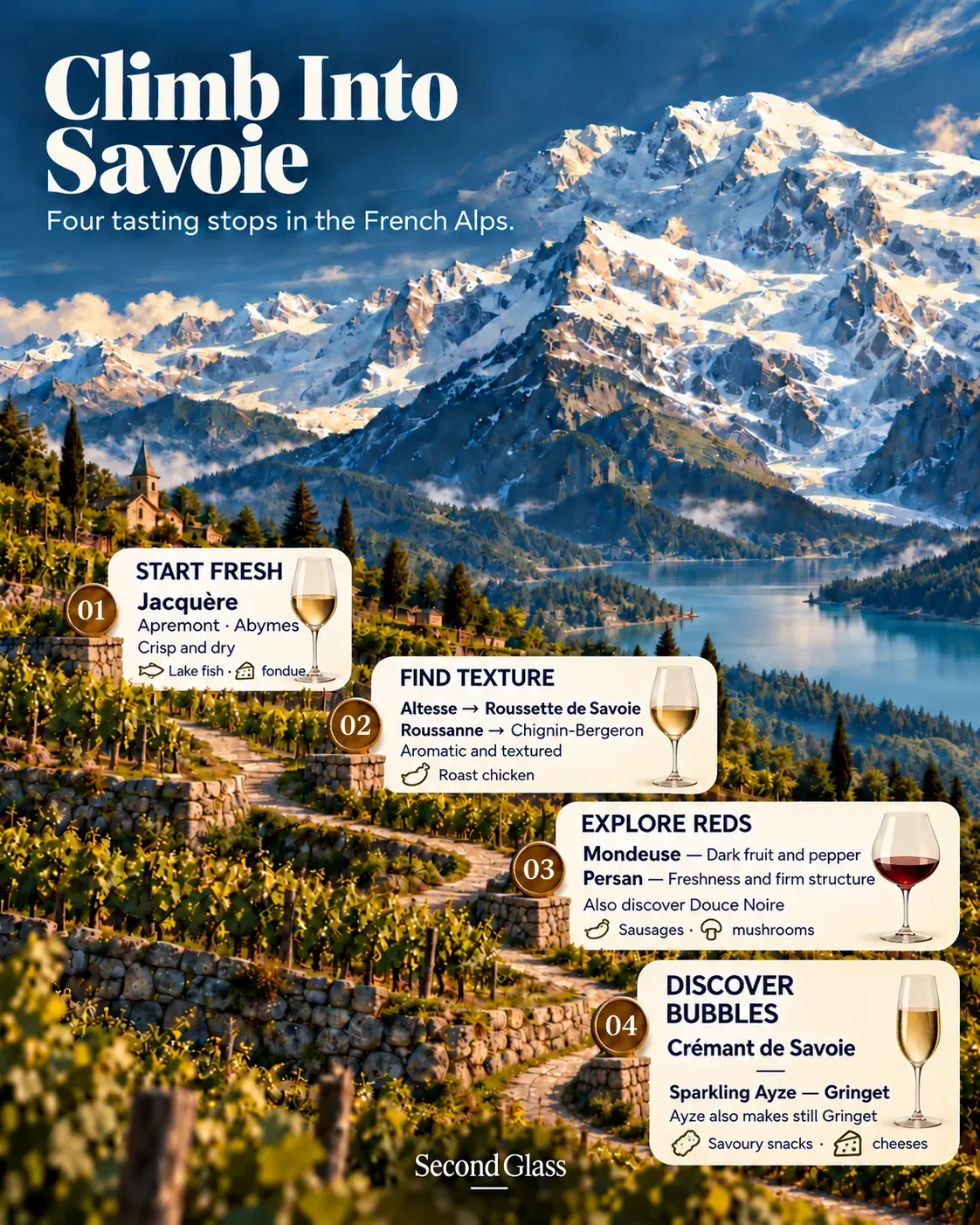
How To Start Exploring Savoie
-
Step 1 — Begin with Jacquère
choose Apremont or Abymes and enjoy it with a simple meal.
-
Step 2 — Compare white grapes
try a Roussette de Savoie made from Altesse, then a Chignin-Bergeron made from Roussanne.
-
Step 3 — Explore the reds
taste a fresh Gamay or Pinot Noir alongside a Mondeuse, ideally with food.
-
Step 4 — Try a special bottle
choose a named Roussette cru, a more structured Mondeuse or a regional sparkling wine such as Crémant de Savoie.
These contrasts will teach you more about Savoie than trying to memorise every grape or appellation at once. Light Jacquère, broader Altesse and peppery Mondeuse show how different the wines of one small Alpine region can be.
Final Thoughts
Savoie rewards exploration through contrast: start with a brisk Jacquère, then try a broader Altesse, a structured Persan or sparkling Gringet. Choose one new grape for your next bottle and see which part of the region you want to explore further.