
Quick answer
What to know first
Jura is a small eastern French wine region bordering Switzerland, renowned for Savagnin, Vin Jaune, distinctive oxidative wines, elegant Chardonnay and light, fragrant reds made from native grapes.
Key Takeaways
- Jura is one of France's smallest but most distinctive wine regions.
- Savagnin and Chardonnay dominate white wine production.
- Vin Jaune is the region's iconic long-aged oxidative wine.
- Native grapes Poulsard and Trousseau produce delicate yet characterful reds.
- The region combines Alpine influences with limestone-rich soils.
- Jura offers remarkable diversity despite its compact size.
- Traditional winemaking sits alongside an exciting new generation of producers.
How Jura usually feels
Where Is Jura?
Jura lies in eastern France between Burgundy and Switzerland. Vineyards stretch for roughly 80 kilometres along the foothills of the Jura Mountains in a narrow north–south corridor.
The landscape is characterised by rolling hills, limestone escarpments, forests and valleys. Vineyards are often planted on slopes that benefit from good sun exposure while remaining relatively cool.
The climate is continental, with cold winters, warm summers and significant annual rainfall. This combination creates long growing seasons that help preserve acidity while allowing grapes to develop complex flavours.
Although small compared with regions such as Bordeaux or Burgundy, Jura has become internationally respected for producing some of France's most distinctive wines.
Why Is Jura Famous?
Jura has a centuries-old winemaking tradition and has preserved styles that are now relatively rare within France.
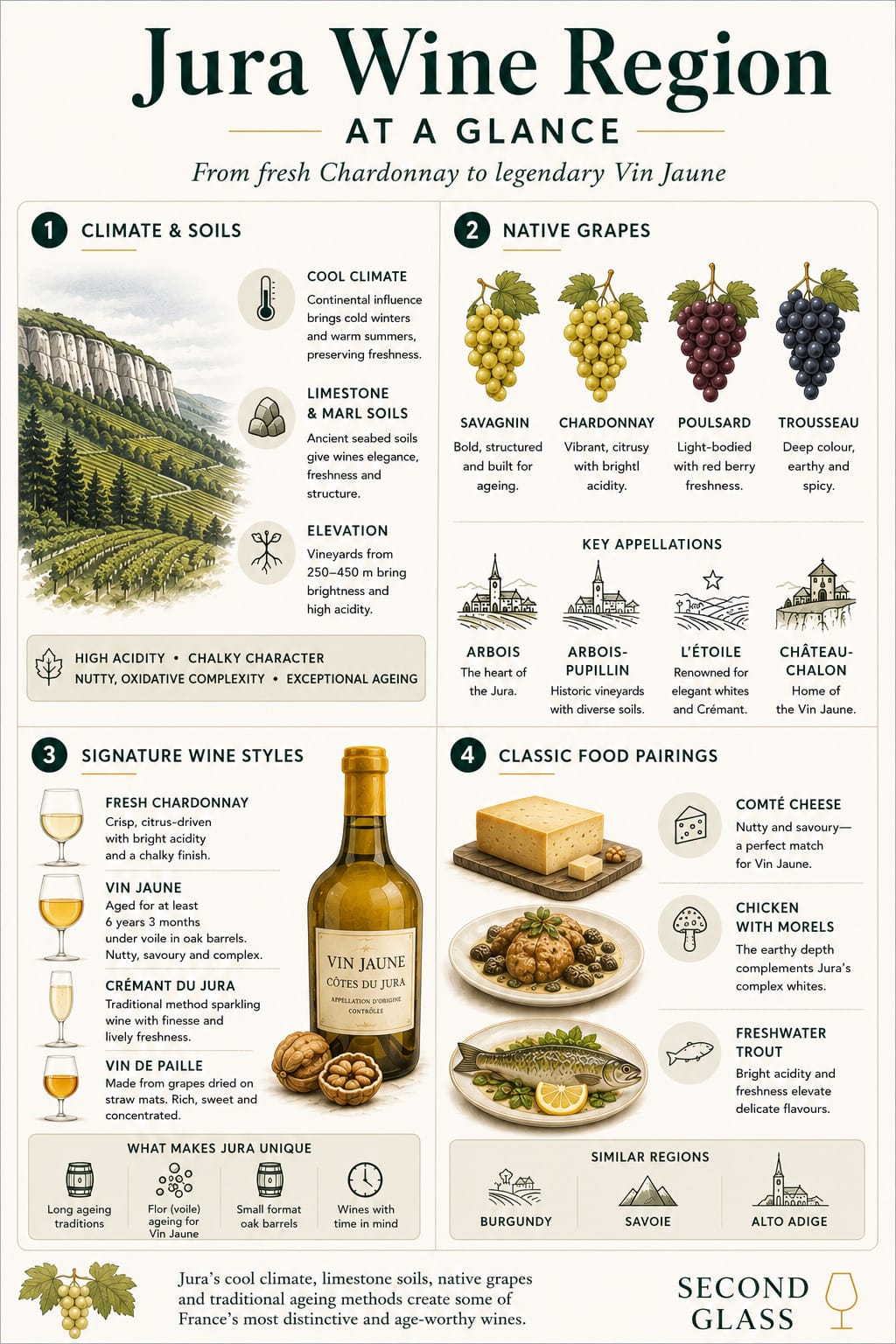
Its greatest claim to fame is Vin Jaune, a remarkable wine made from Savagnin and matured for at least six years and three months beneath a layer of yeast, known locally as voile. This ageing method produces intense nutty, spicy and savoury flavours unlike almost any other wine.
Jura is also celebrated for:
- expressive Chardonnay with bright acidity and a chalky character
- traditional sparkling Crémant du Jura
- sweet Vin de Paille
- elegant reds from native grape varieties
- artisanal producers focused on terroir
Its combination of tradition, rarity and individuality has made Jura especially popular with sommeliers and adventurous wine enthusiasts.
Climate and Terroir
Climate
Jura experiences a cool continental climate.
Cold winters help define the growing season, while warm—but rarely excessively hot—summers allow grapes to ripen gradually. Rainfall is relatively high, making careful vineyard management important.
Soils
The region is famous for limestone and marl soils.
Common soil types include:
- blue marl
- grey marl
- limestone
- clay-limestone mixtures
Marl soils, particularly blue and grey marl, are especially associated with high-quality Savagnin, while Chardonnay also performs very well on limestone-rich sites.
Elevation and Topography
Most vineyards sit between approximately 250 and 450 metres above sea level.
South- and south-west-facing slopes maximise sunshine while helping drainage and reducing frost risk.
How Terroir Shapes Wine Style
The cool climate preserves freshness and acidity.
Limestone soils are often associated with wines that feel taut, fresh and show a chalky character, with pronounced acidity, while marl can contribute depth and structure. Together they produce whites with excellent ageing potential and reds that favour finesse over power.
Important grapes in Jura
| Grape | Style | Flavour profile | Structure | Food pairings |
|---|---|---|---|---|
| Savagnin | Fresh ouillé white and oxidative Vin Jaune. | Preserved lemon, green apple, walnut, curry spice, chamomile and saline notes. | High acidity with exceptional ageing potential. | Comté cheese, roast chicken and mushroom dishes. |
| Chardonnay | Fresh and oxidative dry white. | Apple, citrus, hazelnut, white flowers and a chalky character. | Medium to full body with bright acidity. | Shellfish, trout and poultry. |
| Poulsard | Light-bodied red. | Wild strawberry, cranberry and gentle spice. | Soft tannins with fresh acidity. | Charcuterie and roast pork. |
| Trousseau | Medium-bodied red. | Black cherry, raspberry, pepper and earthy spice. | Moderate tannins with fresh acidity. | Duck and game birds. |
Wine Styles of Jura
Red
Light to medium-bodied wines ranging from delicate Poulsard to more structured Trousseau and Pinot Noir.
White
The region's most important category, spanning fresh Chardonnay with crisp citrus fruit and a chalky finish through to powerful Savagnin and oxidative blends.
Rosé
Produced in smaller quantities, generally fresh, dry and fruit-driven.
Sparkling
Crémant du Jura is made using the traditional method and offers excellent value, combining freshness with fine bubbles.
Sweet
Vin de Paille is produced from dried grapes, resulting in concentrated wines with honey, dried fruit and vibrant acidity.
What Do Wines From Jura Taste Like?
Fruit Characteristics
Green apple, lemon, pear, quince, cranberry, cherry, raspberry and dried citrus.
Floral Characteristics
Chamomile, white blossom, acacia and subtle rose.
Herbal and Savoury Characteristics
Walnut, hazelnut, curry spice, mushroom, smoke and savoury notes, sometimes with a saline edge.
Structural Characteristics
Generally high acidity, moderate alcohol and excellent balance. Reds are usually elegant rather than heavily tannic.
Ageing Characteristics
Many white wines improve over many years. Vin Jaune can age gracefully for decades, developing remarkable complexity.
Vintage Variation
Because Jura has a cool continental climate, vintage conditions significantly influence ripeness, acidity and concentration. Warmer years often produce richer wines, while cooler vintages emphasise freshness and tension.
The Jura names worth recognising
Côtes du Jura
Memory hook: The region-spanning appellation.
Known for: Virtually every regional style with considerable diversity.
Why it matters: Côtes du Jura is the region's longest appellation, stretching across much of Jura.
Arbois
Memory hook: Historic heart of Jura.
Known for: The full range of Jura wine styles, from reds and Chardonnay to Savagnin, Vin Jaune and Vin de Paille.
Why it matters: Arbois is the largest and oldest appellation in the region.
Arbois-Pupillin
Memory hook: Home of Poulsard.
Known for: Outstanding Poulsard and Vin Jaune.
Why it matters: Arbois-Pupillin is a highly regarded village within Arbois and a benchmark for Jura's pale, delicate reds.
L'Étoile
Memory hook: Limestone specialist.
Known for: Chardonnay, Savagnin and Vin Jaune from limestone-rich soils.
Why it matters: L'Étoile produces some of Jura's most refined white wines.
Château-Chalon
Memory hook: The home of Vin Jaune.
Known for: Savagnin aged under voile for at least six years and three months.
Why it matters: Château-Chalon is Jura's most prestigious appellation and a reference point for Vin Jaune.
What to eat with Jura
Regional specialities
Comté cheese is Jura's classic pairing, particularly with Savagnin and Vin Jaune.
Other traditional dishes include:
- Chicken with morel mushrooms
- Creamy poultry dishes
- Freshwater trout
- Mushroom-based recipes
These combinations echo the wines' nutty character, savoury complexity, high acidity and oxidative notes, and Vin Jaune is often used directly in the sauce itself to enhance these flavours.
Everyday local pairings
- Roast chicken
- Comté or similar Alpine-style cheeses
- Mushroom risotto
- Pork loin
- Smoked ham
- Roast turkey
Pairings to approach carefully
Very spicy chilli-based dishes can overwhelm Jura's delicate aromatics.
Highly sweet desserts generally overpower dry oxidative wines unless matched with Vin de Paille.
Similar wine regions to explore
| Region | Similar | Difference |
|---|---|---|
| Burgundy | Cool-climate Chardonnay grown on limestone. | Does not traditionally produce oxidative wines like Vin Jaune. |
| Savoie | Cool Alpine climate and vibrant acidity. | Relies on different native grape varieties. |
| Alto Adige | Mountain viticulture and fresh white wines. | Greater emphasis on international varieties. |
| Friuli Venezia Giulia | Characterful whites with ageing potential. | Generally focuses on fresher, non-oxidative styles. |
| Galicia | Fresh acidity and distinctive regional identity. | Atlantic influence creates a markedly different climate. |
| Oregon | Elegant Pinot Noir and Chardonnay. | Modern varietal winemaking rather than traditional oxidative methods. |
Buying Wines From the Region
Budget (£15–25)
At this level, you will find many excellent entry points into Jura’s style. Fresh, non-oxidative Chardonnay is common, often made using a mix of stainless steel, older barrels or other neutral vessels to preserve purity. These wines typically show crisp apple and citrus fruit with a lightly chalky impression, making them ideal for everyday drinking.
Crémant du Jura is also widely available in this range and offers outstanding value. Made using the traditional method, it often blends Chardonnay with local varieties such as Poulsard or Pinot Noir, delivering fine bubbles, fresh acidity and delicate orchard fruit flavours.
Red wines at this price point are usually light and approachable. Poulsard tends to dominate, offering pale colour, soft tannins and flavours of wild strawberry and cranberry. Some blends or lighter Trousseau wines may also appear, providing slightly more structure while remaining easy to drink.
Overall, this category is ideal for discovering the region’s freshness, elegance and distinctive character without committing to more complex or oxidative styles.
Mid-Range (£25–50)
This is where Jura’s individuality becomes more pronounced. Wines in this bracket often come from lower-yielding vineyards or more attentive winemaking, resulting in greater depth and precision.
Chardonnay becomes more layered, frequently aged in older oak barrels or under a light veil of yeast, adding subtle nutty and savoury notes alongside citrus and stone fruit. Savagnin appears more prominently, either in fresh ouillé (topped-up) styles or lightly oxidative expressions that introduce hints of spice, walnut and savoury complexity, sometimes with a saline edge.
Red wines gain definition and structure. Trousseau shows its full character here, with darker fruit, peppery spice and firmer tannins, while Poulsard can display surprising depth when sourced from older vines. Pinot Noir may also offer refined, Burgundian-style elegance with bright acidity and fine texture.
Single-vineyard bottlings and wines from respected producers become more common, allowing a clearer expression of Jura’s varied soils and microclimates.
Premium (£50+)
At the top end, Jura produces some of its most distinctive and age-worthy wines. Vin Jaune is the centrepiece of this category, aged for at least six years and three months under a veil of yeast. These wines are intensely complex, with flavours of walnut, curry spice, dried citrus and umami richness, supported by powerful acidity that allows them to age for decades.
High-end Savagnin and Chardonnay also reach impressive levels of concentration and nuance. Extended ageing, careful vineyard selection and low yields contribute to wines that combine taut structure and a chalky character with layered aromas of hazelnut, spice, dried fruit and subtle oxidation.
Top cuvées from leading producers often highlight specific terroirs, with marl and limestone soils expressing themselves through structure, texture and aromatic detail. These wines can evolve significantly in bottle, gaining depth and savoury complexity over time.
Premium red wines, particularly from old-vine Trousseau, can also be found in this range. They offer greater intensity, refined tannins and a balance of fruit, spice and earthy character, though the region remains primarily celebrated for its whites at this level.
Common Misconceptions
Are all Jura wines oxidative and taste like Vin Jaune?
No. While Jura is famous for oxidative styles like Vin Jaune, many wines are made in a fresh, non-oxidative (ouillé) style. These wines are topped up during ageing to prevent oxidation and taste bright, clean and fruit-driven rather than nutty or savoury.
Is Chardonnay from Jura the same as Burgundy Chardonnay?
Not exactly. Although both regions grow Chardonnay on limestone soils, Jura Chardonnay is often fresher in style, can display a distinctive chalky character, and may be made in either fresh or lightly oxidative styles. It is typically less influenced by new oak than many Burgundian examples.
Does Jura only produce white wines?
No. Jura produces a full range of wines, including reds made from Poulsard, Trousseau and Pinot Noir, as well as sparkling Crémant du Jura and sweet Vin de Paille.
Is Vin Jaune a sweet wine?
No. Vin Jaune is a dry wine. Its rich, nutty and complex flavours can give the impression of sweetness, but it contains little to no residual sugar.
Are Jura wines too unusual or difficult for beginners?
Not at all. While some styles like Vin Jaune are distinctive, many Jura wines—such as Crémant du Jura or fresh Chardonnay—are approachable and easy to enjoy, making the region accessible to newcomers.
FAQs
What is Jura best known for?
Jura is best known for Vin Jaune, an oxidative white wine made from Savagnin and aged beneath a protective layer of yeast for at least six years and three months. The region is also recognised for Chardonnay with bright acidity and a chalky character, Crémant du Jura and native red grapes.
What grapes are grown in Jura?
The principal grapes are Savagnin and Chardonnay for whites, alongside the native red varieties Poulsard and Trousseau. Pinot Noir also plays an important supporting role.
Does Jura only make unusual wines?
No. While Vin Jaune attracts the most attention, Jura also produces fresh Chardonnay, elegant sparkling wines, approachable reds and sweet wines. Many wines are accessible even if you are new to the region.
Can Jura wines age well?
Yes. Many white wines, particularly Savagnin and Vin Jaune, can age for decades. Quality Chardonnay also develops beautifully with bottle age, gaining nutty and savoury complexity.
What foods pair best with Jura wines?
Comté cheese is the classic match. Roast chicken, mushrooms, trout, creamy sauces and charcuterie also complement the region's wines thanks to their freshness and savoury depth.
Are Jura wines good value?
Generally, yes. Although prices have risen as the region has become more popular, many wines still offer distinctive character at prices below comparable prestige wines from more famous French regions.
How should beginners explore Jura?
Start with Crémant du Jura or Chardonnay before moving to Savagnin. Once familiar with the region's style, compare Poulsard and Trousseau, then finish with Vin Jaune to experience Jura's most iconic wine.
If you are new to Jura
Begin with widely available Crémant du Jura and fresh Chardonnay before exploring Savagnin. Comparing fresh and oxidative white styles is one of the best ways to understand how grape variety, ageing and terroir influence the region's distinctive character.
Final Thoughts
Jura may be one of France's smallest wine regions, but it offers remarkable diversity and originality. From crisp Chardonnay and delicate native reds to the extraordinary complexity of Vin Jaune, it rewards curious wine drinkers with styles found almost nowhere else.