Quick answer
What to know first
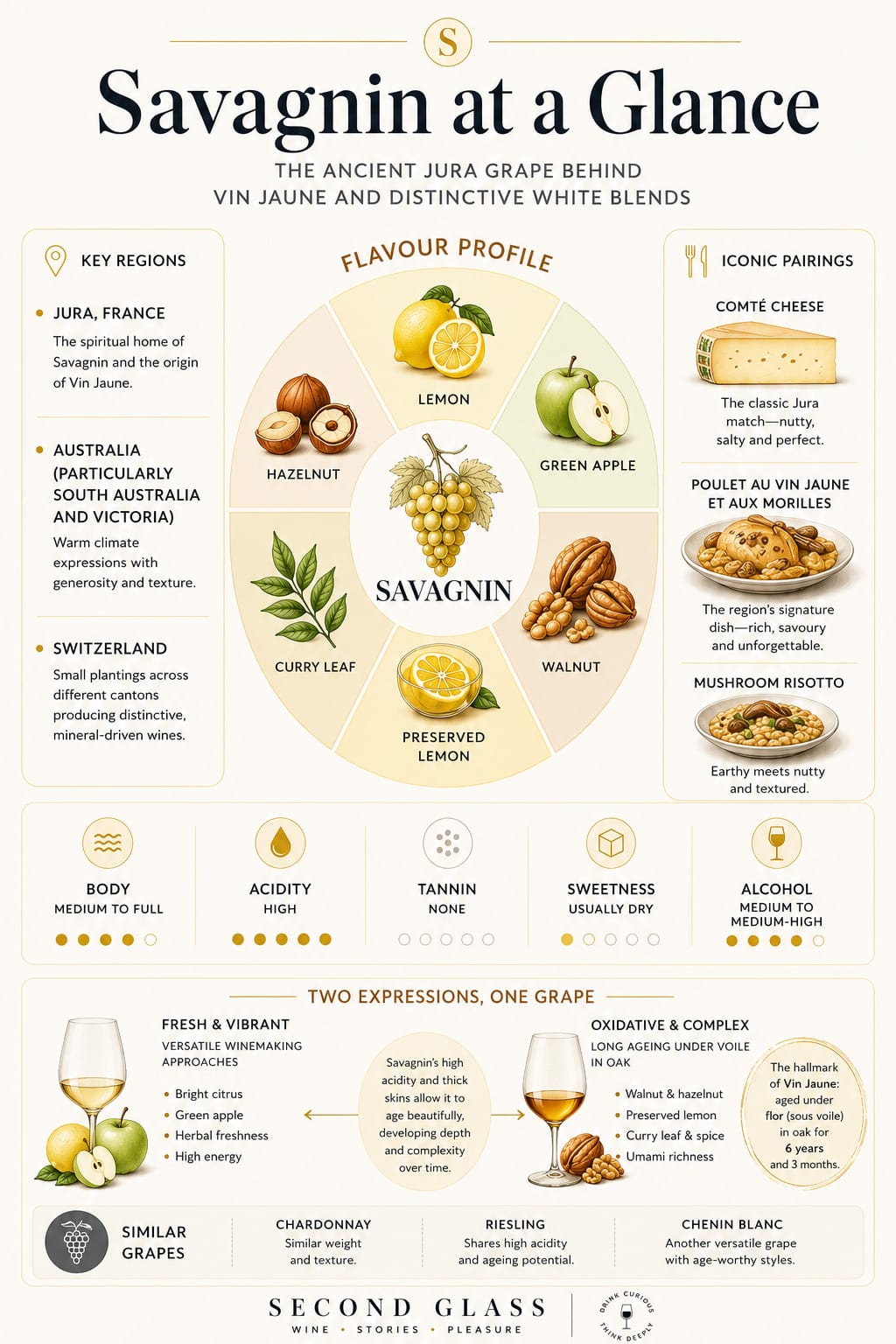
Savagnin is a distinctive white grape best known in France's Jura region. It typically produces dry wines with high acidity and flavours of citrus, green apple, nuts and spice. Some examples develop complex oxidative notes of curry, walnut and preserved lemon.
Key Takeaways
- Savagnin is the signature white grape of Jura in eastern France.
- It naturally has high acidity and excellent ageing potential.
- It can be made in fresh, mineral styles or highly oxidative styles.
- It is the grape behind the famous Vin Jaune wines of Jura.
- Flavours often include citrus, nuts and savoury spice.
- In Jura, Savagnin is sometimes blended with Chardonnay to create balanced, complex white wines.
- Sparkling wines made from Savagnin are uncommon and occupy a niche role in Jura's Crémant production.
- Savagnin pairs particularly well with Comté cheese, mushrooms and poultry dishes.
How Savagnin usually feels
What Is Savagnin?
Savagnin is an ancient white grape variety that has been cultivated in eastern France for centuries and is genetically related to the Traminer family.
Although most famous in the Jura region, Savagnin is grown in small quantities elsewhere, including Switzerland, Austria and Australia. The grape is prized for its ability to retain acidity, reflect terroir and produce wines of extraordinary complexity.
Its reputation largely comes from Vin Jaune, Jura's iconic oxidative wine aged under a veil of yeast, similar in concept to flor ageing in certain fortified wines.
In Jura, Savagnin is also sometimes blended with Chardonnay. These blends combine Chardonnay's rounder fruit and texture with Savagnin's acidity, spice and savoury complexity, producing some of the region's most distinctive dry white wines.
What Does Savagnin Taste Like?
Fruit Flavours
- Lemon
- Preserved lemon
- Green apple
- Quince
- Yellow plum
Floral Notes
- Chamomile
- White blossom
- Dried flowers
Herbal and Spice Notes
- Curry leaf
- Ginger
- Turmeric
- Fennel seed
- Nutmeg
Ageing Characteristics
With age, Savagnin develops notes of walnut, hazelnut, toasted almonds, mushroom, honey and savoury umami-like complexity.
Climate Influence
Cool climates preserve acidity and citrus flavours. Slightly warmer sites produce riper stone fruit and fuller body while still maintaining freshness.
Why Does It Taste Like This?
Savagnin's naturally high acidity gives the wines energy and longevity. The grape ripens relatively late and develops concentrated flavours while maintaining freshness.
Its relatively thick skins contribute aromatic complexity and help the grape withstand extended ageing. The variety is particularly responsive to winemaking decisions.
In non-oxidative styles, producers emphasise citrus fruit, texture and minerality. In oxidative styles, controlled exposure to oxygen and prolonged ageing under yeast create the distinctive walnut, spice and curry-like characteristics for which Jura is famous.
Because of its naturally firm structure and acidity, Savagnin can evolve in bottle for many years, gradually shifting from fresh fruit flavours towards savoury and nutty complexity.
How Ageing Changes Savagnin
Bottle Ageing
Bottle ageing often brings notes of honey, nuts, dried citrus and mushrooms while making the wine feel more integrated and textural. Even fresher, non-oxidative examples can gain impressive complexity over time.
Oxidative Ageing and Vin Jaune
Some of Savagnin's most famous wines undergo oxidative ageing. In Jura's iconic Vin Jaune, the wine matures for more than six years under a veil of yeast known as sous voile. This process gradually concentrates flavours and develops distinctive aromas of walnut, curry leaf, preserved lemon and savoury spice.
Oak Ageing
Some producers use neutral oak to build texture and complexity. New oak flavours are generally not a defining feature of Savagnin, with producers typically preferring vessels that allow the grape's character and ageing notes to take centre stage.
Lees Ageing
Lees ageing is relatively common and contributes creamy texture, savoury depth and additional complexity.
Micro-Oxygenation
Micro-oxygenation is not a defining winemaking practice for Savagnin. Traditional oxidative ageing methods, particularly the sous voile ageing used for Vin Jaune and other oxidative Jura wines, are considerably more important.
Ageing Potential
Quality examples can age exceptionally well. Oxidative styles, especially Vin Jaune, may develop for several decades, while fresher styles commonly evolve positively for five to fifteen years.
Is Savagnin Dry or Sweet?
Savagnin is overwhelmingly produced as a dry wine. Its high acidity and savoury profile naturally lend themselves to dry styles.
Sweet examples exist but are uncommon. The vast majority of wines made from Savagnin are dry, textured and highly food friendly.
Body, Acidity and Tannin
Savagnin generally has a medium to full body with pronounced acidity. It has no tannins but often possesses a firm, structured mouthfeel due to its acidity and extract.
Young wines can feel vibrant and linear, while aged examples become broader, richer and more textured.
Where Is Savagnin Grown?
Classic Regions
Jura, France
The benchmark region for Savagnin.
- Climate: Cool continental
- Style: Fresh, mineral wines, Chardonnay-Savagnin blends and oxidative Vin Jaune
- Typical Flavours: Lemon, walnut, spice, curry leaf and preserved citrus
Many of Jura's traditional white wines are blends of Savagnin and Chardonnay. The proportions vary by producer, with Chardonnay contributing orchard fruit and richness while Savagnin adds freshness, structure and savoury complexity.
New World Regions
Australia
Particularly in cooler parts of South Australia and Victoria.
- Climate: Warm Mediterranean to cool maritime
- Style: Primarily fresh, non-oxidative wines
- Typical Flavours: Citrus, apple, spice and mineral notes
Much of Australia's Savagnin has an unusual history. Many vines were originally planted under the mistaken belief that they were Albariño, helping explain why Australia has more Savagnin than many wine drinkers expect.
Emerging Regions
Switzerland
Small plantings produce aromatic, structured wines with freshness and minerality.
Austria
Very limited plantings are showing potential for mineral and textured expressions.
Famous Wines Made From Savagnin
- Vin Jaune
- Côtes du Jura Blanc
- Arbois Blanc
- L'Étoile Blanc
- Chardonnay-Savagnin blends from Jura
- Crémant du Jura containing Savagnin
These wines range from fresh and mineral to deeply savoury and oxidative.
Sparkling Wines Made From Savagnin
Sparkling Savagnin is uncommon and occupies a niche role in Jura's Crémant production.
Traditional method sparkling wines made with Savagnin usually retain the grape's bright acidity and citrus profile while adding notes of brioche and toasted nuts from lees ageing.
Compared with still versions, sparkling examples are lighter, fresher and generally more approachable when young.
What to eat with Savagnin
Ideal pairings
Comté Cheese
Its nutty richness mirrors Savagnin's savoury character.
Roast Chicken
The grape's acidity balances the richness of poultry.
Poulet au Vin Jaune et aux Morilles
One of Jura's signature dishes. Savagnin, especially Vin Jaune, complements the earthy morels and creamy sauce while its freshness prevents the dish from feeling heavy. This classic regional pairing also illustrates an important wine principle: local wines and local cuisine often evolve together and naturally complement one another.
Mushroom Risotto
Earthy flavours complement Savagnin's aged, umami notes.
Pork with Cream Sauce
The wine's freshness cuts through creamy textures.
Everyday pairings
- Roast chicken
- Grilled Salmon
- Cheese soufflé
- Roast pork
- Vegetable gratin
Pairings to approach carefully
Very Spicy Curries
Heat can overwhelm the wine's subtle complexity.
Very Sweet Desserts
Savagnin's dry profile generally clashes with sugary dishes.
Similar grapes to try
| Grape | Similar | Difference |
|---|---|---|
| Chardonnay | Texture and ageing potential. | Usually less savoury and oxidative. |
| Riesling | High acidity and longevity. | More aromatic and floral. |
| Chenin Blanc | Structure and ageworthiness. | Greater sweetness range. |
| Grüner Veltliner | Spice and freshness. | More peppery and lighter-bodied. |
| Furmint | Acidity and complexity. | More commonly associated with sweet wines. |
| Albariño | Bright acidity and citrus character. | Fruitier and less savoury. |
Buying Guide
Budget (£15–£25)
At this price point, most Savagnin wines are fresh, youthful and made in a non-oxidative style. Expect bright flavours of lemon, green apple and citrus peel, often accompanied by subtle mineral notes and a lightly savoury finish. These wines are usually fermented in stainless steel or neutral vessels to preserve freshness and purity of fruit.
This category offers an excellent introduction to the grape's naturally high acidity and distinctive character. Australian Savagnin and entry-level Jura bottlings are commonly found in this range and pair particularly well with seafood, salads and simple poultry dishes.
Mid-Range (£25–£50)
Wines in this bracket become noticeably more complex and expressive. Producers often employ extended lees ageing or maturation in neutral oak, resulting in greater texture, creaminess and aromatic depth. Alongside citrus and orchard fruit, expect developing notes of hazelnut, preserved lemon, spice and subtle savoury nuances.
Many quality Côtes du Jura and Arbois wines fall into this category. These bottles often strike an appealing balance between freshness and complexity and can usually benefit from several years of additional bottle ageing. This is also the price range where many excellent Chardonnay-Savagnin blends can be found.
Premium (£50+)
The premium category includes some of Jura's most celebrated wines, particularly Vin Jaune and top single-vineyard expressions. These wines display extraordinary concentration, savoury depth and remarkable ageing potential. Aromas and flavours can include walnut, toasted nuts, curry leaf, mushroom, dried citrus and complex umami characteristics.
Premium Savagnin wines are often produced in limited quantities and may spend many years maturing before release. Their high acidity and structural intensity allow them to evolve for decades in the cellar, gradually developing even greater complexity and nuance. For collectors and adventurous wine enthusiasts, these bottles represent some of the most distinctive and longest-lived white wines produced in Jura.
Common Misconceptions
Savagnin Is the Same as Sauvignon Blanc
They are entirely different grape varieties with distinct flavours and histories.
All Savagnin Tastes Oxidative
Many examples are made in fresh, fruit-driven styles.
Savagnin Is Always Heavy
Despite its texture, the grape maintains high acidity and freshness.
It Is Only Grown in France
Small plantings also exist in countries including Australia and Switzerland, while Austria has very limited experimental plantings.
FAQs
Is Savagnin the same as Sauvignon Blanc?
No. They are unrelated grape varieties. Sauvignon Blanc is usually highly aromatic and fruit-driven, whereas Savagnin often shows savoury, spicy and nutty complexity.
Why does Savagnin sometimes smell like curry?
Oxidative ageing can produce compounds that create aromas reminiscent of curry leaf, turmeric and spice. These are considered desirable characteristics in many Jura wines.
Is Savagnin always dry?
Almost always. The grape's naturally high acidity and savoury profile make dry styles the norm.
Can Savagnin age?
Yes. Top Jura examples, particularly oxidative styles such as Vin Jaune, can evolve positively for decades and are renowned for their longevity. Fresher, non-oxidative examples are generally intended for earlier drinking.
Does Savagnin use oak?
Sometimes. Neutral oak is commonly used to build texture, although pronounced new oak flavours are generally uncommon.
Is sparkling Savagnin common?
No. Sparkling examples remain relatively niche and are mainly associated with Crémant du Jura.
Is Savagnin suitable for beginners?
Yes. Fresh, non-oxidative examples offer an excellent introduction, while oxidative styles reward more adventurous wine drinkers.
If you are new to Savagnin
Begin with a fresh, non-oxidative Jura or Australian Savagnin to appreciate its high acidity and citrus character before progressing to oxidative styles such as Vin Jaune.
Final Thoughts
Savagnin remains one of the wine world's most distinctive white grapes. Whether experienced on its own, blended with Chardonnay in Jura's traditional white wines, or as a deeply savoury Vin Jaune, it offers remarkable complexity, freshness and ageing potential that reward curious wine drinkers and make Jura one of the most fascinating white wine regions to explore.