
Quick answer
What to know first
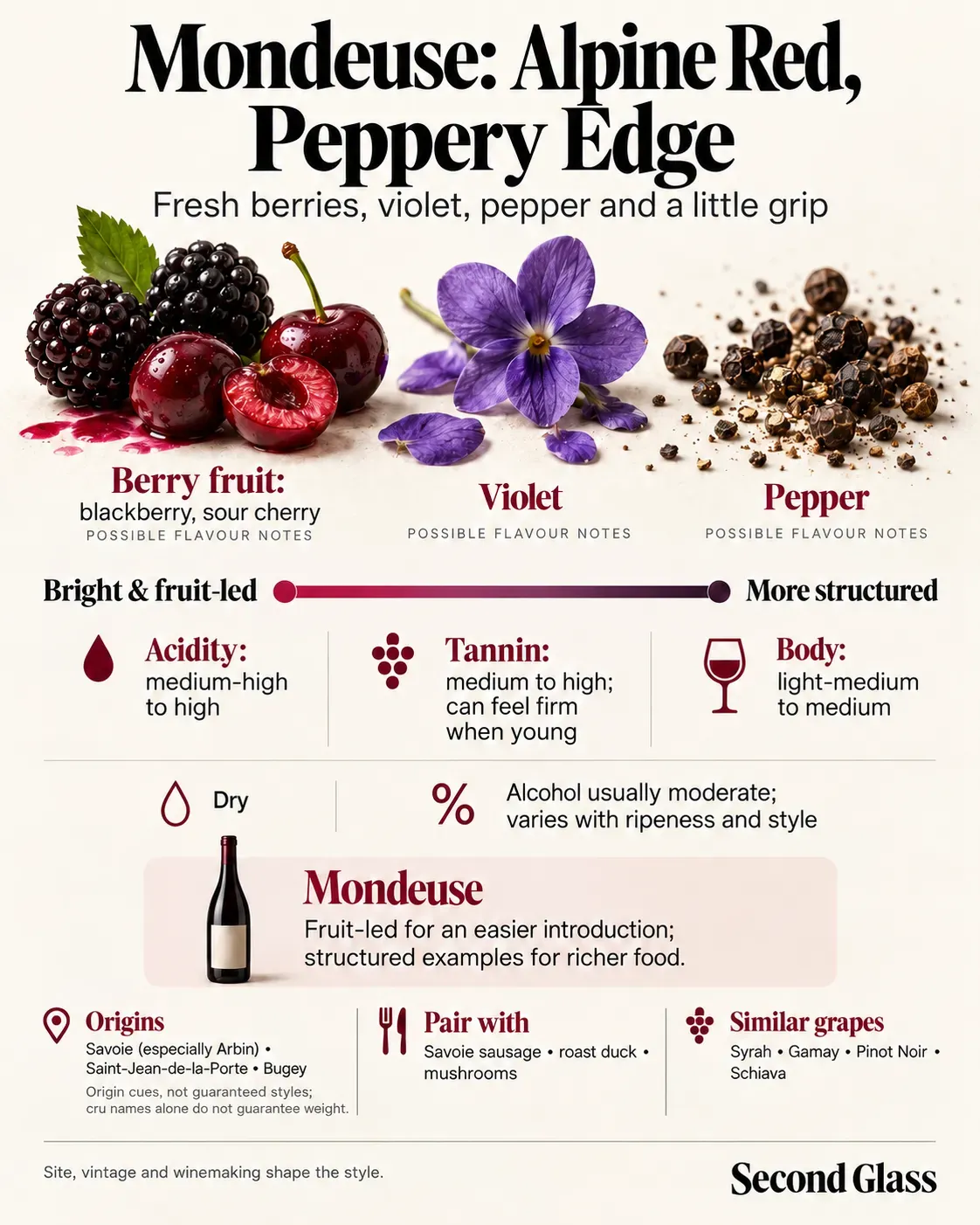
Mondeuse is a red grape from Savoie in eastern France, known for fresh acidity, dark berries, violet and pepper. Its structured, characterful wines are especially associated with Arbin, a Savoie cru, and pair naturally with savoury food.
Introduction
Mondeuse is one of Savoie’s distinctive red grapes: less famous than Pinot Noir or Syrah, yet capable of making vivid, peppery wines with real structure. It is most closely associated with the Alpine vineyards of eastern France, especially the Arbin cru.
A glass might offer blackberries and sour cherries, a floral hint of violet and a recognisable peppery edge. The exact balance depends on where the grapes grow, how ripe they become and how the wine is made. This guide covers Mondeuse’s flavours, regions, food matches and what to look for when buying a bottle.
How Mondeuse usually feels
- Flavour notes
- Blackberry and blackcurrant, Sour cherry and raspberry, Violet, Pepper and Earth and forest-floor notes
Key Takeaways
- Mondeuse noire is a red grape strongly associated with Savoie in eastern France.
- Arbin is a Savoie cru known for Mondeuse noire; the grape also appears in other Savoie crus and in Bugey.
- Expect fresh acidity, dark or red berries, violet and pepper, with tannin that can be firm when young.
- The style ranges from lighter, fruit-led wines to more concentrated, structured examples.
- A few years in bottle can soften the tannins and bring out savoury notes.
- Try it with sausage, roast meats, mushrooms or a hearty lentil dish, adjusting the preparation to the wine’s structure.
- Mondeuse blanche is a separate, very rare grape variety, not a white wine made from Mondeuse noire.
What Is Mondeuse?
Mondeuse noire is an old grape variety from the Savoie area of the French Alps and remains an important local red grape. It is also grown in neighbouring Bugey, in eastern France.
The grape ripens relatively late and benefits from well-exposed sites where it can reach full ripeness. In Savoie, vines grow on varied Alpine slopes, where altitude, aspect and local conditions shape the style in the glass. Arbin is especially associated with Mondeuse: it is a Savoie cru whose red wines are made from Mondeuse noire, as is the cru of Saint-Jean-de-la-Porte.
“Grosse Syrah” is a historical synonym used for Mondeuse noire, but it should not be taken to mean that Mondeuse is simply Syrah or that the two wines taste alike. Mondeuse noire and Syrah are distinct grape varieties connected through Mondeuse blanche: Mondeuse noire is an offspring of Mondeuse blanche and Tressot, while Mondeuse blanche is one of Syrah’s parents alongside Dureza.
What Does Mondeuse Taste Like?
Mondeuse is often recognisable by its combination of fresh acidity, dark fruit, pepper and floral aromas. Tannin can be firm, particularly in young or concentrated wines, but not every bottle will feel powerful: lighter, fruit-led versions can be refreshing and easy to drink. The grape gives tendencies, while site, vintage and winemaking make each wine different.
Fruit Flavours
Blackberry and blackcurrant are common, alongside redder flavours such as sour cherry, raspberry or wild strawberry. Riper or more concentrated wines may taste darker and richer, while fresher examples can lean towards tart cherry and crunchy berry fruit.
Floral Notes
Violet is a familiar aroma in Mondeuse, sometimes appearing as a light floral lift above the fruit. It is not present in every bottle, and can be more noticeable in some vintages and styles than others.
Herbal and Spice Notes
Pepper is one of the grape’s characteristic savoury notes. Depending on the wine, it may be joined by dried herbs, earthy tones or a hint of forest floor. These notes are more likely to become apparent with bottle age or in wines with a more structured style.
Climate Influence
Mondeuse ripens late, so the season and site influence how much fruit ripeness it achieves. Cooler conditions can preserve freshness and bring out a more tangy, peppery character; riper fruit may make a broader, darker-fruited wine.
Why Does It Taste Like This?
Mondeuse’s flavour and structure come from several factors working together. The grape’s natural acidity helps keep the wine fresh, while the colour and tannin extracted from the skins contribute depth and grip. Growing conditions affect ripeness, and the winemaker controls how much skin contact and extraction the wine receives.
In a cooler or more challenging season, fruit may remain tart and the tannins can feel more noticeable. With riper grapes, careful extraction can give more concentration without making the wine harsh. Oak, if used, can add a more rounded texture or savoury flavour, but it is a choice in winemaking rather than a defining feature of Mondeuse.
Ageing and Structure
Young Mondeuse can combine bright fruit with firm, sometimes rustic-feeling tannins. Bottle ageing can soften that grip and allow earthy, savoury and spicy notes to emerge as the fresher fruit becomes less dominant. The change is most rewarding in wines with enough concentration and balance to develop; lighter, everyday examples are often best enjoyed young.
Some winemakers use oak to round out the texture or add subtle spice and savoury complexity. Others choose neutral vessels or little oak to keep the fruit and peppery character in focus. Oak is not essential to Mondeuse’s identity, so check the producer’s description if it matters to you.
Many everyday bottles are made to be enjoyed in the first few years after release. More structured examples, especially from recognised sites such as Arbin, may reward several years in bottle. Follow the producer’s drinking window where available, since ageing potential varies by wine.
Body, Acidity and Tannin
Mondeuse usually has lively acidity and medium to firm tannin. Its body commonly sits between light-medium and medium, although concentrated wines can feel more substantial. That combination gives many examples a fresh, mouthwatering quality alongside a gentle grip on the gums.
If a young bottle seems angular, give it time in the glass or serve it slightly cool with food. A lighter version may feel closer to a fresh, food-friendly Alpine red; a more structured one can stand up to richer dishes and may benefit from a few years of bottle age.
Explore reds with freshness, fruit or Alpine character
| Entity | Shared thread | How it differs |
|---|---|---|
| Syrah | Dark fruit, pepper and a possible savoury character. | Syrah is often fuller-bodied and more deeply coloured, though style varies. |
| Gamay | Fresh acidity and red-fruit character, especially in lighter styles. | Gamay generally has softer tannin and a juicier, less peppery profile. |
| Pinot Noir | Fresh acidity, moderate body and red-fruit flavours. | Mondeuse tends to be darker-fruited, firmer in tannin and more peppery. |
| Schiava | A fresh, mountain-grown red with a lighter style. | Schiava is generally paler, softer in tannin and more delicate in fruit. |
| Persan | Another distinctive Savoie red with freshness and peppery notes. | Persan is rarer, deeply coloured and often firmer in tannin. |
Serve Mondeuse with savoury, substantial food
Ideal pairings
- Pork sausages, grilled lamb, roast duck or braised beef
- Mushrooms, lentils, aubergine or roasted root vegetables with herbs or savoury sauce
- Firm, savoury cheeses such as Tomme de Savoie, Beaufort, Comté or aged Gruyère
- Diots de Savoie with lentils, potatoes or braised cabbage
Mondeuse’s acidity refreshes the palate, while its peppery notes complement browned, roasted flavours. Match lighter bottles with poultry, pork or charcuterie; choose a structured example for slow-cooked meat or richer dishes.
Everyday pairings
- Sausages or pork chops
- Roast chicken
- Burgers
- Mushroom pasta
- Lentil stew
- Roasted vegetables or a simple gratin
Pairings to approach carefully
Very delicate fish, lightly seasoned dishes and fragile salads may be overwhelmed by a structured Mondeuse. Sweetness can make a dry wine seem more bitter or angular, while chilli heat can emphasise tannin and alcohol. Intensely creamy dishes may make a lighter bottle seem thin.
How To Choose a Bottle
Savoie, France is Mondeuse’s heartland. Look for Arbin or Saint-Jean-de-la-Porte, both Savoie crus associated with red wines made from Mondeuse noire. These wines can be firm and concentrated, but Arbin is not a single fixed style: producer, vintage, vine age, extraction and ageing all matter.
The place name on the bottle tells you about the wine’s origin, while producer or merchant tasting descriptions offer clues about its style. A description such as “structured”, “concentrated” or “age-worthy” suggests a firmer, more cellar-friendly wine. Terms such as “fruit-led”, “fresh” or “lightly extracted” usually point towards a more approachable bottle. Oak details should come from the producer or merchant rather than being assumed from the appellation alone.
Other Savoie labels may name Chignin, Chautagne or Jongieux. These can offer lively, fruit-led expressions as well as more serious examples, so read the producer’s notes rather than assuming that the village name alone predicts weight.
Bugey, just west of Savoie, also grows Mondeuse. Check the appellation and producer notes because the region includes varied red styles, as well as some sparkling or pétillant expressions. Sparkling wine is not the style most commonly associated with Mondeuse noire, but local rules allow red grapes including Mondeuse in some such wines. Mondeuse blanche, a separate grape, can also appear in local white or sparkling wines.
Small plantings exist in places including California, Oregon and Australia. These are niche expressions rather than established regional styles; look for the grape name and producer description, and expect a different balance of ripeness and fruit from Alpine examples.
How to serve Mondeuse
Red
Mondeuse
13–16°C 55–61°F
Serve slightly cool to emphasise fresh fruit, pepper and lively acidity. More structured bottles can sit towards the upper end.
Buying Guide
Budget (£15–£20 / $20–$28)
At the budget level, look for straightforward Mondeuse from Savoie or Bugey, particularly bottles described as fresh, fruity or easy-drinking. These wines are often made for early enjoyment, but price alone does not guarantee a particular flavour profile, level of quality or ageing potential. Use the producer’s notes and vintage information to judge the bottle.
A recent vintage is often the safest choice. Check that the bottle has been stored well and look for a producer or merchant description that mentions approachable tannin.
Mid-Range (£20–£30 / $28–$45)
Mid-range bottles often offer more concentration, better site expression or longer élevage, but these qualities depend on the producer and wine rather than price alone. Look for Arbin, Saint-Jean-de-la-Porte or carefully made wines from Chignin, Chautagne or Jongieux. Producer reputation matters at this level, as extraction and ageing choices can make a significant difference.
Choose a bottle described as structured, savoury or age-worthy if you want to cellar it briefly. If you plan to drink it soon, look for terms such as balanced, fresh or fruit-led. Match the wine to the meal according to its style: lighter examples suit poultry, vegetables and cold meats, while firmer wines can work with richer sauces, red meat or aged cheese.
Premium (£30-£50+ / $45–$75+)
Premium Mondeuse is usually found in limited-production wines from respected growers, old vines, favourable sites or carefully selected parcels in Arbin and Saint-Jean-de-la-Porte. These bottles may combine dark fruit, floral lift, pepper, firm tannin and greater length, but price should not be treated as proof of quality, power or ability to age.
Check the vintage, producer, vineyard source and ageing details. A premium bottle does not need to taste heavily oaked or powerful; elegance, freshness and savoury complexity can be better indicators of quality. Consider buying two bottles if possible: one to drink now after decanting and another to follow over several years, provided the producer and vintage suggest that development is likely.
Prices vary by retailer, vintage, shipping and local taxes, particularly in the US where sales tax is often added at checkout. Availability can also be limited outside specialist wine merchants, so compare the producer, vintage and bottle size rather than relying on price alone.
Choose a fresh, fruit-led Savoie Mondeuse
For a first bottle, choose a dry Savoie Mondeuse described as fresh, fruit-led or lightly extracted. Expect tart cherry or blackberry, pepper, lively acidity and noticeable but manageable tannin. Serve it slightly cool with sausage, roast chicken or mushrooms. For a fuller style, try Arbin or Saint-Jean-de-la-Porte, checking the producer’s notes for clues about structure. Do not assume the cru name alone predicts weight, since vintage and winemaking also shape the wine.
How To Experiment
- Step 1 — Choose one fruit-led, approachable Mondeuse and one more structured bottle from Arbin or Saint-Jean-de-la-Porte.
- Step 2 — Serve both slightly cool and note their fruit, acidity, pepper and tannin before eating.
- Step 3 — Try sausage, roast chicken or mushrooms with each wine.
- Step 4 — Compare how the food changes each wine’s freshness, grip and savoury flavours.
- Step 5 — If possible, repeat the tasting later with a bottle that has a few years of age.
Common Misconceptions
Mondeuse is just another name for Syrah
“Grosse Syrah” is a historical synonym for Mondeuse noire, but the grapes are distinct and their wines are not interchangeable. Mondeuse noire and Syrah are connected through Mondeuse blanche, but they are not identical.
Every Mondeuse is a powerful, heavy red
Some are structured, but lighter, fresher styles are also made.
All Mondeuse tastes strongly of pepper
Pepper is a common hallmark, but its intensity varies.
Mondeuse blanche is white Mondeuse noire
They are separate grape varieties.
Mondeuse must be aged in oak
Oak is optional; some winemakers use little or none to preserve freshness and fruit.
Questions about Mondeuse
Is Mondeuse a red or white grape?
Mondeuse noire is a red grape used mainly for still red wines. Mondeuse blanche is a separate variety used in some white or sparkling wines.
What does Mondeuse taste like?
It often shows blackberry, blackcurrant or sour cherry, with fresh acidity, violet and pepper. The balance varies by bottle.
Where does Mondeuse come from?
It is associated with Savoie in eastern France and is also grown in neighbouring Bugey.
Is Mondeuse related to Syrah?
Yes, but they are distinct grapes. They are connected through Mondeuse blanche, which is a parent of both.
What should I eat with Mondeuse?
Try sausage, roast meats, mushrooms, lentils or aged mountain cheese. Lighter bottles also suit roast poultry and charcuterie.
Should Mondeuse be chilled?
Serve it slightly cool. The article suggests around 14–16°C, with lighter bottles towards the cooler end.
Can Mondeuse age?
Structured examples can develop softer tannins and savoury complexity over several years. Lighter bottles are usually best young.
Final Thoughts
Mondeuse is a rewarding grape to explore if you enjoy fresh reds with berry fruit, pepper and a little grip. Start with a fruit-led Savoie bottle, then compare it with an Arbin or Saint-Jean-de-la-Porte wine, using the producer’s style notes to understand how site and winemaking shape the grape.