Quick answer
What to know first
Choose low-tannin, fruit-forward reds like Pinot Noir, Gamay, Grenache, or Merlot for the smoothest introduction to red wine. If red wine has seemed bitter or heavy before, you may have started with the wrong bottle.
Introduction
Red wine doesn't have to be heavy, powerful or intensely tannic. Some reds are genuinely light and fragrant, while others offer more body or structure without becoming aggressively drying.
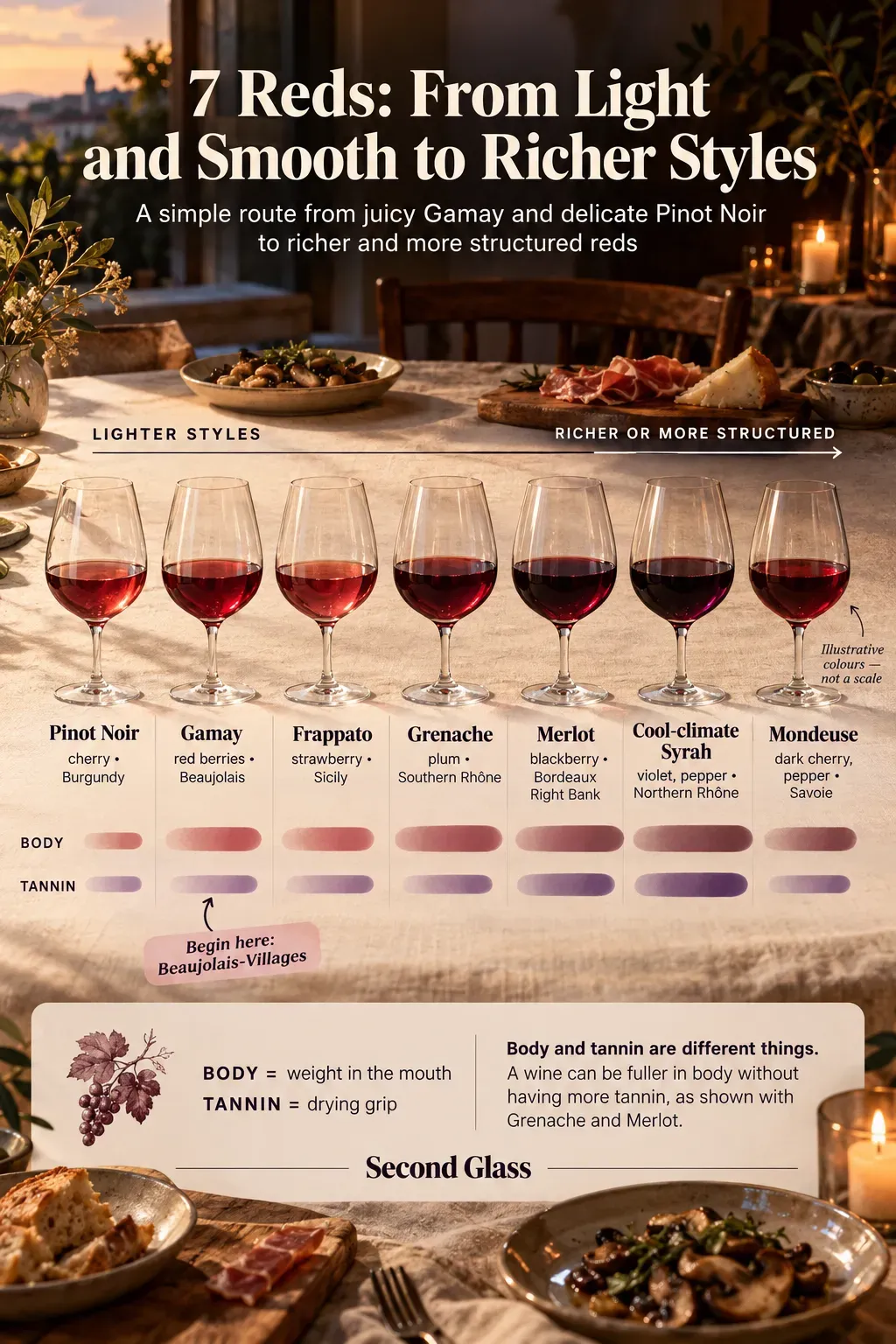
If you're new to red wine — or simply prefer fresher, smoother styles — understanding the difference between body and tannin is a useful place to start. This guide begins with lighter options such as Pinot Noir, Gamay and Frappato before moving towards richer Grenache and Merlot, then more structured cool-climate Syrah and Mondeuse.
Key Takeaways
- Gamay, Pinot Noir and Frappato are excellent places to start if you want genuinely lighter red wines.
- Low tannin and light body aren't the same thing: a wine can be fuller-bodied but still feel relatively soft.
- Gamay typically combines juicy red fruit, lively acidity and gentle tannins.
- Pinot Noir offers a step towards greater savoury complexity while generally retaining freshness and fine tannins.
- Grenache and Merlot are useful options when you want more body without necessarily moving towards very firm tannins.
- Cool-climate Syrah and Mondeuse can offer freshness alongside more noticeable tannin and structure.
- Serving lighter reds slightly cool rather than warm can emphasise their freshness and fruit.
Why Do Some Red Wines Feel Smoother?
That dry, slightly grippy sensation you get from some red wines comes largely from tannins.
Tannins are compounds found in grape skins, seeds and stems, as well as oak. Because red wines are usually fermented with their skins, they generally contain more tannin than white wines.
But the amount varies enormously.
Smoother reds often combine relatively gentle tannins with juicy fruit and refreshing acidity. Some are genuinely light-bodied, while others have more weight but still avoid an aggressively drying finish.
The seven wines below follow that progression: we'll start with lighter, gentler reds before moving towards richer and more structured styles.
How Light Red Wine usually feels
1. Pinot Noir
Best for: delicate, silky red wine
Pinot Noir is one of the classic choices if you want a lighter red.
Expect flavours such as cherry, raspberry and strawberry, sometimes joined by floral, earthy or savoury notes. Its naturally high acidity keeps the wine fresh, while tannins are usually relatively gentle.
Regions to explore include:
- Burgundy, France
- Oregon, USA
- Central Otago, New Zealand
Pinot Noir can vary considerably by region and winemaking, but its combination of fragrance, freshness and fine tannins makes it an excellent reference point for lighter reds.
2. Gamay
Best for: juicy fruit and very easy drinking
Gamay is most closely associated with Beaujolais in France, where it produces some of the world's most refreshing red wines.
Typical flavours include:
- Strawberry
- Raspberry
- Red cherry
- Violet
Many Beaujolais wines have light bodies, lively acidity and low levels of tannin.
For an accessible introduction, try Beaujolais or Beaujolais-Villages. For something with more depth and structure, explore one of the ten Beaujolais crus.
Gamay is particularly useful if you find heavier red wines tiring or overly drying.
3. Frappato
Best for: fragrant Mediterranean reds
Frappato comes from Sicily and shows that warm climates can still produce wonderfully fresh red wines.
Expect flavours of:
- Strawberry
- Red cherry
- Blood orange
- Dried herbs
- Flowers
Frappato is generally light-bodied, aromatic and relatively low in tannin.
It can be bottled by itself or blended with Nero d'Avola, most famously in Cerasuolo di Vittoria. Those blends tend to have more body and structure than varietal Frappato.
Try Frappato if you enjoy Pinot Noir or Gamay but want something more Mediterranean in character.
4. Grenache
Best for: soft, ripe fruit
Grenache — known as Garnacha in Spain — takes us slightly beyond genuinely light red wine.
It can produce relatively full-bodied, high-alcohol wines, particularly in warm climates. However, its tannins are often softer than those of grapes such as Cabernet Sauvignon, Nebbiolo or Tannat.
Typical flavours include:
- Strawberry
- Raspberry
- Red plum
- Dried herbs
- Sweet spice
Look towards Spain and the Southern Rhône, where Grenache is widely grown and frequently blended with other varieties.
Choose Grenache when you want something richer and warmer than Pinot Noir or Gamay without moving straight into heavily tannic territory.
5. Merlot
Best for: soft texture with more body
Merlot isn't usually considered a light red grape, but it deserves a place in a guide to smoother reds.
Its tannins can feel rounder and softer than Cabernet Sauvignon's, while flavours often include:
- Plum
- Black cherry
- Blackberry
- Chocolate
- Cedar
Good regions to explore include Bordeaux's Right Bank, Washington State and Chile.
Styles vary significantly, particularly with climate and oak ageing, so don't expect every Merlot to be soft and simple. But if you want to move from lighter reds towards something richer, Merlot can provide a useful bridge.
6. Cool-Climate Syrah
Best for: savoury flavours and peppery freshness
Syrah might seem like an unusual inclusion because some versions can be dark, concentrated and firmly tannic.
But cooler-climate examples can emphasise freshness, perfume and savoury complexity rather than sheer weight.
Look for flavours such as:
- Blackberry
- Black cherry
- Violet
- Black pepper
- Olive
The Northern Rhône is the classic reference point, although these wines aren't necessarily low in tannin — and many of the region's best examples are built to age.
Think of cool-climate Syrah as the next step if you enjoy fresh red wine but want more structure and savoury character.
7. Mondeuse
Best for: adventurous drinkers
Mondeuse is strongly associated with Savoie in the French Alps.
It's less familiar than Pinot Noir or Gamay, but that's part of its appeal. Expect dark berries, pepper, herbs and plenty of freshness.
Mondeuse can have noticeable tannins, so it isn't necessarily the softest wine on this list. What earns it a place is its combination of freshness, moderate body and distinctive Alpine character.
Try it when you're ready to move beyond the familiar grapes and explore something more unusual.
How to serve Light Red Wine
Red
Pinot Noir
13–16°C 55–61°F
Serve cool enough to keep the fruit fresh. A brief spell in the fridge is useful if the room is warm.
Red
Gamay
12–15°C 54–59°F
Serve lightly chilled to sharpen its juicy red fruit and floral freshness.
Red
Frappato
12–15°C 54–59°F
Serve lightly chilled to make its floral, strawberry and herbal character especially vivid.
Red
Grenache
15–17°C 59–63°F
Serve just below room temperature to balance its ripe fruit, alcohol and spice.
Red
Merlot
15–18°C 59–64°F
Serve below warm room temperature so its plum fruit and soft texture remain balanced.
Red
Syrah
15–18°C 59–64°F
Serve below warm room temperature; fresher Syrah suits the lower end and richer Shiraz the upper end.
Red
Mondeuse
13–16°C 55–61°F
Serve slightly cool to highlight its mountain freshness, peppery fruit and lively acidity.
What to eat with lighter and smoother red wines
Ideal pairings
- Roast chicken
- Mushroom dishes
- Charcuterie
- Grilled vegetables
- Tomato-based pasta
Fresh acidity and relatively gentle tannins make many lighter reds flexible with savoury food.
Everyday pairings
- Pizza
- Burgers
- Pasta
- Roast chicken
Pairings to approach carefully
Match the weight of the wine to the dish. Delicate reds can be overwhelmed by very rich food, while extremely sweet sauces can make dry reds seem harsher.
Light-Bodied vs Low-Tannin: What's the Difference?
Body and tannin describe two different parts of the drinking experience.
Body is the overall weight and richness of a wine in your mouth. Tannin is the drying, grippy sensation created largely by compounds from grape skins, seeds and stems.
That means a wine can be relatively light but still have noticeable tannin — or fairly full-bodied while remaining soft.
It's also why Grenache and Merlot can belong in a guide like this without being genuinely light-bodied: they provide a useful route into richer reds while often feeling softer than more firmly tannic styles.
Red Wines That Can Feel More Tannic
If you dislike a strong drying sensation, some grapes and styles may take more getting used to.
Young wines made from Cabernet Sauvignon, Nebbiolo and Tannat, for example, can have substantial tannin. Barolo, which is made from Nebbiolo, is particularly known for combining fragrance with firm structure when young.
That doesn't make these wines better or worse. They're simply built differently.
Food can also change how a tannic wine feels. The combination of a dish's protein, fat, seasoning, sauce and overall intensity can affect the pairing, so a structured red may feel more balanced with an appropriate meal than when tasted on its own.
Seven smooth reds from lighter to richer styles
| Grape | Similar | Difference |
|---|---|---|
| Pinot Noir | Fresh, fragrant and generally fine-tannined. | Can show more savoury complexity than very fruit-forward light reds. |
| Gamay | Light-bodied with juicy red fruit and lively acidity. | Often especially fruit-forward and relatively low in tannin. |
| Frappato | Light-bodied, aromatic and relatively low in tannin. | Adds a distinctly Mediterranean mix of red fruit, citrus and herbs. |
| Grenache | Often has relatively soft tannins and generous fruit. | Can be considerably richer, warmer and higher in alcohol. |
| Merlot | Often offers round, approachable tannins. | Usually has more body and darker fruit than genuinely light reds. |
| Syrah | Cool-climate examples can combine freshness with aromatic character. | Usually brings more structure, dark fruit and peppery character. |
| Mondeuse | Fresh and aromatic with peppery character. | Can have more noticeable tannin than the gentlest wines in the guide. |
Beginner Guidance
If you're choosing your first bottle, Beaujolais-Villages is a particularly useful starting point. It's typically juicy, fresh and relatively low in tannin, making it easier to identify the qualities that distinguish lighter reds.
From there, try Pinot Noir for something potentially more savoury, Frappato for a Mediterranean alternative, Grenache for greater richness and Merlot as a step towards fuller-bodied red wine.
How To Experiment
The easiest way to understand these differences is to taste two contrasting wines side by side.
Pour a Gamay alongside a Merlot, for example. Taste each without worrying too much about identifying individual aromas.
Instead, ask three simple questions:
- Which feels heavier in your mouth?
- Which feels fresher?
- Which leaves your mouth feeling drier after you swallow?
You're comparing body, acidity and tannin rather than trying to decide which wine is better. Once you recognise those differences, choosing bottles becomes much easier.
Common Misconceptions
Light red wine means weak or flavourless wine
Light body describes how much weight a wine has in your mouth, not how much flavour it contains. Pinot Noir, Gamay and Frappato can be intensely aromatic despite feeling relatively delicate.
Smooth red wine always means low tannin
Not necessarily. Ripeness, alcohol, acidity, oak ageing and winemaking can all influence how soft a wine feels. A wine can contain noticeable tannin without seeming particularly harsh.
All Pinot Noir is light and delicate
Pinot Noir varies considerably. Climate, ripeness, extraction and oak can produce wines ranging from pale and delicate to comparatively rich and structured.
Merlot is always a light red wine
Merlot is often smooth, but it isn't usually light-bodied. Many examples are medium to full-bodied, particularly when grown in warmer climates or made in a richer style.
Red wine should always be served at room temperature
Not necessarily. Modern room temperatures can be warmer than ideal for red wine. Lighter reds often show particularly well when served slightly cool, helping their fruit and acidity feel fresher.
Questions about light and smooth red wine
What is a good smooth red wine for beginners?
Beaujolais-Villages is an excellent starting point. Made from Gamay, it generally offers juicy fruit, refreshing acidity and relatively gentle tannins. From there, explore Pinot Noir or Frappato before moving towards richer styles such as Grenache and Merlot.
What does low-tannin red wine feel like?
It creates less of the drying, grippy sensation associated with tannin. Low tannin describes texture rather than flavour, so these wines can still offer plenty of fruit, floral, herbal or savoury character.
Is Pinot Noir a smooth red wine?
Usually, yes. Pinot Noir commonly has fine, relatively gentle tannins and high acidity, giving it a fresh, often silky texture. Styles vary considerably according to region, vintage and winemaking.
Is Merlot a light red wine?
Usually not. Merlot is commonly medium to full-bodied, but its tannins can feel softer and rounder than those of Cabernet Sauvignon. This makes it useful when exploring richer red wine without necessarily seeking very firm tannins.
Should light red wine be chilled?
Light reds often benefit from being served slightly cool. A little chilling can emphasise freshness and fruit, while serving them extremely cold can mute their aromas. Think lightly chilled rather than fridge-cold.
What should I try after light red wine?
Move gradually towards greater body or structure. Grenache can introduce more richness, while Merlot offers a step towards fuller-bodied red wine. Cool-climate Syrah and Mondeuse can then introduce more noticeable structure while retaining freshness.
Final Thoughts
If heavy, tannic reds aren't for you, there's an enormous range of alternatives.
Start with Gamay, Pinot Noir and Frappato for genuinely lighter styles. Move towards Grenache and Merlot when you want more richness without necessarily seeking aggressive tannins.
Then experiment with wines such as cool-climate Syrah and Mondeuse as your palate becomes more familiar with structure.
The useful question isn't whether a red wine is “serious” or “easy”.
It's whether its balance of fruit, freshness, body and tannin suits the way you like to drink.