
Quick answer
What to know first
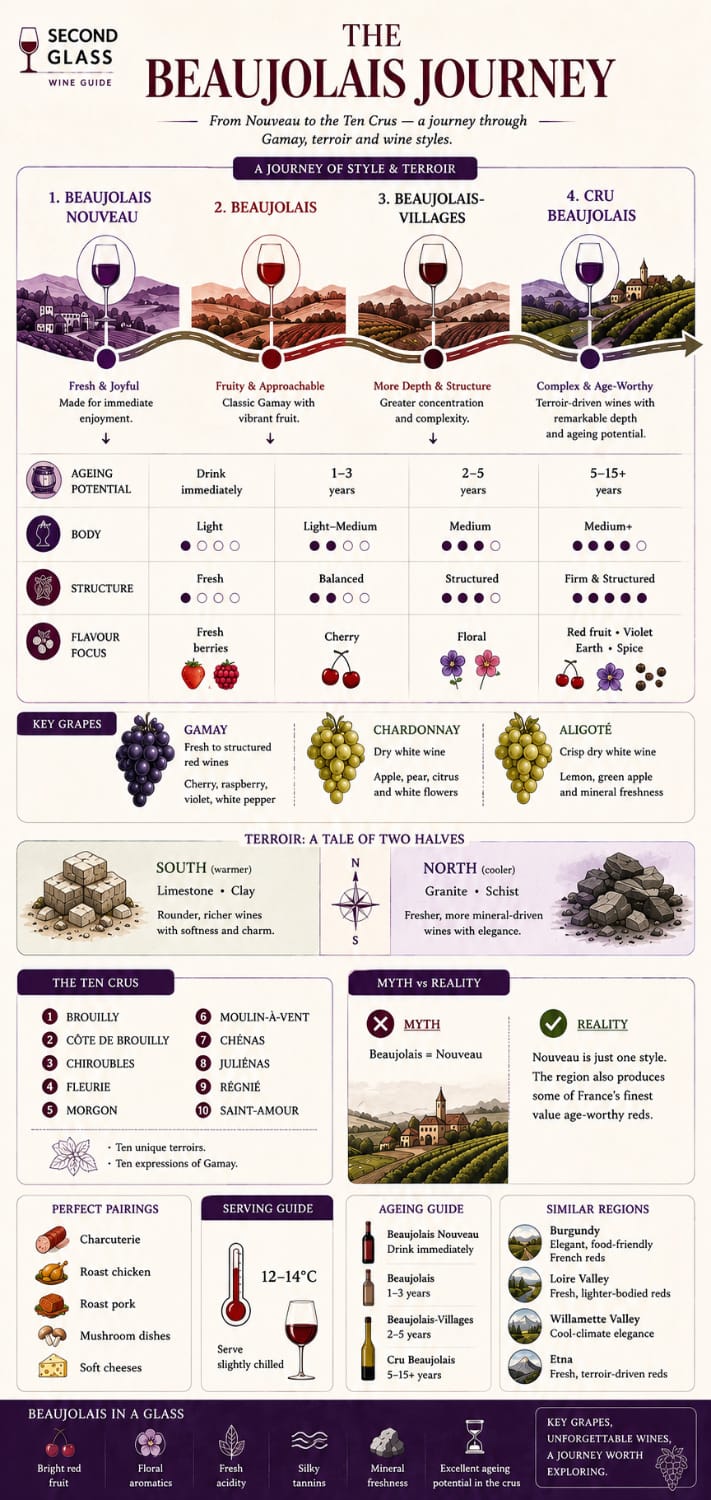
Beaujolais is a wine region in eastern France, just south of Burgundy, famous for vibrant Gamay wines. While Beaujolais Nouveau is its best-known export, the region also produces elegant, terroir-driven crus with bright red fruit, fresh acidity and impressive ageing potential.
Key Takeaways
- Beaujolais sits immediately south of Burgundy in eastern France.
- Gamay is the region's defining grape, producing fresh, expressive red wines.
- Granite-rich soils give many wines their purity, freshness and aromatic lift.
- The ten crus represent the highest quality expressions of the region.
- Beaujolais Nouveau is only one small part of the region's diverse production.
- The wines are among France's best values, offering exceptional quality for their price.
- From light everyday reds to cellar-worthy bottles, Beaujolais offers remarkable variety.
How Beaujolais usually feels
Where Is Beaujolais?
Beaujolais lies between Burgundy and the northern Rhône, stretching for around 55 kilometres north from the city of Lyon. Although it forms part of the wider Burgundy wine trade, it has developed a distinct identity thanks to its unique grape varieties, soils and winemaking traditions.
The landscape changes noticeably from south to north. Southern Beaujolais is characterised by gently rolling limestone hills and picturesque golden-stone villages, while the northern half becomes steeper, with vineyards climbing granite slopes that produce many of the region's finest wines.
The climate is predominantly continental, bringing warm summers and cool winters, but its proximity to the Rhône Valley introduces subtle Mediterranean influences that help grapes ripen consistently while retaining freshness.
Today, Beaujolais occupies an important position within French wine, offering wines that combine accessibility, regional character and outstanding value.
Why Is Beaujolais Famous?
For many wine drinkers, Beaujolais is synonymous with Beaujolais Nouveau, the youthful wine released every November just weeks after harvest. The annual celebration transformed the region into an international phenomenon during the twentieth century and remains one of the wine world's most recognisable traditions.
However, Beaujolais' modern reputation increasingly rests on something quite different: its crus. These ten villages demonstrate just how expressive Gamay can be, producing wines with remarkable depth, complexity and an ability to reflect their individual terroirs.
Wine enthusiasts are drawn to Beaujolais because it offers vibrant fruit, refreshing acidity and a genuine sense of place, often at prices that compare favourably with neighbouring Burgundy.
Climate and Terroir
Climate
Beaujolais enjoys a predominantly continental climate, with warm summers that encourage reliable ripening and cool winters that allow the vines to rest. Rainfall is moderate, and southern influences from the Rhône Valley help soften extremes, particularly during the growing season.
These conditions allow Gamay to ripen fully while preserving the bright acidity that gives Beaujolais its signature freshness.
Soils
Soil diversity is one of the region's defining strengths.
Northern Beaujolais, home to the crus, is dominated by ancient granite, schist and decomposed volcanic rock. These free-draining soils encourage concentrated fruit, floral aromas and fine structure.
Further south, limestone and clay become increasingly common, producing softer, more approachable wines with generous fruit.
Elevation and Topography
Most vineyards sit between 200 and 500 metres above sea level. The best sites occupy well-exposed hillsides where sunlight, drainage and airflow combine to produce grapes of exceptional quality.
Steeper slopes naturally reduce yields, helping concentrate flavour while encouraging healthy vines.
How Terroir Shapes Wine Style
Beaujolais demonstrates how dramatically terroir can influence a single grape variety.
Granite typically produces wines with vibrant red fruit, lifted floral aromas and silky tannins, while clay contributes greater body and richness. Limestone often enhances freshness and elegance.
This diversity explains why each cru develops its own recognisable personality despite relying almost entirely on Gamay.
Important grapes in Beaujolais
| Grape | Style | Flavour profile | Structure | Food pairings |
|---|---|---|---|---|
| Gamay | Fresh to structured red wines. | Cherry, raspberry, wild strawberry, violet and white pepper. | Light to medium body, high acidity, low to moderate tannin and moderate alcohol. | Roast chicken, charcuterie, mushroom dishes and roast pork. |
| Chardonnay | Dry white wine. | Apple, pear, citrus and white flowers. | Light to medium body with fresh acidity. | Roast chicken, Brie, Camembert and lighter mushroom dishes. |
| Aligoté | Crisp dry white wine. | Lemon, green apple and mineral freshness. | Light-bodied with high acidity. | Charcuterie, soft cheeses and simple seafood dishes. |
Wine Styles of Beaujolais
Red
Red wine defines Beaujolais.
Styles range from the youthful fruitiness of Beaujolais Nouveau to everyday regional wines, increasingly concentrated Beaujolais-Villages and the complex, age-worthy crus.
Each step up offers greater concentration, complexity and expression of place.
White
Produced mainly from Chardonnay, Beaujolais Blanc is fresh, elegant and often lightly mineral, although production remains relatively small.
Rosé
Rosé wines are uncommon but can be delightfully refreshing, offering delicate red berry flavours and crisp acidity.
Sparkling
Some vineyards contribute grapes to Crémant de Bourgogne, producing traditional method sparkling wines with fresh citrus fruit and subtle brioche notes.
What Do Wines From Beaujolais Taste Like?
Fruit Characteristics
Most Beaujolais wines showcase vibrant red fruit.
Common flavours include:
- Cherry
- Raspberry
- Strawberry
- Redcurrant
Riper vintages and certain crus may also show blackberry or plum.
Floral Characteristics
Many wines display fragrant aromas of:
- Violet
- Rose petals
- Peony
These floral notes are one of Gamay's defining characteristics.
Herbal and Savoury Characteristics
As wines mature, they often develop greater complexity with notes of:
- White pepper
- Earth
- Forest floor
- Dried herbs
- Crushed stone
Structural Characteristics
Beaujolais is known for its balance rather than power.
Expect:
- Bright acidity
- Fine, silky tannins
- Moderate alcohol
- Smooth texture
The crus generally offer more structure while maintaining freshness.
Ageing Characteristics
Regional Beaujolais is best enjoyed within a few years of release.
Cru wines, however, can develop beautifully over 5 to 15 years, gaining savoury complexity while retaining freshness and elegance.
Vintage Variation
Warmer vintages tend to produce richer wines with darker fruit and softer acidity.
Cooler years emphasise floral aromas, bright acidity and lighter-bodied styles.
The Beaujolais names worth recognising
Beaujolais AOC
Memory hook: The fresh, easygoing regional appellation.
Known for: Approachable wines that highlight Gamay's freshness, fruit and drinkability.
Why it matters: Beaujolais AOC is the clearest entry point into the region's bright, uncomplicated charm.
Beaujolais-Villages
Memory hook: A step up in concentration without losing friendliness.
Known for: Wines from selected northern villages with more depth and complexity than basic Beaujolais.
Why it matters: Beaujolais-Villages is often the best starting point for learning the region before moving into the crus.
Fleurie
Memory hook: The fragrant, graceful cru.
Known for: Silky Gamay with cherry, raspberry, violet and peony-like florals.
Why it matters: Fleurie is often the easiest cru to recognise when you want elegance rather than power.
Brouilly
Memory hook: The generous, friendly cru.
Known for: Juicy, approachable reds with bright red fruit and easy charm.
Why it matters: Brouilly is the largest Beaujolais cru and a useful first step beyond Beaujolais-Villages.
Chiroubles
Memory hook: The high-altitude, delicate cru.
Known for: Delicate, aromatic wines with freshness, finesse and lifted floral fruit.
Why it matters: Chiroubles shows Beaujolais at its most graceful and refreshing.
Morgon
Memory hook: The savoury, age-worthy cru.
Known for: Structured Gamay with cherry, earth, mineral notes and deeper forest-floor complexity as it ages.
Why it matters: Morgon helps show why Beaujolais is not only a light, young-drinking wine.
Moulin-à-Vent
Memory hook: The most powerful cru.
Known for: Firm, concentrated Gamay with dark cherry, spice, mineral grip and serious ageing potential.
Why it matters: Moulin-à-Vent is a benchmark for structured Cru Beaujolais that can develop for years.
Juliénas
Memory hook: The richer, spiced cru.
Known for: Fuller fruit, spice and wines with excellent ageing potential.
Why it matters: Juliénas adds depth and savoury power to the Beaujolais cru lineup.
Chénas
Memory hook: The small cru with firm bones.
Known for: Floral elegance, firm structure and subtle earthy complexity.
Why it matters: Chénas is the smallest cru and often rewards drinkers looking beyond the best-known names.
Côte de Brouilly
Memory hook: Brouilly with a volcanic lift.
Known for: Fresh, energetic Gamay from the slopes of Mont Brouilly, often with stony, peppery detail.
Why it matters: It shows how Beaujolais soils and elevation can sharpen the region's fruit-driven style.
Régnié
Memory hook: The newest cru with youthful charm.
Known for: Vibrant, fruit-forward wines that are usually supple and easy to enjoy young.
Why it matters: Régnié rounds out the crus with a lively, approachable style.
Saint-Amour
Memory hook: The romantic northern cru.
Known for: Bright, floral Gamay that can range from soft and early-drinking to more structured styles.
Why it matters: Saint-Amour adds another expression of Beaujolais, often balancing charm with northern-cru freshness.
What to eat with Beaujolais
Regional specialities
Beaujolais has long been associated with the cuisine of nearby Lyon, one of France's great gastronomic cities.
Classic pairings include:
- Saucisson lyonnais
- Roast pork
- Coq au vin
- Duck
- Chicken with cream sauces
The freshness of Gamay cuts through rich dishes while complementing savoury flavours.
Everyday local pairings
Beaujolais is one of the easiest wines to pair with everyday meals.
Excellent choices include:
- Burgers
- Roast chicken
- Pizza
- Sausages
- Mushroom pasta
- Charcuterie
- Brie
- Camembert
Pairings to approach carefully
Delicate Beaujolais can struggle alongside very spicy dishes or heavily charred steaks, where intense flavours may overpower the wine's subtle fruit and floral character. Fuller-bodied crus such as Moulin-à-Vent or Morgon cope better with richer meat dishes.
Similar wine regions to explore
| Region | Similar | Difference |
|---|---|---|
| Burgundy | Elegant, food-friendly French reds. | Pinot Noir replaces Gamay. |
| Loire Valley | Fresh, lighter-bodied reds. | Cabernet Franc dominates. |
| Willamette Valley | Cool-climate elegance. | Pinot Noir and New World climate. |
| Baden | Comparable freshness and finesse. | Germany's Spätburgunder provides Pinot Noir rather than Gamay. |
| Etna | Fresh, terroir-driven reds. | Nerello Mascalese and volcanic Sicily. |
| Valpolicella Classico | Bright, versatile reds. | Corvina-based blends. |
Buying Wines From the Region
Budget (£10–15)
At this level, expect straightforward, fruit-driven wines that emphasise freshness and drinkability over complexity. Most bottles will come from the broader Beaujolais or Beaujolais-Villages appellations, often sourced from younger vines or flatter vineyard sites.
Winemaking at this price point typically focuses on preserving bright fruit through techniques such as carbonic or semi-carbonic maceration, resulting in wines with juicy red berry flavours, low tannin and a soft, easygoing texture. These wines are best enjoyed young, usually within one to three years of release, and are ideal for casual drinking or pairing with simple meals.
While depth and structure are limited, careful selection can still uncover excellent value, particularly from conscientious producers who prioritise balance and purity even at entry level.
Mid-Range (£15–30)
This is where Beaujolais begins to show its true character and diversity. In this range, you gain access to many of the crus, as well as higher-quality Beaujolais-Villages from better vineyard sites and older vines.
Wines at this level typically offer greater concentration, more defined structure and a clearer expression of terroir. Expect more layered fruit, often moving beyond simple red berries into darker fruit, floral complexity and subtle savoury notes. Tannins are more present but remain fine and approachable, and acidity continues to provide freshness and balance.
Many wines in this category can be enjoyed immediately but also have the capacity to develop over five to ten years, gaining complexity and nuance with time. This price range represents one of the strongest value propositions in French wine, particularly when compared to similarly styled wines from Burgundy.
Premium (£30–70+)
At the top end, Beaujolais reveals its full potential. Wines in this category typically come from the finest vineyard sites within the crus, often farmed by highly regarded producers who focus on low yields, old vines and meticulous vineyard management.
Winemaking tends to be more nuanced, sometimes incorporating partial destemming, longer macerations or ageing in oak to build structure and complexity while preserving the purity of Gamay. The resulting wines show impressive depth, with concentrated fruit, layered aromatics and a refined, age-worthy structure.
These bottles can evolve over ten to fifteen years or more, developing savoury, earthy and mineral characteristics that bring them closer in style to fine red Burgundy. While prices remain relatively modest compared to top Pinot Noir, the quality at this level can be exceptional, offering serious collectors and enthusiasts a compelling alternative.
Common Misconceptions
Beaujolais is only light and simple
While many entry-level wines are easy-drinking and fruit-forward, the crus can be structured, complex and capable of long ageing. Some examples rival fine Burgundy in depth and nuance.
All Beaujolais tastes the same
The region shows remarkable diversity. Differences in soil, elevation and winemaking create distinct styles across the ten crus, from the floral elegance of Fleurie to the power of Moulin-à-Vent.
Beaujolais should always be drunk young
Although Beaujolais Nouveau and basic regional wines are best enjoyed early, many cru wines improve significantly with age, developing savoury and earthy complexity over time.
Beaujolais is low quality
This outdated perception stems largely from the mass-market success of Beaujolais Nouveau. Today, many producers focus on quality-driven, terroir-expressive wines that are highly respected by critics and collectors.
Gamay is a simple grape
Gamay is often underestimated, but in the right conditions it produces wines with impressive aromatic complexity, structure and ageing potential.
FAQs
Should Beaujolais be served chilled?
Yes, slightly. Most Beaujolais shows best when served just below room temperature, around 12–14°C. This enhances freshness and highlights the wine’s fruit and floral character.
What glass should you use for Beaujolais?
A standard red wine glass works well, but a Burgundy-style glass with a wider bowl can help emphasise the wine’s aromatics and delicate structure.
How long should you decant Beaujolais?
Most Beaujolais does not require decanting, especially lighter styles. However, structured crus such as Morgon or Moulin-à-Vent can benefit from 30–60 minutes of air to open up.
Is Beaujolais suitable for summer drinking?
Absolutely. Its bright acidity, moderate alcohol and refreshing fruit make it one of the best red wines for warmer weather, especially when lightly chilled.
Are there natural or organic Beaujolais wines?
Yes. Beaujolais has become a centre for natural and organic winemaking, with many producers farming sustainably and using minimal intervention in the cellar.
Can Beaujolais be paired with vegetarian dishes?
Very easily. Its freshness and low tannin make it an excellent match for vegetable-based dishes, particularly those featuring mushrooms, lentils or roasted vegetables.
Does Beaujolais contain oak flavours?
Most Beaujolais is made without significant oak influence, preserving pure fruit character. However, some premium crus may see partial oak ageing, adding subtle spice and structure.
If you are new to Beaujolais
Start with Beaujolais-Villages, then compare Fleurie and Brouilly for charm and perfume before tasting Morgon and Moulin-à-Vent for structure. Try Beaujolais Blanc as a contrast, and compare several crus side by side when you want to understand how different the region can be.
Final Thoughts
Modern Beaujolais is far more than Beaujolais Nouveau. It is a diverse and exciting region capable of producing everything from joyful everyday reds to elegant, cellar-worthy wines. Whether you're discovering Gamay for the first time or exploring the individuality of the ten crus, Beaujolais rewards curiosity with freshness, personality and outstanding value.