
Quick answer
What to know first
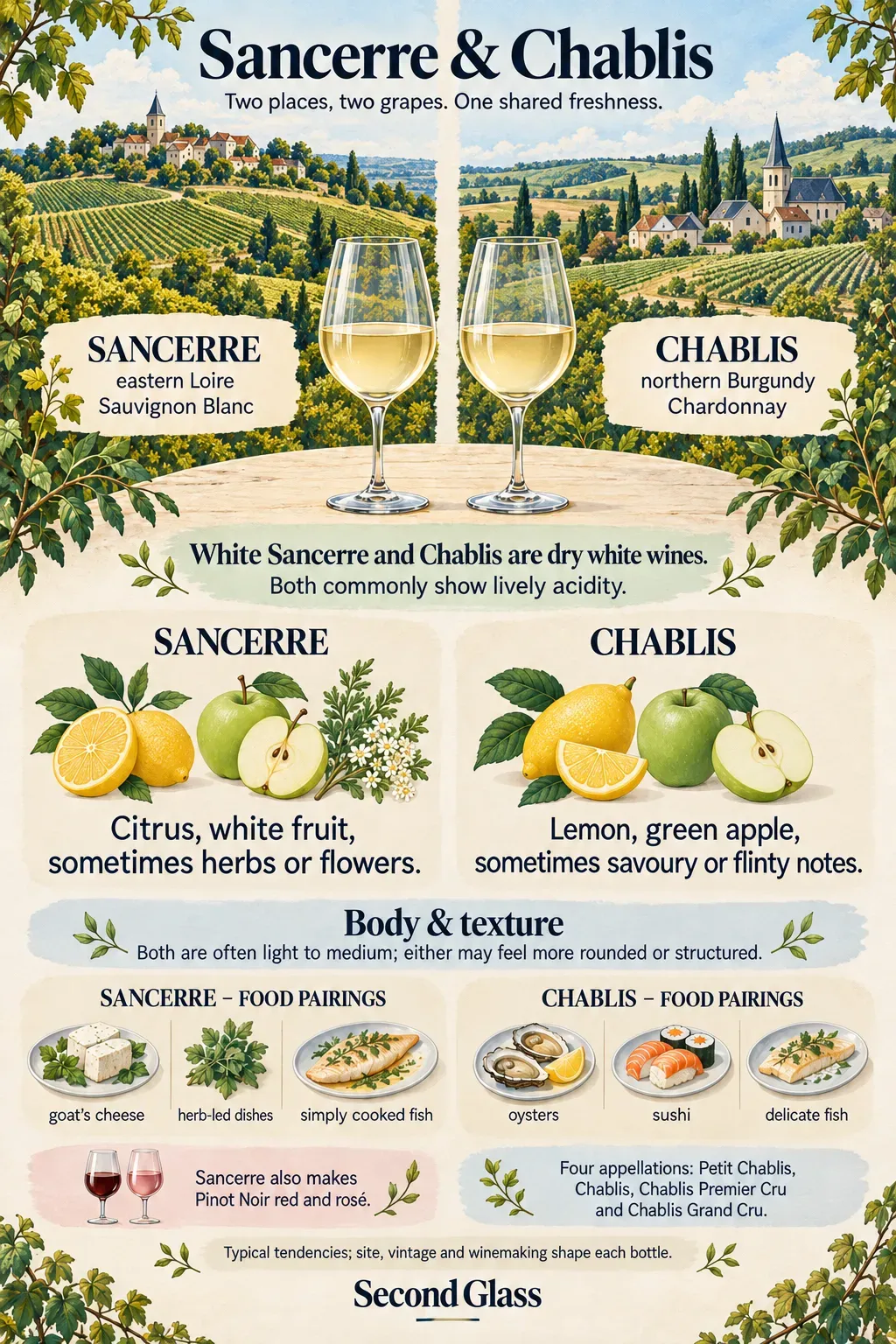
Both are French appellations known for dry, fresh white wines. White Sancerre is Sauvignon Blanc; Chablis is Chardonnay. Sancerre often has more herbal or floral lift, while Chablis may feel more restrained and savoury.
Introduction
Sancerre and Chablis are often compared by people choosing a crisp French white. They share freshness and can both work with food, but they begin with different grapes and places. Those differences offer useful clues; they do not make every bottle from either region taste the same.
This guide focuses on white Sancerre and Chablis, the styles most often compared. Sancerre also makes red and rosé wines, so check the wine’s colour when choosing a bottle.
Key Takeaways
- Sancerre is in the eastern Loire; Chablis is in northern Burgundy.
- White Sancerre is made from Sauvignon Blanc; Chablis is made from Chardonnay.
- Both whites commonly show lively acidity, though perceived acidity and body vary by bottle.
- Sancerre often has herbal or floral lift; Chablis may feel more restrained and savoury.
- Chablis’s four appellations help identify origin and classification; Premier Cru and Grand Cru can offer greater depth and ageing scope.
Sancerre vs Chablis
Which differences matter most to you?
Wine region
Sancerre
Place Centre-Loire, eastern Loire Valley.
Main white grape Sauvignon Blanc.
Wine region
Chablis
Place Northern Burgundy.
Main white grape Chardonnay.
| Compare | Sancerre | Chablis |
|---|---|---|
| Place | Centre-Loire, eastern Loire Valley. | Northern Burgundy. |
| Main white grape | Sauvignon Blanc. | Chardonnay. |
| Other styles | Red and rosé from Pinot Noir. | Dry white wines only. |
| Typical white-wine notes | Citrus, white fruit, sometimes herbs or flowers. | Lemon, apple, sometimes savoury or flinty notes. |
| Acidity | Commonly lively. | Commonly lively. |
| Body and texture | Often light to medium; some whites are more textured. | Often light to medium; some wines are broader or more structured. |
| Appellations | Sancerre AOC. | Petit Chablis, Chablis, Chablis Premier Cru, Chablis Grand Cru. |
| Food ideas | Goat’s cheese, herbs, fish. | Oysters, delicate fish, sushi. |
Both whites commonly show lively acidity, while perceived acidity and body vary by bottle. The flavour notes and textures below are tendencies shaped by site, vintage and winemaking, so individual wines can overlap.
Why These Wines Differ
Sancerre is an appellation in the Centre-Loire, in the eastern Loire Valley. Its best-known wines are dry whites made from Sauvignon Blanc. Pinot Noir is used for Sancerre’s red and rosé wines.
Chablis is in northern Burgundy. The Chablis wine region has four appellations: Petit Chablis, Chablis, Chablis Premier Cru and Chablis Grand Cru. All are dry white wines made from Chardonnay.
Sauvignon Blanc often gives white Sancerre an aromatic lift, with citrus and sometimes herbal or floral notes. Chardonnay in Chablis can show a quieter profile, with lemon, apple and savoury impressions. The grape sets an expectation, but site and winemaking also matter.
Maturation is one way those choices shape the experience. In Chablis, oak may be absent, subtle or more noticeable; producers also use stainless steel, concrete, large-format wood and older barrels. These choices can affect texture and how prominent fruit or savoury notes seem. In Sancerre, differences in vineyard site and winemaking can take a white from fresh and direct to broader and more textured.
What Changes in the Glass?
Aromatic intensity
Sancerre often gives a more immediately expressive impression, with citrus or white fruit and, in some wines, herbs or flowers. Chablis may seem more restrained, with lemon, green apple or savoury and flinty impressions.
Acidity
Both whites commonly show lively acidity. The useful comparison is how that freshness comes across alongside the wine’s aromas, body and texture. One may feel brisk and mouth-watering; the other may balance its freshness with a more rounded texture.
Body and texture
Many white Sancerres and Chablis are light to medium in body. Some Sancerres feel broader or more textured; some Chablis are more concentrated or structured. Oak use, vessel and maturation can affect texture, as can site and vintage.
“Mineral” is a tasting description, not proof of a particular soil flavour. In either wine, consider it one way to describe an impression rather than a literal ingredient.
Variation Within Each Region
Sancerre ranges from fresh, direct whites intended to be enjoyed young to wines with more texture and concentration. Some more structured examples can develop with time, but the region’s familiar citrus and herbal styles remain useful reference points when browsing.
The four Chablis appellations identify different origins and classifications. Petit Chablis and Chablis are useful starting points; Premier Cru and Grand Cru identify wines from classified vineyard sites. As a broad buying expectation, Premier Cru and Grand Cru often offer greater concentration and ageing scope than the entry appellations. The classification can guide your search, but the producer, site and vintage still shape the individual bottle.
Food Pairing Comparison
Sancerre’s citrus and possible herbal or floral notes can work well with herbs, salads and goat’s cheese. Goat’s cheese is particularly associated with the region, and its tangy character can sit comfortably beside a fresh white wine. Sancerre can also suit simply grilled fish and shellfish.
Chablis is a natural option with oysters and other shellfish, sushi, or delicate fish dishes. A simple preparation lets the wine’s freshness and savoury notes complement the food without competing with strong seasoning.
Richer preparations call for attention to texture. With a buttery sauce or creamy dish, look for a Sancerre described as broader or a Chablis with more structure. The appellation level can help you narrow your options, but the producer’s description or a trusted retailer can be more useful for predicting the specific wine’s texture.
Which Should You Choose?
- Choose white Sancerre if you usually enjoy Sauvignon Blanc and want citrus with possible herbal or floral lift.
- Choose Chablis if you want to explore Chardonnay from a defined region, often in a dry, fresh style with savoury notes.
- Choose Sancerre for herbs or goat’s cheese when the wine’s aromas suit the preparation.
- Choose Chablis for oysters or delicate fish when you want a restrained white alongside subtle seafood flavours.
- For a richer dish, choose by texture: look for a bottle described as broader or more structured, from either region.
- If you are unsure, compare both at similar price points and vintages.
How to serve Sancerre vs Chablis
White
Sancerre Blanc
8–12°C 46–54°F
The Vins du Centre-Loire (BIVC) guide gives a range of 8–12°C; 10–12°C is a useful starting point for white Sancerre.
White
Chablis
10–11°C 50–52°F
Serve Chablis and Chablis Premier Cru at 10–11°C. Petit Chablis can be served cooler; Chablis Grand Cru is served warmer, at 12–14°C.
How to compare Sancerre and Chablis
Choose a dry white Sancerre and a Chablis from similar vintages and close price points. Taste them at the same temperature in similar glasses, then try both with simply cooked fish. One bottle offers one expression of its appellation.
How To Compare Them Step by Step
- Step 1 — Read the labels. Note the appellation, vintage and, for Chablis, whether it is Petit Chablis, Chablis, Premier Cru or Grand Cru.
- Step 2 — Smell each wine. Notice whether aromas seem immediately expressive or more restrained, then look for citrus, white fruit, herbs, flowers, apple or savoury notes.
- Step 3 — Taste each wine. Compare how lively its acidity feels, its body, and whether its texture seems lean, rounded or structured.
- Step 4 — Compare the finish. Notice which flavours linger and whether you prefer a more aromatic or savoury impression.
- Step 5 — Try them with simply cooked fish. Keeping the preparation the same helps you decide which wine you prefer with that dish.
Questions about Sancerre and Chablis
Is Sancerre always white?
No. White Sancerre is the best-known style, but the appellation also makes red and rosé wines from Pinot Noir.
Is Chablis always unoaked?
No. Chablis is Chardonnay from a defined appellation, not a guarantee of one winemaking choice. Oak use can vary by wine.
Which is more aromatic?
Some Sancerres show more immediately noticeable herbal or floral aromas, while Chablis may seem more restrained.
Which is better with oysters?
Chablis is a classic choice, but fresh white Sancerre can also work with shellfish. The preparation and style of the bottle matter.
Do both wines need decanting?
Usually, neither needs decanting for an everyday serving. If a young, structured Chablis seems closed, try giving it time in the glass first.
What do the Chablis appellation levels tell you?
They identify defined origins and classifications. Premier Cru and Grand Cru can offer greater concentration and ageing scope, but the classification does not guarantee a particular taste.
Final Thoughts
Sancerre and Chablis offer two ways into dry French white wine: Sauvignon Blanc from the eastern Loire and Chardonnay from northern Burgundy. Taste them with the same simply cooked fish, then choose the aromas and texture you most enjoy.