
Quick answer
What to know first
Piedmont, in north-west Italy, is famous for Barolo, Barbaresco and Barbera. Its wines range from fragrant, tannic reds to crisp whites and gently sparkling Moscato.
Introduction
Piedmont is often introduced through Barolo and Barbaresco, two celebrated Nebbiolo wines from the Langhe hills. But the region offers much more: juicy Barbera, approachable Dolcetto, crisp Gavi, aromatic Moscato and distinctive wines from the hills in the north.
A useful way to explore Piedmont is to compare its places and styles. Start with the structured reds of the Langhe, then look at the lighter wines of Roero, the varied grapes of Monferrato and the cooler vineyards of Alto Piemonte. This guide explains what to expect from each and what to pour with food.
Piedmont spans light, sweet Moscato, fresh dry whites and firm Nebbiolo reds. Acidity, body, tannin and alcohol vary considerably by grape and wine style—use the grape profiles below to find your preference.
How Piedmont usually feels
- Colour
- Pale garnet to deeply coloured reds; dry whites; sparkling wines; sweet white and red styles.
- Fruit
- Red cherry and sour cherry, Plum and blackberry, Peach, apple and citrus and Fresh grape
- Floral
- Rose, Orange blossom and Gentle floral notes in Arneis
- Savoury
- Dried herbs, Earthy and savoury notes in Nebbiolo and Bready character in lees-aged Alta Langa
Key Takeaways
- Piedmont is in north-west Italy, between the Alps and the Ligurian Apennines.
- The Langhe is home to Barolo and Barbaresco, both made from Nebbiolo.
- Barbera offers vivid acidity and generous fruit; Dolcetto is usually softer and darker in flavour.
- Roero is known for white Arneis as well as Nebbiolo-based red wines.
- Gavi is a dry white made from Cortese, while Moscato d’Asti is gently sparkling and sweet.
- Alto Piemonte brings a cooler, more northerly expression of Nebbiolo and other local grapes.
- You do not need to start with an expensive Barolo: Piedmont has many rewarding wines at more approachable prices.
Where Is Piedmont?
Piedmont lies in north-west Italy. Its name means “at the foot of the mountains”, and the Alps form much of its northern and western edge. To the south, the Ligurian Apennines separate it from the Mediterranean coast.
The region is large and varied. Its wine areas include the Langhe, Roero and Monferrato in the south, as well as Canavese and Alto Piemonte farther north. The best-known vineyards are on hillsides around towns such as Alba, Asti and Alessandria, but Piedmont’s wine identity extends well beyond them.
The landscape shifts from steep Alpine foothills to rolling vineyard country. This variety helps explain why Piedmont has so many grapes and appellations, rather than one uniform style.
Why Is Piedmont Famous?
Piedmont’s reputation rests partly on Nebbiolo, the grape behind Barolo and Barbaresco. These wines can combine pale colour and fragrant aromas with high acidity and firm tannins. They are often built to develop over time, and the finest examples are among Italy’s most sought-after reds.
The region also has a strong tradition of wines for the table. Barbera’s freshness makes it an adaptable partner for food, while Dolcetto is often made for earlier drinking. Piedmont’s whites, sparkling wines and sweet wines broaden the picture: Gavi and Roero Arneis are dry whites, Alta Langa is made by the traditional method, and traditional sweet Asti and Moscato d’Asti are aromatic, with freshness and bubbles.
Wine has shaped the region’s food culture and landscape over generations. Today, Piedmont’s reputation comes from both its celebrated appellations and the variety of wines produced across its hills.
Climate and Terroir
Piedmont has a broadly continental climate, with warm summers and cold winters. Conditions vary across the region: northern vineyards are closer to the Alps, while the southern hills are influenced by their distance from the mountains and by the Ligurian Apennines.
Autumn fog is part of the Langhe’s growing-season character. It can linger as Nebbiolo ripens late into the season, but fog alone does not determine a wine’s style. Vintage conditions, vineyard exposure, altitude and a producer’s choices all matter.
The soils are equally varied. The Langhe includes marl and limestone-rich soils, while Roero has notable sandy areas. In Alto Piemonte, vineyards can sit on rocky, mineral-rich or volcanic-derived ground. These differences help create a patchwork of growing conditions; they do not guarantee a particular flavour in the glass.
Important grapes in Piedmont
-
Nebbiolo
- Style
- Aromatic, structured reds, including Barolo, Barbaresco, Langhe Nebbiolo and northern appellations.
- Flavour profile
- Red cherry, rose, herbs and, with development, savoury or earthy notes.
- Structure
- Often pale in colour, with high acidity and firm tannins; body and intensity vary.
- Food pairings
- Braised beef, game, mushrooms and tajarin with truffle; choose a less tannic or mature example for delicate truffle preparations.
-
Barbera
- Style
- Fresh, fruit-forward reds, from easy-going examples to more concentrated wines.
- Flavour profile
- Sour cherry, plum and blackberry.
- Structure
- Usually high in acidity, deeply coloured and lower in tannin than Nebbiolo.
- Food pairings
- Tomato pasta, pizza, braised beef and richer agnolotti; acidity helps balance tomato and rich sauces.
-
Dolcetto
- Style
- Dry, often approachable red wines.
- Flavour profile
- Black cherry and plum.
- Structure
- Dark-fruited, with noticeable but generally softer tannins than Nebbiolo.
- Food pairings
- Agnolotti del plin with a simple meat sauce and relaxed everyday meals.
-
Arneis
- Style
- Dry white wines, best known from Roero.
- Flavour profile
- Pear, apple, citrus and gentle floral notes.
- Structure
- Often rounded in texture with a fresh finish; weight varies by wine.
- Food pairings
- Roast chicken, pork, mushroom dishes and soft, tangy cheeses.
-
Cortese
- Style
- Dry white wines from Gavi.
- Flavour profile
- Citrus, apple and fresh herbs.
- Structure
- Usually light to medium-bodied and fresh.
- Food pairings
- Seafood, salads, vegetable dishes and aperitivo snacks.
-
Moscato Bianco
- Style
- Aromatic whites, including sweet, gently sparkling Moscato d’Asti and fully sparkling Asti Spumante in dry or sweet styles.
- Flavour profile
- Peach, fresh grape and orange blossom.
- Structure
- Pronounced aromas and fresh acidity. Moscato d’Asti is sweet and low in alcohol; Asti Spumante has fuller bubbles, with sweetness and alcohol varying by style.
- Food pairings
- Sweet styles suit fruit tarts and hazelnut cake; dry Asti Spumante works with aperitivo snacks and light seafood dishes.
Wine Styles of Piedmont
Nebbiolo reds: Barolo and Barbaresco are the region’s most famous expressions. They are typically dry, aromatic and tannic, but the balance of fruit, structure and oak varies between producers, sites and vintages. Less formal examples include Langhe Nebbiolo and Nebbiolo d’Alba.
Barbera and Dolcetto: These are useful routes into Piedmont’s everyday reds. Barbera is usually brighter in acidity and fruit, while Dolcetto tends to have darker flavours and more evident tannin. Both can suit relaxed meals as well as more elaborate cooking.
White wines: Gavi and Roero Arneis are two of the region’s best-known dry whites. Erbaluce offers another distinctive option, including still, sparkling and sweet wines.
Sparkling and sweet wines: Alta Langa is a traditional-method sparkling wine. Asti Spumante is fully sparkling and best known for its traditional sweet style, although dry versions also exist. Moscato d’Asti is gently sparkling, sweet and lower in alcohol. Both belong to the Asti DOCG and are made from Moscato Bianco. Brachetto d’Acqui is a fragrant red sparkling wine, often sweet.
Northern reds: Gattinara, Ghemme and Carema are among the Nebbiolo-led wines of the north. Their cooler settings and varied soils give readers a different perspective on the grape from the Langhe, though each appellation and producer has its own style.
What Do Wines From Piedmont Taste Like?
There is no single Piedmont flavour. Nebbiolo may smell of red cherry, rose, dried herbs or earthy notes, with firm tannins and freshness. Barbera is more likely to emphasise cherry and plum, supported by lively acidity. Dolcetto often brings darker fruit and a softer, more immediate profile.
The whites range from crisp and citrusy Gavi to broader, gently aromatic Arneis. Moscato d’Asti is unmistakably aromatic, often recalling peach, fresh grape and flowers, with sweetness and a light fizz. Traditional sweet Asti Spumante can show a similar aromatic profile with fuller sparkle, while dry Asti versions are less sweet.
Ageing potential also varies. Barolo and Barbaresco can develop savoury, dried-fruit and earthy nuances with time, but many Barbera, Dolcetto, Gavi and Arneis wines are intended to be enjoyed young. Vintage conditions affect ripeness, freshness and structure, so these descriptions are typical patterns rather than guarantees.
The Piedmont names worth recognising
-
Barolo DOCG
Memory hook: Langhe Nebbiolo with firm structure and named vineyard variation.
Known for: Nebbiolo reds with red-fruit, floral and savoury notes.
Why it matters: Its communes and vineyard sites vary in exposure and conditions; producer, site and vintage all influence style.
-
Barbaresco DOCG
Memory hook: A distinct Langhe Nebbiolo appellation with its own sites and rules.
Known for: Fragrant, structured and age-worthy Nebbiolo.
Why it matters: It is not simply a lighter version of Barolo; site, producer, vintage and bottle age shape its balance and readiness.
-
Roero DOCG
Memory hook: Arneis white and Nebbiolo red, across the Tanaro from the Langhe.
Known for: Roero Arneis and Nebbiolo-based reds.
Why it matters: Sandy areas are notable, though soils and styles vary within the appellation.
-
Monferrato
Memory hook: Barbera country east of the Langhe.
Known for: Barbera d’Asti and the more specific Nizza appellation.
Why it matters: It offers a range of fresh, fruit-led Barbera, from early-drinking wines to richer examples.
-
Gavi DOCG
Memory hook: Dry Cortese white from south-eastern Piedmont.
Known for: White wines ranging from light and crisp to more substantial.
Why it matters: It is a useful Piedmont choice for readers looking for a dry white.
-
Asti DOCG
Memory hook: Moscato Bianco in gently or fully sparkling styles.
Known for: Moscato d’Asti and Asti Spumante.
Why it matters: The styles differ in fizz, alcohol and typical sweetness; dry Asti versions also exist.
-
Alta Langa DOCG
Memory hook: High-elevation traditional-method sparkling wine.
Known for: Sparkling wine made mainly from Pinot Noir and Chardonnay.
Why it matters: Bottle fermentation and extended lees ageing can contribute savoury, bready character.
-
Alto Piemonte
Memory hook: Cooler northern Nebbiolo country.
Known for: Nebbiolo-led reds from appellations including Gattinara, Ghemme, Boca, Bramaterra and Lessona.
Why it matters: Its cooler setting and varied soils offer a northern comparison with the Langhe.
How to serve Piedmont
Red
Nebbiolo red
16–18°C 61–64°F
Serve at cool room temperature; avoid excess warmth, which can make alcohol and tannin feel harsher.
Red
Dolcetto
14–16°C 57–61°F
Serve slightly cool to keep its dark fruit fresh; let a very cold glass warm gently so the tannins feel less firm.
White
Gavi
8–11°C 46–52°F
Serve cool rather than ice-cold so citrus, orchard fruit and texture remain apparent.
White
Cortese
8–11°C 46–52°F
Serve cool rather than ice-cold so citrus, orchard fruit and texture remain apparent.
White
Roero Arneis
8–11°C 46–52°F
Serve cool rather than ice-cold so citrus, orchard fruit and texture remain apparent.
Sparkling
Alta Langa
6–10°C 43–50°F
Serve well chilled, but let a very cold bottle sit briefly so its aromas can emerge.
Sweet and sparkling
Moscato d’Asti
6–8°C 43–46°F
Serve well chilled; allow it to warm slightly in the glass if its aromas seem muted.
Piedmont wines at the table
Regional specialities
Tajarin with butter and white truffle can suit a restrained or mature Nebbiolo, whose fragrance complements the truffle; a powerful, tannic Barolo may overwhelm a delicate preparation. Brasato al Barolo suits structured Barolo or fresh Barbera, while agnolotti del plin works with Barbera or Dolcetto depending on the richness of the filling and sauce.
Everyday local pairings
- Pizza and tomato pasta with Barbera, whose acidity and fruit complement tomato.
- Roast chicken or pork with Barbera, Dolcetto or fuller Arneis, chosen to match the seasoning.
- Mushroom risotto with Nebbiolo or textured Arneis.
- Fried food and aperitivo snacks with Gavi or traditional-method Alta Langa.
- Fruit tarts or hazelnut cake with Moscato d’Asti or sweet Asti Spumante.
Pairings to approach carefully
Young, tannic Nebbiolo may feel harsh with delicate fish or lightly dressed salads; Gavi or Arneis is usually a better fit. Very hot chilli can make dry, high-alcohol reds seem more aggressive. A dry wine can taste sour beside a very sweet dessert, so choose a sweet style such as Moscato d’Asti instead.
Similar wine regions to explore
| Shared thread | How it differs | |
|---|---|---|
| Burgundy, France | Both reward exploration by place and vineyard and produce expressive, age-worthy wines. | Burgundy’s signature red is Pinot Noir, generally less tannic than Nebbiolo, alongside its celebrated Chardonnay. |
| Loire Valley, France | Like Piedmont, the Loire offers varied wines across distinct subregions and local grapes. | Its styles include Atlantic-influenced whites and Cabernet Franc reds, rather than Piedmont’s defining Nebbiolo and Barbera. |
| Etna, Sicily | High vineyards and varied volcanic terrain make it an interesting comparison with parts of Piedmont. | Etna’s Nerello Mascalese has a distinct volcanic and Mediterranean character. |
| Northern Rhône, France | Both regions make structured, savoury reds that can develop with age. | The Northern Rhône focuses on Syrah, with darker fruit and peppery notes rather than Nebbiolo’s red-fruited, floral profile. |
| Willamette Valley, Oregon | Its Pinot Noir can be pale, aromatic and driven by red fruit, offering a comparison with Nebbiolo’s fragrance. | Willamette Valley Pinot Noir usually has softer tannins and a different balance of acidity. |
| Mendoza, Argentina | Both regions have varied growing conditions across their vineyard areas. | Mendoza is best known for Malbec, typically darker, fuller and less tannic in feel than Nebbiolo. |
Buying Guide
The figures below are broad retail guidance rather than fixed equivalents between the UK and US. Prices vary by market, merchant, producer, vintage and bottle.
Budget
Around £10–18 / $15–25, look for Barbera d’Asti, Dolcetto, basic Gavi, Moscato d’Asti or a regional Piedmont red. These bottles are usually made for straightforward drinking, with fresh fruit and less emphasis on extended ageing or oak. They are a practical way to discover which grapes and styles you enjoy. At the upper end of this tier, look for a clearly named grape or appellation rather than relying only on “Piedmont” on the label.
Mid-Range
Around £18–35 / $25–50, explore Langhe Nebbiolo, better examples of Barbera, Roero Arneis, Gavi di Gavi or northern reds such as Gattinara. These wines often offer more detail in aroma, texture and finish, while still being approachable with food. Langhe Nebbiolo can introduce Nebbiolo’s fragrance and tannin without the price or concentration of many Barolo and Barbaresco wines. Spending more here can be worthwhile when you want a clearer sense of a grape or place.
Premium
From around £35 / $50 and upwards, you will find many Barolo and Barbaresco wines, as well as single-site bottlings, mature vintages and more ambitious sparkling wines. These may show greater depth, structure and development, though price alone cannot guarantee that a bottle will suit your taste. Look for an established appellation, a vintage you are ready to drink or cellar, and a merchant’s guidance on the wine’s style. Spend more when you want the detail and ageing potential of a particular site or producer, rather than simply because a label says Barolo.
A first route through Piedmont
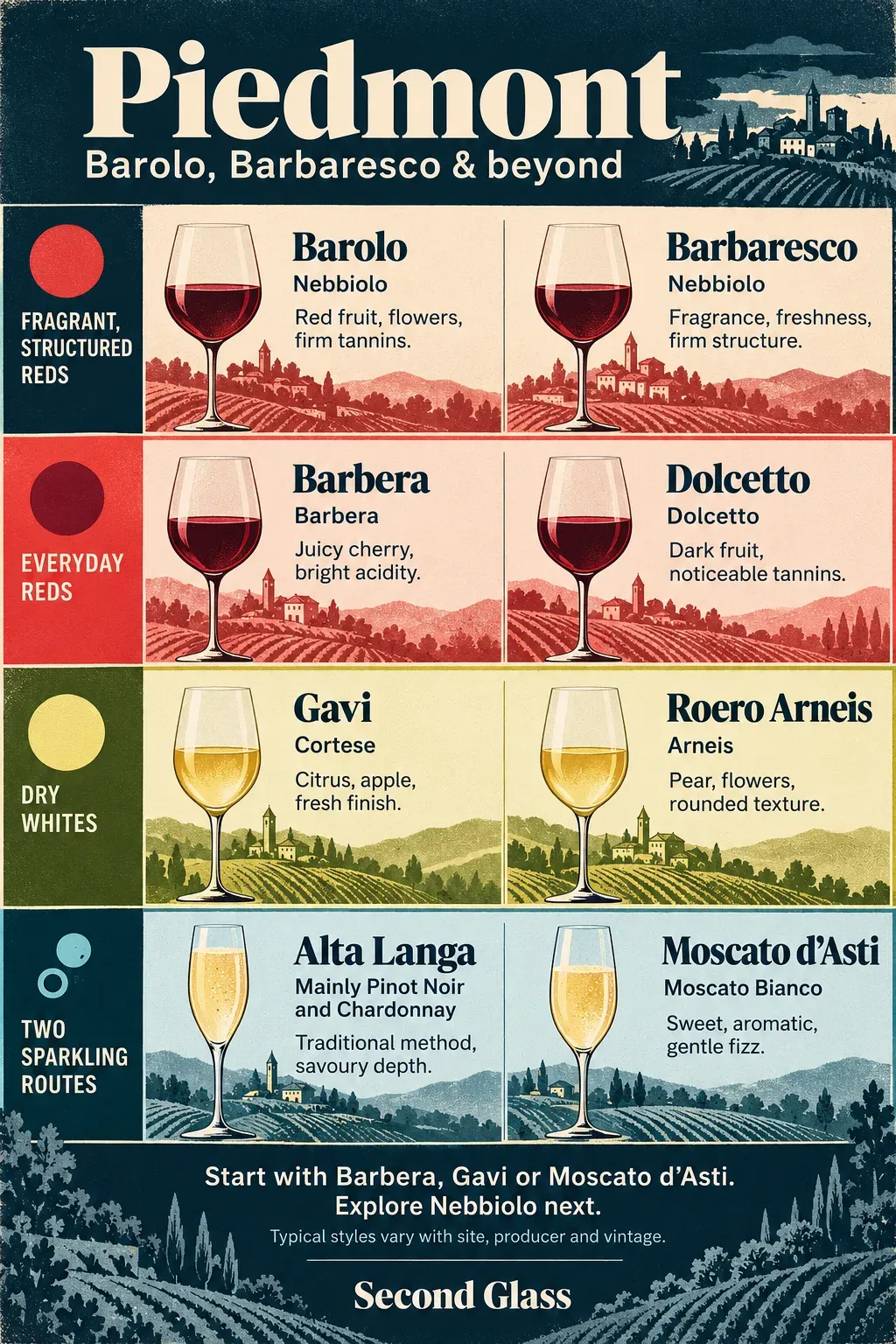
Start with Barbera d’Asti, Dolcetto or Gavi to explore Piedmont’s approachable, food-friendly wines. Choose Barbera for bright acidity and juicy fruit, Dolcetto for darker flavours and softer tannins, or Gavi for a crisp white. Try Langhe Nebbiolo next to notice how fragrance sits alongside firmer tannins and acidity. Compare it with Barolo or Barbaresco if you want to explore more structured Nebbiolo, or with Gattinara or Ghemme for a northern expression. Finish with Moscato d’Asti or Alta Langa to discover the region’s aromatic and sparkling styles.
How To Experiment
- Step 1 — Choose Barbera d’Asti for bright acidity and juicy fruit, Dolcetto for darker flavours, Gavi for a crisp white, or Moscato d’Asti for sweet, aromatic fizz.
- Step 2 — Compare Barolo with Barbaresco, noting how site, producer and vintage shape each wine.
- Step 3 — Taste a Langhe wine beside Roero Arneis or a northern Nebbiolo to explore contrasting places and styles.
- Step 4 — Move to a premium or mature bottle when you want to explore the detail and ageing potential of a particular appellation, site or producer.
Common Misconceptions
Piedmont means Barolo
Barolo is important, but the region also makes Barbera, Dolcetto, Gavi, Arneis, Moscato, sparkling wines and distinctive northern reds.
Nebbiolo is always a dark, powerful wine
Nebbiolo wines can be relatively pale in colour and highly aromatic. Their tannins and acidity can still be firm, but body and intensity vary by appellation, site, vintage and producer.
Dolcetto is sweet
Despite the grape’s name, most Dolcetto is dry. Its name is thought to refer to the grape’s sweetness when ripe, not the finished wine.
Barolo is always better than Barbaresco
Neither appellation is automatically superior; each offers distinct styles shaped by its places, producers and vintages. Choose according to the balance of fragrance, structure and texture you enjoy.
All Piedmont reds need years in the cellar
Some can benefit from ageing, but many Barbera and Dolcetto wines are made to enjoy young. Check the style and producer guidance before deciding to cellar a bottle.
Questions about Piedmont
What grape is Barolo made from?
Barolo is made from Nebbiolo. The grape is known for pale colour, fragrant aromas and firm tannins. Barolo can show red cherry, rose, herbs and savoury notes, but its character varies by vineyard site, vintage and producer. Langhe Nebbiolo can be a useful introduction before trying a Barolo.
Is Barbaresco different from Barolo?
Both are Nebbiolo wines from distinct Langhe appellations, with their own boundaries and rules. Barolo has a longer minimum ageing requirement, but that alone does not determine how a wine tastes or when it is ready. Site, producer, vintage and bottle age shape each wine, so comparing examples from a similar vintage is more useful than relying on a simple ranking.
What is a good Piedmont wine for beginners?
Barbera d’Asti, Dolcetto, Gavi and Moscato d’Asti are accessible starting points. Barbera offers bright acidity and juicy fruit; Dolcetto is usually dry and dark-fruited; Gavi is a crisp white; Moscato d’Asti is sweet, aromatic and gently sparkling. If you want to explore Nebbiolo, try Langhe Nebbiolo before moving to Barolo or Barbaresco.
Can Piedmont wines be aged?
Some can. Barolo, Barbaresco and northern Nebbiolo wines can develop in bottle, though their ageing window depends on the wine and vintage. Many Barbera, Dolcetto, Gavi and Arneis wines are best enjoyed while their fruit is fresh. Follow the producer’s advice rather than assuming every Piedmont wine benefits from extended cellaring.
What food goes well with Barolo?
Barolo suits dishes with enough flavour and texture to meet its tannin and structure. Try braised beef, game, mushroom dishes, aged cheese or tajarin with truffle. A particularly powerful young Barolo may overpower delicate truffle preparations; a more restrained or mature Nebbiolo can be a better fit.
Is Gavi always made from Cortese?
Yes. Gavi is made from Cortese under its appellation rules. It is typically a dry white with citrus, apple and fresh herbal notes, though some examples are light and crisp while others have more weight or complexity. Compare it with Roero Arneis or Erbaluce if you want a more aromatic or textured white.
What is the difference between Asti and Moscato d’Asti?
Both are made from Moscato Bianco and belong to the Asti DOCG. Asti Spumante is fully sparkling and best known for its traditional sweet style, though dry versions also exist. Moscato d’Asti is gently sparkling, sweet and lower in alcohol. Both can show peach, fresh grape and floral aromas.
Final Thoughts
Piedmont is a region to explore through contrast: Nebbiolo beside Barbera, Langhe beside Roero, dry whites beside gently sparkling Moscato. Start with a style that suits your meal, then follow the grape or place that interests you most.